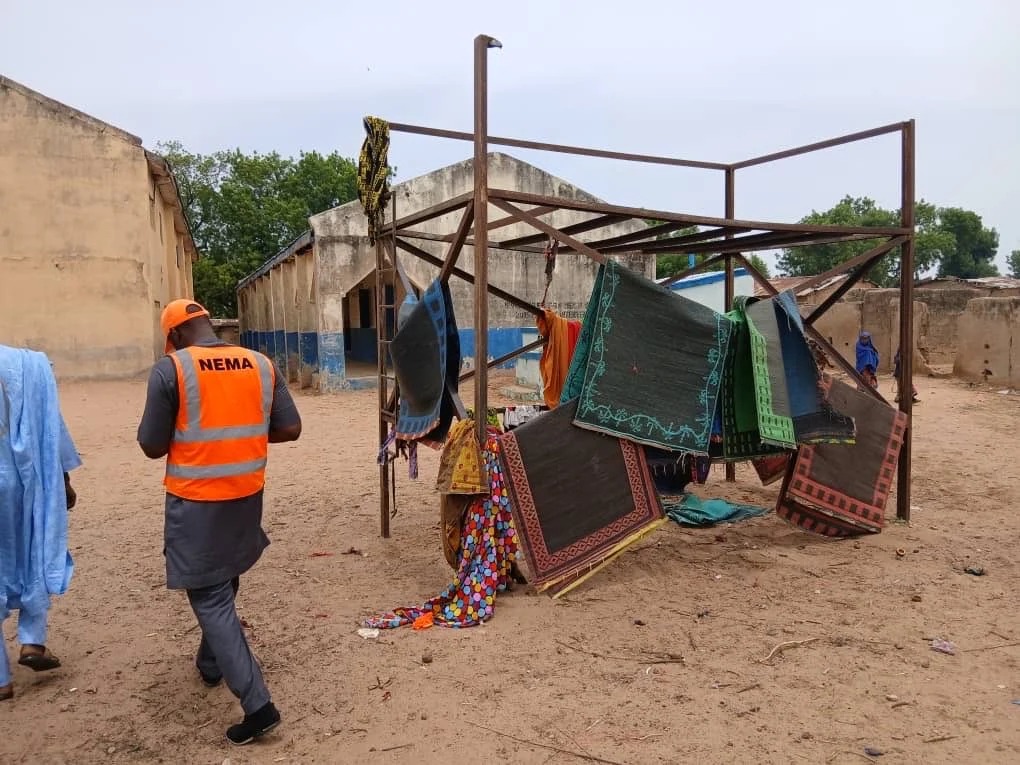
The National Emergency Management Agency has revealed that recent attacks by armed bandits in Tureta Local Government Area of Sokoto State have forced thousands of residents to flee their homes, creating a fresh humanitarian challenge in communities already grappling with insecurity.
The agency disclosed this in a statement published on Wednesday through its official social media platform following an assessment conducted by its Sokoto Operations Office to determine the extent of the damage and the number of people affected by the violence.
According to NEMA, the assessment was carried out after a series of deadly attacks that occurred on June 7 and June 9, 2026, in Dan Gulbi community and surrounding areas, where armed bandits reportedly launched coordinated assaults that left several people dead and many others displaced.
The agency said findings from the field assessment indicated that the attacks caused widespread panic among residents, forcing entire families to abandon their homes and seek refuge in safer locations.
Many of the displaced persons, according to the report, are currently taking shelter in public buildings, schools and neighbouring communities, while others have moved in with relatives and friends in nearby settlements.
The development has heightened concerns about the growing humanitarian consequences of insecurity in parts of northwestern Nigeria, where recurring attacks by armed groups continue to affect thousands of people.
NEMA explained that the assessment team visited affected communities to evaluate the scale of displacement, identify urgent humanitarian needs and gather information that would assist authorities and humanitarian organisations in planning relief interventions.
Officials noted that the attacks had disrupted normal life in the affected communities, leaving many families without access to their homes, farmlands and other sources of livelihood.
The agency stated that the displacement has created immediate needs in areas such as food supply, shelter, healthcare, sanitation and psychosocial support for victims who have experienced trauma as a result of the violence.
Residents who fled the attacks reportedly left behind personal belongings and agricultural assets in their haste to escape, raising fears of worsening economic hardship among affected households.
Community leaders in the area described the attacks as devastating, noting that many residents are still struggling to come to terms with the losses suffered during the assaults.
The attacks on Dan Gulbi and neighbouring communities are the latest in a series of security incidents that have affected parts of Sokoto State in recent years.
Banditry remains one of the major security challenges confronting communities in the North-West, with armed groups often targeting villages, farmlands and travelers in search of ransom, supplies or strategic control of territories.
Security analysts say the humanitarian impact of such attacks extends far beyond the immediate loss of lives, often resulting in prolonged displacement, disruption of education, reduced agricultural productivity and increased pressure on host communities.
The situation in Tureta Local Government Area has also raised concerns about the welfare of vulnerable groups, including women, children and the elderly, who are frequently among the hardest hit during displacement crises.
Humanitarian workers warn that prolonged displacement could expose affected persons to additional risks, including health challenges, food insecurity and loss of access to essential social services.
NEMA assured that it remains committed to working closely with the Sokoto State Government, security agencies and other relevant stakeholders to provide support for affected populations and coordinate emergency response efforts.
The agency emphasized the importance of timely intervention to alleviate the suffering of displaced persons and prevent the humanitarian situation from deteriorating further.
Officials also stressed the need for continued security operations aimed at restoring peace in affected communities and creating conditions that would allow displaced residents to return home safely.
Local authorities are reportedly monitoring developments closely while engaging relevant agencies to determine the type and scale of assistance required in the affected areas.
Community leaders have appealed to both state and federal authorities to intensify security measures and provide urgent relief materials for displaced families.
They noted that many victims are facing uncertainty about their future and require immediate support to meet their basic needs.
Observers say the latest displacement crisis underscores the continuing challenge posed by insecurity in rural communities and highlights the need for sustained efforts to address both the security and humanitarian dimensions of the problem.
As emergency responders continue their assessments and relief planning, thousands of displaced residents remain hopeful that assistance will arrive quickly and that lasting solutions will be found to end the cycle of violence affecting their communities.
For many families uprooted by the attacks, the immediate priority is safety and survival. However, beyond the provision of humanitarian aid, residents are calling for stronger security measures that will enable them to return to their homes, rebuild their lives and resume normal economic and social activities without fear of further attacks.
The latest findings by NEMA serve as another reminder of the profound human cost of banditry and the urgent need for coordinated action to protect vulnerable communities across Sokoto State and other affected parts of the country.