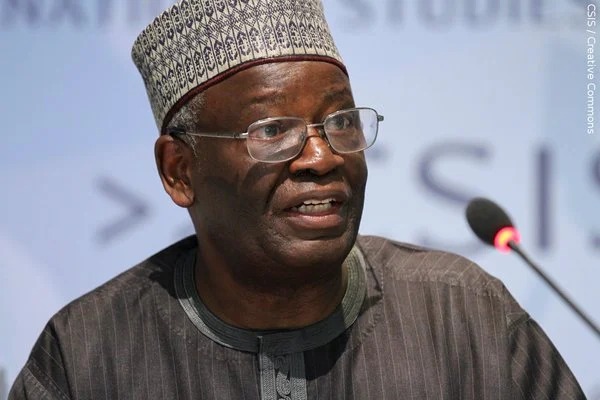
Former Chief of Staff to late President Muhammadu Buhari, Ibrahim Gambari, alongside diplomat Moudjib Djinadou and development advocate Dimas Garba, has called on African leaders and citizens to embrace self-rediscovery and indigenous solutions as the foundation for the continent’s transformation and sustainable development.
The trio made the call on Tuesday during the launch of Renegade Africa: All it Takes to Be African, a book authored by Djinadou, a former United Nations official and founder of the Itumo Institute. The event was held at the Savannah Centre for Diplomacy, Democracy and Development in Utako, Abuja.
The speakers argued that Africa’s continued dependence on imported political, economic and governance frameworks has largely failed to produce the level of progress expected across the continent, despite decades of experimentation with models borrowed from other regions of the world.
They maintained that genuine development would only emerge when African countries begin to build institutions, policies and governance systems that reflect the continent’s unique history, values, cultures and realities.
The event brought together diplomats, academics, policy experts, civil society leaders and development practitioners who engaged in extensive discussions on Africa’s future and the need for a renewed continental vision driven by African perspectives.
Speaking as chairman of the occasion, Gambari stressed that sustainable development in Africa cannot be achieved through wholesale adoption of foreign systems without adapting them to local circumstances.
According to him, many of the challenges facing African nations today stem from a disconnect between inherited governance structures and the realities of African societies.
He argued that development policies are more likely to succeed when they are rooted in indigenous knowledge systems, local traditions and community-based institutions that have evolved over generations.
“Africa must discover itself again,” Gambari said, emphasizing that lasting solutions to the continent’s problems would come from within rather than from externally imposed frameworks.
The former diplomat noted that while globalization offers opportunities for cooperation and learning, African nations must avoid becoming overly dependent on ideas that do not align with their social, cultural and economic contexts.
He further observed that many African countries continue to struggle with poverty, insecurity, weak institutions and governance challenges despite implementing development prescriptions that have been promoted internationally for decades.
According to him, the continent’s vast human and natural resources should place it among the world’s most prosperous regions, yet persistent developmental setbacks indicate the need for a fresh approach.
Author of the book, Djinadou, said Renegade Africa: All it Takes to Be African was written to challenge conventional thinking about Africa and encourage a deeper examination of what it truly means to pursue development from an African perspective.
He argued that many African nations have become trapped in cycles of imitation, adopting systems and policies designed for entirely different historical and cultural environments.
According to him, Africa possesses rich intellectual traditions, governance mechanisms and social values that can contribute significantly to addressing contemporary challenges.
Djinadou urged Africans to reject narratives that portray the continent as perpetually dependent on external guidance, insisting that Africa has the capacity to shape its own future.
He described self-rediscovery as a necessary step toward building confidence, strengthening institutions and unlocking the continent’s enormous potential.
The former UN official also stressed the importance of education in fostering a renewed sense of identity among young Africans.
He said educational systems across the continent should place greater emphasis on African history, philosophy, innovation and indigenous knowledge, enabling future generations to appreciate their heritage while engaging effectively with the modern world.
Adding his voice to the discussion, Dimas Garba highlighted the need for African leaders to prioritize policies that reflect local realities rather than relying excessively on imported development templates.
He argued that while international partnerships remain important, African countries must take ownership of their development agendas and define success according to their own aspirations and priorities.
Garba noted that many communities across the continent continue to demonstrate resilience, innovation and resourcefulness despite facing significant challenges.
He said these strengths should be harnessed as part of broader efforts to drive economic growth, improve governance and strengthen social cohesion.
The speakers collectively pointed to the numerous challenges confronting Africa, including unemployment, insecurity, poverty, political instability, weak infrastructure and limited industrialization.
However, they maintained that these obstacles should not overshadow the continent’s vast opportunities.
According to them, Africa possesses abundant natural resources, a youthful population, expanding markets and growing technological capabilities that can serve as catalysts for transformation if properly managed.
Participants at the event echoed similar sentiments, emphasizing the importance of promoting African-led research, policy innovation and institutional development.
Several contributors argued that the continent’s future depends not only on economic reforms but also on a broader cultural and intellectual renaissance that encourages Africans to value and build upon their own experiences.
The launch of Renegade Africa therefore became more than a literary event; it served as a platform for reflection on Africa’s development journey and the choices that will shape its future.
As discussions concluded, a common message emerged from the gathering: Africa’s progress will require confidence in its own identity, greater reliance on indigenous strengths and a willingness to create solutions that reflect the continent’s unique realities rather than simply replicating models developed elsewhere.
For Gambari, Djinadou and Garba, the path to a more prosperous and stable Africa lies in self-discovery, self-belief and the deliberate construction of institutions and policies grounded in African values, experiences and aspirations.