Why Nigeria’s renewal will not arrive in a convoy, and why that is the most difficult sentence this country must learn to read
By Charles Obiajulu Ugwu – PhD
Nigeria has been waiting, for sixty-five years, for someone to arrive.
Not a policy. A person. A figure crossing a runway, descending from a podium, raising a hand at the moment of inauguration, declaring that the long humiliation is over and the great repair has begun. Every generation of Nigerians has rehearsed this scene with a different lead actor. The soldier in starched fatigues. The technocrat with a thick file. The democrat with a clenched fist. The clergyman with a verse. The returnee with a foreign degree. The septuagenarian with one last chance. The political party of the year. The constitutional convention of the decade. The redeemer is always different. The waiting is always the same.
This essay is an attempt to say plainly what the country has refused to hear. The redeemer is not coming. The redeemer was never coming. The very category of redemption, as Nigeria has imagined it, is the disease wearing the costume of the cure. As long as the country believes that its rescue will arrive as an event, it will continue to produce, year after year, the conditions of its own decay. The waiting is the dysfunction. The hoping is the trap.
There is an old Japanese phrase that captures, almost casually, the alternative the country has never tried. “Chiri mo tsumoreba yama to naru” Even dust, when it piles up, becomes a mountain. It sounds, on first hearing, like the kind of motivational miniature that gets stitched onto cushions in airport lounges. It is, in fact, one of the most subversive sentences a Nigerian can read, because it describes a theory of how nations actually become themselves, and that theory is the precise opposite of everything this country has practised in its public life.
Consider, for a moment, what the phrase is really saying. It is saying that the consequential is built out of the inconsequential. That the visible mountain is made of the invisible particle. That the historian who studies a country’s loud moments is studying its surface, while the historian who studies its quiet repetitions is studying its substance.
It is saying that the receipts a clerk issues honestly for thirty years, the queue the commuter respects at 5 a.m. when no one is watching, the inspection the engineer carries out fully when shortcuts are available, the contract a junior officer executes to specification when the deviation would never be discovered, the immunisation cold chain a nurse maintains in a forgotten primary health centre across two governments, are not background noise to the national story. They are the national story. They are what civilisations are.
Nigeria does not believe this. Nigeria has never believed this. And the consequences of that disbelief are now arranged on every street in the federation, in shapes too large to ignore.
To grasp how deep the disbelief runs, one has only to walk through a single day in Lagos, or Onitsha, or Kano, and count what each citizen privately replaces in the absence of the state. The middle-class household in Magodo runs its own electricity through a generator and an inverter and, increasingly, solar panels on a rooftop the public grid will never reach with reliability. It pumps its own water from a borehole drilled to a depth that betrays no public confidence in municipal supply. It guards its own street through a private security arrangement with a vigilante outfit paid in cash every Sunday. It schools its own children in a private institution because the public school in the same local government has not had a functional library in a decade.
It treats its own illnesses in a private clinic because the general hospital is a place to die in, not a place to recover. It buries its own dead through a private undertaker because the morgues have neither electricity nor dignity. By the time the sun sets on this household, the state has been replaced eight times by private substitutes, each one paid for out of an income already taxed for the original. This is not a household coping with a crisis. This is a household that has accepted, without rebellion, that the country no longer exists for it in any operational sense, and that survival is now a personal logistics problem. Multiply that household by forty million and you have the actual Nigerian republic, hiding inside the constitutional one.
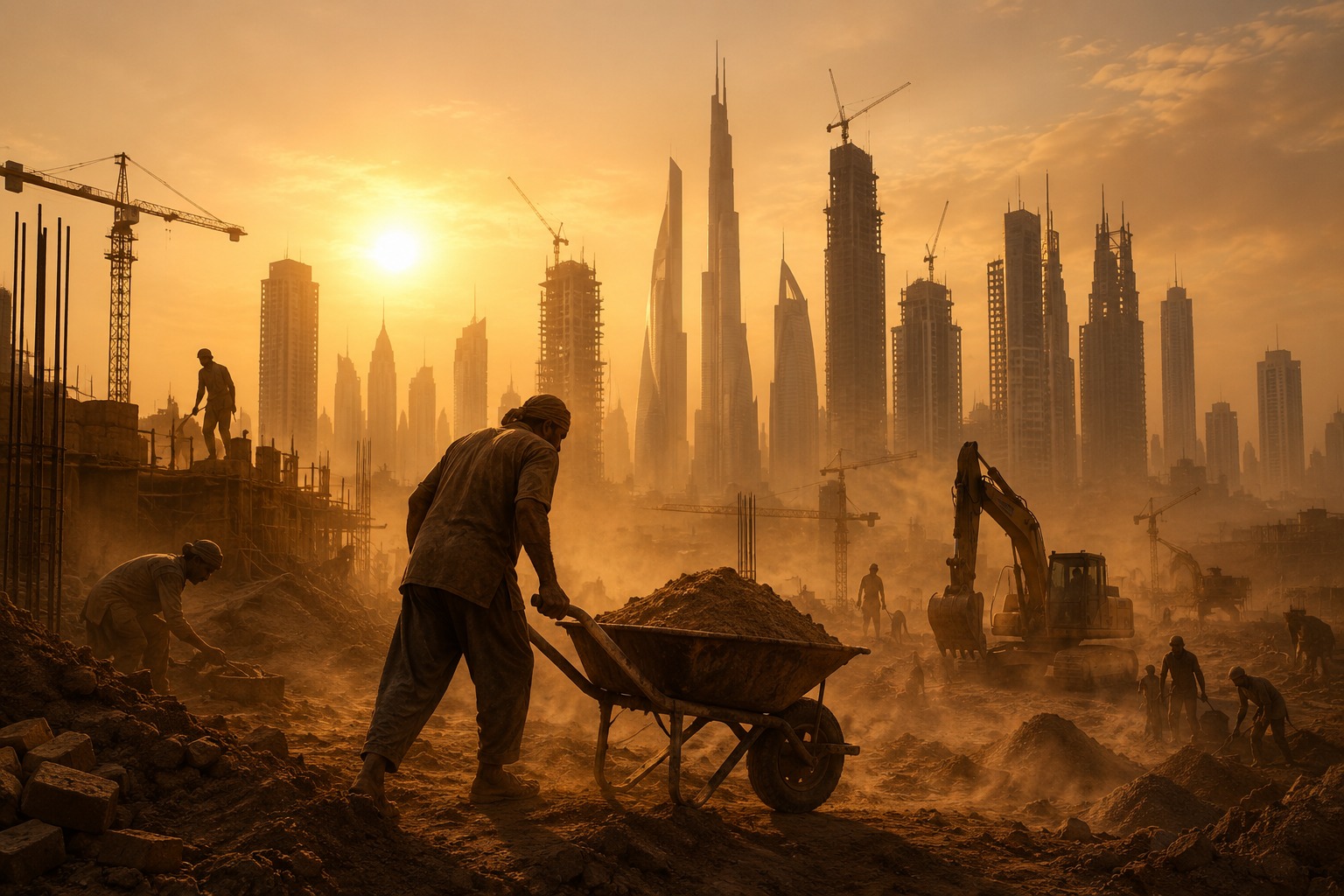
How did this happen? Not in an instant. Not through a coup. Not through a single bad president. It happened the way mountains happen. Particle by particle. Year by year. A small theft tolerated here. A small standard waived there. A small inspection skipped. A small audit buried. A small contract inflated. A small certificate forged. A small posting purchased. A small admission negotiated. Each act, in its moment, was unremarkable. Each was below the threshold of national attention. Each was small enough to be excused, rationalised, rescheduled, forgotten. And yet they accumulated, in their millions, until the country woke up one morning inside a landscape it could not recognise and could no longer climb out of.
This is the cruelty of the dust principle. It works whether you are paying attention or not. The same physical law that builds the mountain of Toyota also builds the mountain of the failed federation. The dust falls in every country every day. The question is never whether accumulation is occurring. The question is what is being accumulated, and on what kind of surface.
In Japan, the surface held. That fact is worth dwelling on, because the temptation to attribute Japanese success to some mystical cultural inheritance is both lazy and false. Japan’s compounding capacity was built, painfully, in the wreckage of two civilisational catastrophes. The Meiji Restoration of the 1860s tore apart a feudal order and replaced it with an institutional one. The American Occupation after 1945 rewrote the constitution, broke the zaibatsu, and seeded the labour and educational reforms that would carry the country into its industrial decades. In between and after, Japanese statecraft built four features into its institutional skin that made the dust hold.
It built measurement, the patient recording of small events so that they could compound. It built retention, the protection of officials and policies long enough that today’s small effort connected to next year’s small effort and the year after’s. It built standardisation, the radical idea that the procedure was the same in Osaka as in Sapporo, on the night shift as on the day, in 1962 as in 1992. And it built protected slowness, the cultural permission for the clerk who improved one form by one column to be rewarded eventually rather than punished immediately for not being spectacular.
Nigeria, by contrast, built none of these. Nigeria built the inverse of each. It built a state that cannot measure itself, where ministries lose files faster than they generate them and census figures are contested before they are published. It built a state that cannot retain its memory, where every administration treats the work of its predecessor as contraband, projects are abandoned at handover, and permanent secretaries learn to bury rather than preserve.
It built a state that cannot standardise its conduct, where every transaction at every counter is a custom negotiation, where the fee depends on the day, the inspector depends on the relationship, and the timeline depends on the inducement. And it built a state that punishes patience savagely, where the honest auditor is reassigned, the diligent teacher is unpaid for six months, the methodical police officer is transferred to a hardship post, and the careful surveyor is starved out of the profession. Every signal the architecture sends to the citizen is the same. Do not deposit. Extract. The small honest act is economic suicide. The large dramatic gesture is the only rational career.
The country is therefore not failing because Nigerians are uniquely corrupt, or uniquely lazy, or uniquely ungovernable. It is failing because the surface on which small honest acts must accumulate has been deliberately, transactionally, generationally pulverised. The dust falls. The dust is swept away. The dust falls. The dust is swept away. The mountain that ought to be rising is being held at zero altitude by a system designed, with horrible efficiency, to do precisely that.
This is why every Nigerian reform that has been organised around an event has failed, and will continue to fail. The new currency does not hold because the surface beneath it does not hold. The new agency does not hold because the institutional retention machinery does not exist to keep it alive past the principal’s tenure. The new constitution does not hold because the small daily fidelities a constitution rests on were never deposited. The redeemer figure does not hold because the architecture beneath the redeemer eats him within eighteen months. Nigerians have watched this loop run, with different actors and identical scripts, for so long that they have started to mistake the loop itself for the natural order of things.
It is not. There is an exit. The exit is unspectacular, which is why it has been refused.
The exit begins with the admission that Nigeria’s renewal will not come from above and will not come at once. It will come, if it comes at all, from the redesign of the surface on which small acts compound. That work has four dimensions, and none of them will trend on social media.
The first is the construction of public ledgers in domains the country claims to care about. A standing, weekly-updated, citizen-accessible record of every pothole reported and every metre repaired on federal roads. A teacher attendance ledger published per state. A primary health centre stock register that any mother in Bauchi can verify before she walks three kilometres with a sick child. A court adjournment ledger that names the judge, the case, and the number of times the matter has been pushed. A police response register. A power outage register, hour by hour, feeder by feeder. The point is not the data. The point is that the recording surface for accumulation finally exists. What is recorded can compound. What is unrecorded disperses without trace, which is exactly what has been happening for sixty-five years.
The second is the redirection of national attention from heroes to handlers. Nigeria’s political culture is structurally addicted to the search for the exceptional individual at the top. The compounding theory of national rebirth says the search is in the wrong place. The depositors who build civilisations are not at the top. They are in the middle. They are the nurse who runs the cold chain for two decades, the teacher who teaches for thirty years in the same village, the customs officer who logs every container truthfully across four regimes, the magistrate who writes considered judgments in a court with no air-conditioning, the local government accountant who has refused, for an entire career, to sign what she has not verified.
These people exist. They exist in numbers the country has never bothered to count. They are the actual mountain of Nigerian fidelity, hiding in plain sight, unrewarded, unprotected, often actively persecuted. A serious reform doctrine begins by finding them, naming them, protecting them, and engineering the institutional conditions in which their small daily fidelities can finally connect across years and offices into something the country can stand on.
The third is the substitution of retention metrics for speed metrics. Nigerian governance is theatrically obsessed with the demonstration project, the bridge commissioned in record time, the agency stood up in ninety days, the policy rolled out before the next news cycle. Compounding is hostile to this temporality. It rewards what stays in place, not what arrives quickly.
The serious metrics of national rebirth are unglamorous. What percentage of policies survives administration change. What percentage of senior civil servants is retained across regimes. What percentage of infrastructure is still functioning at year ten. What percentage of programmes is still funded at year five. These numbers cannot be photographed. They cannot be commissioned at a ribbon-cutting. They are the only numbers that have ever measured a serious country.
The fourth is the inversion of selection pressure. As long as the patient honest worker in the Nigerian system is economically suicidal, no inspirational appeal will produce more of him. The architecture has to be redesigned so that small fidelities are not punished. This means civil service compensation that allows a senior accountant in the Federal Ministry of Finance to live without a side hustle.
It means tenure protection for inspectors and auditors and prosecutors that survives the displeasure of the politicians they oversee. It means procurement rules that reward the supplier with a ten-year track record over the supplier with a six-month relationship. The selection pressure of the system must reverse. At present it rewards extraction and punishes deposit. Until that is inverted, no quantity of speeches will move the country forward by a centimetre.
There is a final observation, and it is the one that ought to be hardest to dismiss. Nigeria does not need to begin accumulating. Nigeria has already accumulated. Beneath the political theatre, beneath the dysfunction, beneath the headlines, the country contains an enormous, unrecorded mountain of small daily fidelities that the state has never bothered to find. The market woman in Onitsha who has measured her cup honestly for forty years. The mechanic in Ibadan who has trained six apprentices through the igba boi covenant without cheating any of them at the moment of settlement.
The parish priest in rural Enugu who has buried the dead of his community for three decades without taking from the bereaved. The headmistress in Sokoto who has run a primary school in a village without electricity and produced, year after year, graduates who can read. The retired permanent secretary who refused, across an entire career, to sign what he had not verified, and who lives now on a modest pension in a modest house, unrecognised by the country he held together one signature at a time.
These are not romantic figures. They are statistical realities. They exist in numbers large enough to remake the federation, if the federation ever found the perceptual equipment to see them and the institutional honesty to protect them. Their fidelities have been falling, as dust, for decades. The tragedy of Nigeria is not that the mountain does not exist. It is that the country has organised itself to sweep the mountain away each morning, while waiting for one to be delivered.
The doctrine offered here is, in the end, almost embarrassingly simple. Stop waiting. Stop searching for the convoy. Begin the patient, unglamorous, unspectacular work of building the surface on which the dust already falling can finally hold. Honour the depositor over the spectator. Reward the boring over the brilliant. Protect the patient over the photogenic. Measure what stays, not what arrives. Find the mountain you already have.
The country has tried, for two-thirds of a century, to be remade in an afternoon. It has not worked. It will not work. The afternoon is not where countries are made. They are made in the long, quiet, unwatched hours, when the dust is falling and someone, somewhere, is deciding whether to sweep it away or to let it, at last, accumulate.
That decision is now. That decision is yours. That decision is the only one left.
About the Author
Charles is a contrarian thinker writing from Lagos