By Dr. Iyke Ezeugo
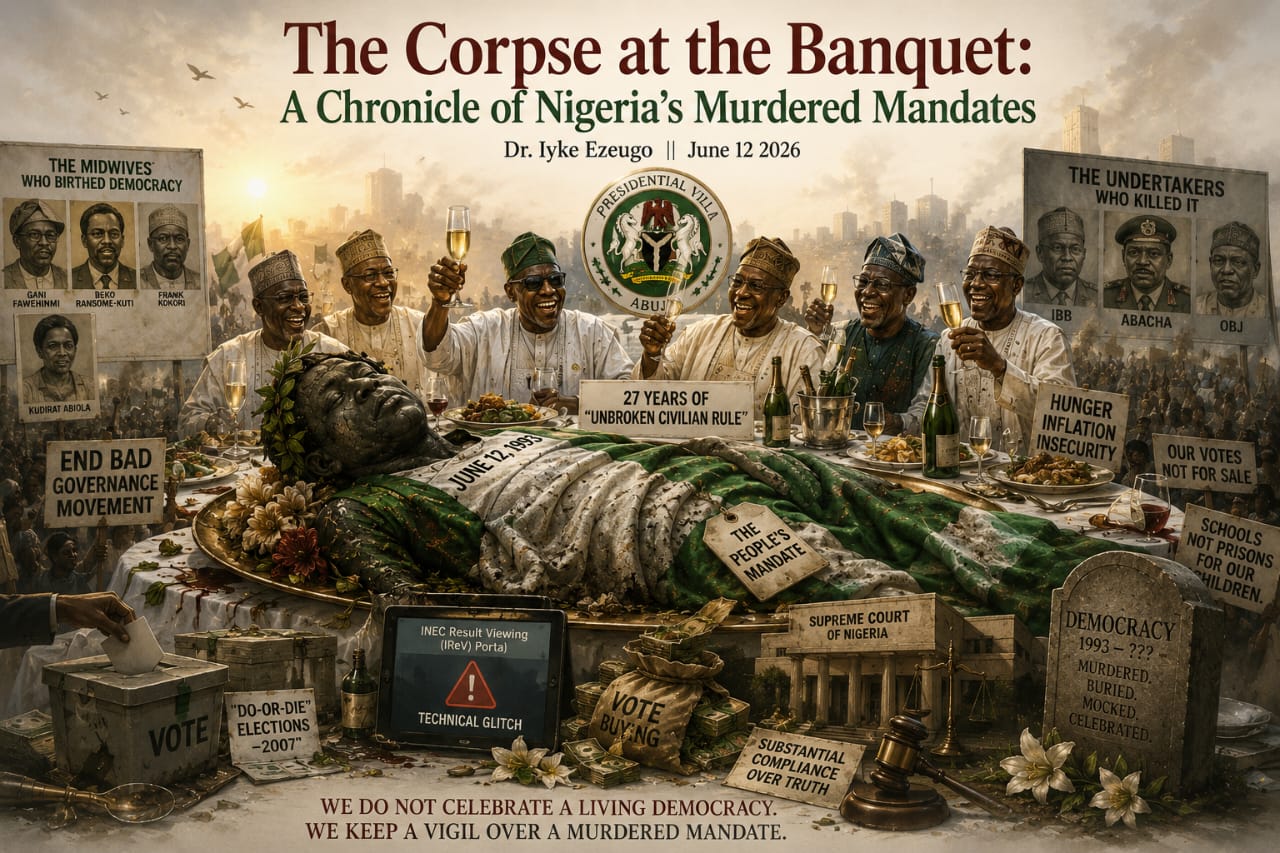
To watch the Nigerian political class celebrate “Democracy Day” is to witness a macabre theatrical masterpiece – a grand, annual banquet where the murderers dress in white lace, raise crystal glasses of champagne, and offer glowing toasts to the very man they assassinated. It is the ultimate exercise in national cognitive dissonance. We are asked to cheer at the graveside, to pretend that the bloated corpse seated at the head of the table is merely sleeping.
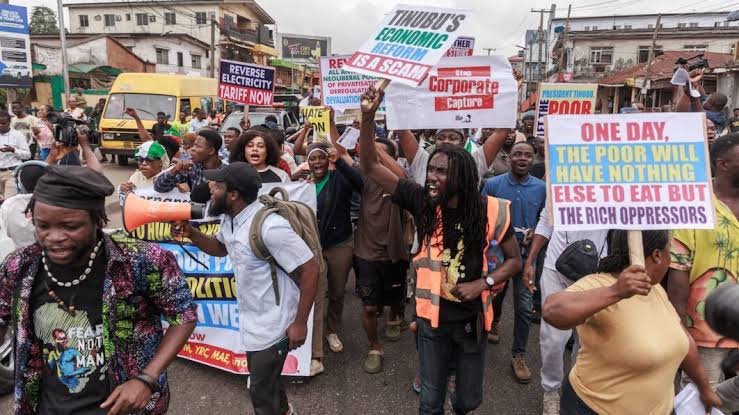
As the years roll into 2026, the absurdity has only ripened. While the current occupants of the Presidential Villa broadcast polished speeches urging resilience and celebrating “27 years of unbroken civilian rule”, the streets of Abuja and Lagos hum with the desperate chants of the End Bad Governance Movement, protesting crushing hardship, skyrocketing inflation, and the rampant abduction of schoolchildren.
To understand how we arrived at this purgatory, one must peel back the scabs of history. We must look at the midwives who sacrificed their lives to birth the democratic child, the undertakers who snatched it from the cradle, and the sophisticated machinery deployed to ensure the people’s voice is permanently muted.
The Midwives and the Original Sin
The story of our democratic tragedy does not begin with an election; it begins with an abortion. On June 12, 1993, Nigerians performed a miracle. Defying decades of manufactured ethnic and religious divisions, millions queued under the scorching sun to endorse a Muslim-Muslim ticket, handing a pan-Nigerian mandate to Chief Moshood Kashimawo Olawale (MKO) Abiola. The electoral umpire at the time, Professor Humphrey Nwosu, utilized the “Option A4” system—a transparent mechanism that stripped the shadows from the process then. It was arguably the freest, fairest election in our history.
But the military junta, commanded by the gap-toothed Machiavelli, General Ibrahim Badamasi Babangida, looked at this beautiful, breathing infant of popular will—and drove a bayonet through its heart. The annulment of the June 12 election was Nigeria’s original democratic sin.
What followed was a baptism of fire. The true midwives of Nigerian democracy were not politicians seeking power; they were martyrs. Patriots like the indefatigable Gani Fawehinmi, Beko Ransome-Kuti, and Frank Kokori were hurled into solitary confinement. The streets of Lagos ran red with the blood of protesters. The heroic Kudirat Abiola was gunned down in broad daylight on the streets of Ikeja by the strike force of General Sani Abacha. MKO Abiola himself paid the ultimate price, dying in detention under the most suspicious of circumstances just as freedom beckoned.
They gave their blood to purchase democracy. But the child handed to Nigerians in 1999 was a terrifying changeling.
The Era of “Do-or-Die” and the Undertakers in Civilian Garb
When the military finally retreated to the barracks in 1999, they ensured they held the leash. They swapped their khaki uniforms for flowing Agbada, installing one of their own, General Olusegun Obasanjo, to oversee the new republic.
If the pioneers bled for democracy, the new custodians systematically bled it dry. They introduced us to a terrifying lexicon of electoral warfare. Obasanjo famously declared the 2007 elections a “do-or-die affair.” Under the chairmanship of Professor Maurice Iwu, the Independent National Electoral Commission (INEC) perfected the art of writing results before the ballots were cast.
We witnessed the strangulation of internal party politics, where godfathers sat in the dark recesses of Bourdillon and Wadata Plaza, unilaterally imposing candidates. There were brief, fleeting moments of conscience—President Umaru Musa Yar’Adua stood before the world and admitted his election was profoundly flawed, and Goodluck Jonathan shocked the continent by declaring his ambition was “not worth the blood of any Nigerian.” But these were beautiful anomalies in a system engineered for ruthlessness.
The Tech-Washing of Fraud and the Midnight “Glitch”
As the electorate grew wiser, the political elite grew more devious. Physical ballot snatching became too messy, too visible. The murder of democracy required a cleaner, more sophisticated weapon. Enter the era of “tech-washed” rigging.
By the 2023 elections, INEC, under Professor Mahmood Yakubu, had spent billions of taxpayers’ money promising a technologically bulletproof election via the Bimodal Voter Accreditation System (BVAS) and the INEC Result Viewing (IReV) portal. The promises were hypnotic. Yet, when the midnight hour struck and the will of the people was being uploaded, the portal conveniently suffered a “technical glitch.” The servers went blind precisely when the presidential results were to be transmitted. Magic.
The ensuing result was a statistical tragedy. The election produced a historical low in voter turnout, plunging to a dismal 26.72%. Out of over 93 million registered voters, less than a third bothered to cast a ballot, and the victor emerged with just 36.6% of that fraction. It meant the presidency was captured with the mandate of less than 10% of the entire Nigerian electorate.
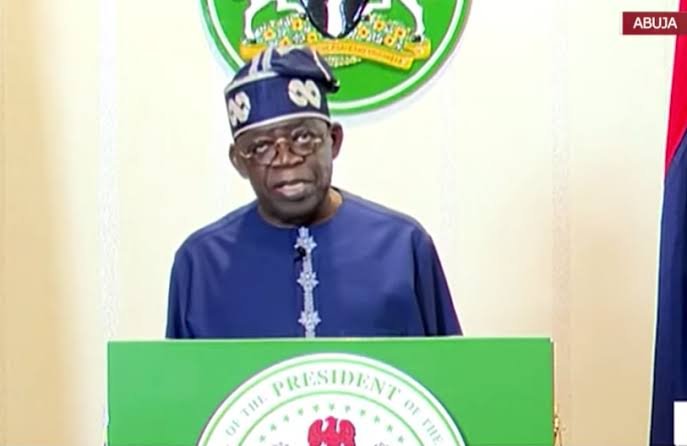
This was not a democratic victory; it was a hostile takeover, perfectly aligned with the terrifyingly honest doctrine articulated by Bola Ahmed Tinubu before the polls: “At all cost, fight for it, grab it, snatch it and run with it.” And the deal has been done!
Weaponised Poverty and the Supreme Cemetery
To sustain this heist, the political class deployed the most cruel weapon in their arsenal: the weaponization of poverty. You do not need to persuade the electorate if you can starve them into submission. Keep the masses hungry enough, and they will trade four years of their children’s future for a pack of spaghetti and a crisp N5,000 note on election morning. It is an insidious psychological warfare that reduces citizens to beggars at their own feast.
And when the people cried foul, the robbers offered a cynical smile and a familiar taunt: “Go to court.”
They said this because they knew a dark truth: the Nigerian Judiciary, historically revered as the last hope of the common man, had been turned into the graveyard of electoral justice. The courts have become places where technicalities triumph over truth, where judges rule on the “substantial compliance” of an election while willfully ignoring the blood on the ballot papers. When the Supreme Court validates numbers that defy basic arithmetic – such as crowning a man who came fourth in an election as the winner – the gavel no longer serves justice. It merely hammers the final nails into the coffin of the democratic process.
The Ghost We Toast
So, what exactly goes through the minds of those standing on the podiums every June 12? Can they, in their quietest moments, look at the mirror and claim they are reviving democracy, or do they know they are merely adjusting the funeral wreaths?
Majority of Nigerians have answered that question with their apathy. They have retreated into the philosophy of the defeated, realizing that their Permanent Voter Cards (PVCs) are powerless against the sheer violence, ethnic baiting, and judicial complicity of the ruling elite. Why stand in line for hours when the winner has already been decided in a hotel room the night before?
To celebrate Democracy Day in Nigeria today is to engage in a profound historical mockery. We are not celebrating a living entity. We are keeping a vigil. Until the day the Nigerian electoral system is ripped from the hands of the snatchers – until the institutions are cleansed, the judiciary remembers its soul, and power is returned to the actual fingerprints of the people – our Democracy Day will remain exactly what it is: an exquisitely decorated tombstone.
Dr. Ezeugo is a Forensic Researcher, a Social Impact Expert, and a Satirist who uses his perspectives and parodies to challenge the status quo, spark debates, and inspire fresh perspectives on public affairs through insightful intellectual injections.