An interrogation of Nigeria’s most expensive silence
By Charles Obiajulu Ugwu -PhD
In a village in Zamfara whose name no longer appears on any tourism map, a woman named Hauwa once walked four kilometres every Sunday to a tin-roofed prayer house built on the edge of a millet field. She had walked that road for thirty-one years. She had walked it pregnant, and she had walked it grieving. She had walked it with her firstborn strapped to her back, and she had walked it again, decades later, to thank God when that same firstborn graduated from a teachers’ college in Gusau.
The pastor of that prayer house, a soft-spoken man with a Bible held together by masking tape, never asked her for money she did not have. He did not promise her a Mercedes. He did not promise her America. He promised her, in the cadence of a faith older than the colony itself, that God would walk with her through whatever the road brought.
On a Tuesday in March, the road brought men on motorcycles.
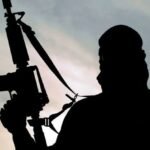
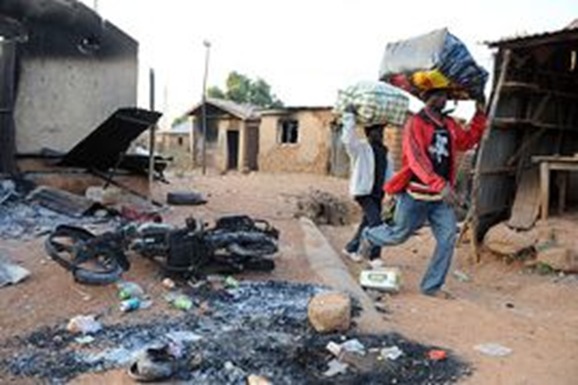
They came at dusk, fifty of them, possibly more, with rifles slung across their chests like firewood. They burned the prayer house first, because the prayer house had a bell, and the bell, if struck, might have warned the next village. Then they burned the millet field. Then they took Hauwa, along with eleven other women, into a forest whose name does not appear on any government map either. The pastor was shot in the courtyard of his own home, still holding the masking-taped Bible. He was sixty-seven years old.
That night, on a satellite channel beamed into millions of Nigerian homes, a different kind of pastor was finishing a different kind of service. He stood on a stage lit like a film set, in a sanctuary larger than the entire local government area where Hauwa had once lived. He wore a suit that cost more than her son’s annual salary. He prophesied, with great confidence, into the lives of his congregants. He saw a breakthrough coming. He saw a door opening. He saw delay being cancelled. He saw a foreign visa materialising. He saw, in the spirit, a particular sister in the back row receiving a brand new car before the end of the quarter.
He did not see Hauwa.
He did not see the forest. He did not see the rifles. He did not see the masking-taped Bible in the courtyard. He did not see, anywhere in the vast theatre of his vision, the specific coordinates of the specific evil that was, at that very moment, devouring the country whose flag hung behind his stage.
This essay is about that gap. The gap between what was seen and what was not seen. The gap between the prophecy that pays and the prophecy that costs. The gap, in the end, between prayer and power.
There is a particular kind of quiet that descends on a nation when its most loudly advertised power refuses to perform its only advertised function. Nigeria is currently sitting inside that quiet.
Between January and March of this year, EONS Intelligence recorded 176 violent incidents, 383 deaths, and 229 abductions in a single quarter, and these numbers, grim as they are, no longer shock anyone. Schoolchildren are taken from their dormitories in batches of one hundred, three hundred, four hundred. Travellers vanish off federal highways. Worshippers are abducted from their pews. The Northwest alone produced 2,938 documented kidnappings in twelve months. The state, by its own admission, negotiates. The army, by its own actions, overstretches. The citizen, by no choice of his own, prays.
And it is precisely that last verb, prays, that this essay wishes to interrogate.
Nigeria is not a country short of spiritual capacity. By population density of self-declared prophets, apostles, generals, bishops, founders, and overseers, this may well be the most spiritually saturated landmass on earth. There are men in this country who have, on tape, in front of cameras, before vast and weeping congregations, raised the dead. There are women who have restored sight, dissolved tumours, exposed witches, broken generational curses, cancelled visa denials, reversed barrenness, and on at least one famous occasion caused a stadium to fill with the visible perfume of heaven. The miracles are not modest. The claims are not provisional. They are absolute, broadcast, monetised, and rebroadcast on a dozen satellite channels for the edification of a continent.
So one must ask, with the seriousness the moment demands: where are they now?
Where is the apostle whose handkerchief reportedly cured cancer in three Nigerian states and two diaspora cities? Where is the man of God who, by his own testimony, commands legions of warring angels? Where is the prophet who can call by name the secret enemies inside a man’s village, and yet cannot, apparently, call by name the location of a single bandit camp in Zamfara? Where are the deliverance ministries whose specialty is binding territorial spirits, now that the territory itself is bound?
The silence is not accidental. It is structural. And it deserves an honest accounting.
For decades, a particular bargain has been struck between Nigerian congregants and a certain class of spiritual entrepreneur. The terms were never written, but they were always understood. The believer would bring his faith, his offering, his first fruits, his vow, his seed, his sacrificial gift, his building fund contribution, his anointing oil purchase. In exchange, the man of God would deliver outcomes that no other actor in Nigerian life, not the state, not the bank, not the hospital, not the university, was capable of delivering. Healing where medicine failed. Visas where embassies refused. Children where wombs were closed. Promotion where godfathers were absent. Protection where police were complicit.
The arrangement worked, in its own commercial logic, because the outcomes it promised were individual, unfalsifiable, and easily reattributed. If the visa came, the prophet was vindicated. If it did not, the supplicant lacked faith. If the disease was healed, the anointing was real. If the patient died, the will of God was mysterious. The genius of the model was that it could never lose, because it never agreed to be measured.
But the present crisis is not individual. It is national, collective, geographically specific, and pitilessly visible. Bandits are not a metaphor. Boko Haram is not a generational curse to be cancelled at a midnight vigil. ISWAP does not retreat when commanded in tongues. The kidnappers of Kebbi schoolchildren did not flee at the rebuke of a televangelist. The herdsman who burns a Plateau village is not a territorial spirit susceptible to anointed oil. These are armed men with logistics, supply chains, financiers, and forest sanctuaries. They are a material problem. And material problems, embarrassingly for a certain class of spiritualist, demand material answers.
This is the fracture line. The prosperity gospel and its miracle-merchant variants were always exquisitely engineered for the individual transaction. They were never built, and have therefore never been deployed, for the civilisational emergency. When the country itself is the patient, the handkerchief does not scale.
The spiritualists have made a quiet, almost imperceptible adjustment to their public theology. The crusades continue, but the deliverance is now from “stagnation” and “delay” rather than from bandits. The prayer points have shifted to “favour” and “open doors” rather than the closure of forest hideouts. The prophetic declarations for the new year speak generically of “Nigeria’s restoration” without naming a single insurgent commander, without identifying a single arms route, without offering a single coordinate. The vagueness is not a failure of nerve. It is a feature. Specificity is the enemy of unfalsifiability.
A clarification is owed here. This essay does not deny the existence of authentic spiritual life in Nigeria. The Catholic priest who has been kidnapped four times and still says Mass in a frontier parish is a spiritualist. The imam who shelters Christian families during a herder raid is a spiritualist. The Anglican bishop who buries his murdered seminarians and refuses to leave his diocese is a spiritualist.
The cloistered nun who has prayed the rosary daily for fifty years over a nation she will never see safe is a spiritualist. The pastor with the masking-taped Bible in the courtyard, who walked the road with Hauwa for thirty-one years and refused to abandon it even when the men on motorcycles came, was a spiritualist. These figures exist. They are not silent. They are simply not famous, because their theology does not require fame to function.
The question raised here is narrower and sharper. It is directed at a specific class, those who built fortunes, fleets, private jets, universities, and broadcast empires on the explicit promise of supernatural intervention in the affairs of men. Those whose billboards still line the expressways promising fire, breakthrough, and unstoppable victory. Those who have not hesitated, in calmer seasons, to claim credit for election outcomes, currency movements, and the survival of presidents. To them, the question is not theological. It is contractual.
You sold a product. The product was supernatural power applied to Nigerian conditions. The conditions have now intensified to the point of national emergency. Where is the product?
The congregants, for their part, have been remarkably patient. This patience is itself a sociological curiosity. In any commercial transaction, sustained non-delivery would produce demand for refund, public complaint, regulatory intervention, or at minimum a migration to a competitor. In the Nigerian spiritual marketplace, non-delivery produces deeper attendance. The believer who has tithed for twenty years and watched his village descend into terror does not, in general, confront his pastor. He intensifies his giving. He attends the special deliverance service. He buys the new anointed item. The asymmetry is not accidental. It is the result of decades of carefully constructed theological architecture in which doubt itself is reclassified as the spiritual disease being treated.
But there is a limit. There must be. And the present moment may be testing it.
Across Nigeria, in private conversations one increasingly hears a question that would have been unthinkable a decade ago, even five years ago. If our men of God are so powerful, why has none of them produced, between them, a single bandit’s capture, a single kidnap victim’s miraculous return, a single forest sanctuary’s miraculous exposure? It is a heretical question, and it is being asked. Quietly, but it is being asked. Once a question of that sort enters general circulation, the architecture begins, slowly, to crack.
This essay will not predict the collapse of Nigerian Pentecostalism. Such predictions have been wrong for forty years and will continue to be wrong, because the underlying demand the movement satisfies, for meaning, dignity, community, and the suspension of unbearable conditions, is real, durable, and unlikely to vanish. What may collapse, however, is the particular variant that overpromised most aggressively and underdelivered most visibly during this national emergency. Religious economies, like all economies, correct. The correction may be slow. It may be generational. But it is coming.
In the meantime, the country burns. Hauwa is still in the forest. The pastor with the masking-taped Bible is still in the courtyard. And the question stands, unanswered, in the air above every prayer mountain and every cathedral and every miracle crusade ground:
Where are you? If you are as powerful as you have always said you were, why is this still happening?
The pulpits, for now, are quiet. Or rather, they are loud about everything except this. The believer is left to draw his own conclusion. The conclusion, when finally drawn, will not be kind.
A nation that has been told for forty years that prayer is power is now being shown, in real time, the difference between the two. That is a discovery from which no spiritual economy fully recovers.
The fracture has arrived. The cartographers of heaven have gone strangely silent. And the people, who paid in advance, are beginning, slowly, painfully, but unmistakably, to look elsewhere.
About the Author
Charles is a contrarian thinker writing from Lagos