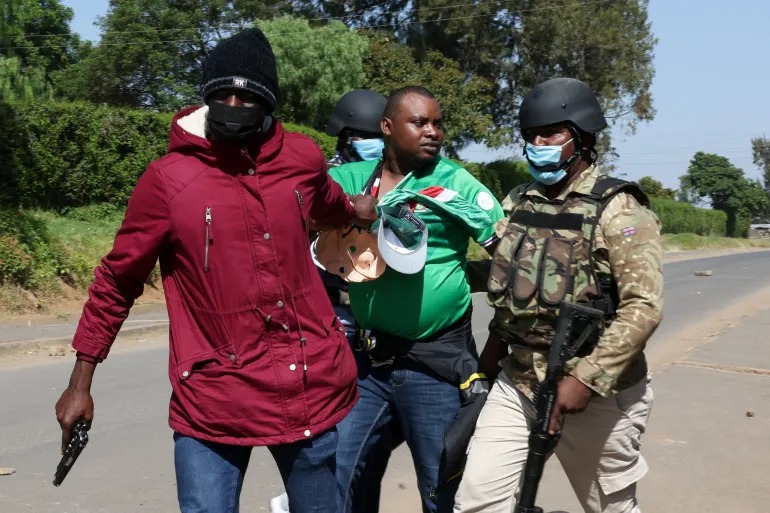
Tension flared on Tuesday in the Kenyan tourist town of Nanyuki as several protesters were arrested during demonstrations against the construction of an Ebola quarantine centre intended for United States citizens arriving from the Democratic Republic of Congo.
The facility, located at the Laikipia Air Base near the foothills of Mount Kenya, has become the centre of growing public anger and anxiety among residents who fear the possible introduction of the deadly Ebola virus into Kenya.
According to reports, the quarantine centre is designed to isolate and monitor Americans arriving from the Democratic Republic of Congo, where authorities are battling a major Ebola outbreak.
Kenya has never officially recorded a case of Ebola, and the proposed facility has triggered widespread concern among many citizens who believe the project could expose the country to unnecessary health risks.
On Tuesday, dozens of demonstrators gathered close to the air base to protest against the project, carrying placards and chanting slogans demanding that the quarantine centre be scrapped.
Some protesters wore protective suits, gloves and face masks to dramatise their fears over the highly contagious disease, while others carried a symbolic coffin with the word “Ebola” boldly written across it.
The demonstration attracted heavy police presence as security operatives attempted to prevent protesters from approaching restricted areas near the military facility.
Journalists from Agence France-Presse at the scene reported that police officers fired tear gas to disperse the crowd after tensions escalated during the protest.
Several demonstrators were arrested during the operation, although authorities had yet to disclose the exact number of people detained or the specific charges against them.
Residents participating in the protest accused both Kenyan authorities and the United States government of disregarding public safety concerns by choosing Kenya as a quarantine location.
Many argued that bringing individuals potentially exposed to Ebola into the country, even under strict medical supervision, posed unnecessary risks to local communities.
One of the protesters, 30-year-old Zipporah Wachira, voiced the fears shared by many residents in the area.
“We don’t have that disease in this country… they are bringing a virus into our country,” she said during the protest.
The quarantine facility is expected to contain 50 isolation beds and is reportedly being managed by American personnel.
Construction work at the centre was said to be nearing completion late last week, despite mounting opposition from sections of the local population.
The project has generated intense public debate in Kenya, especially on social media platforms where many citizens questioned why the quarantine centre could not be established elsewhere.
Critics of the plan argue that Kenya’s tourism industry, which heavily depends on international confidence and travel, could suffer serious reputational damage if fears surrounding Ebola spread among tourists and investors.
Nanyuki, the town at the centre of the controversy, is widely known as a gateway to Mount Kenya and a popular destination for tourists, climbers and safari visitors.
Some business owners in the area expressed fears that international headlines linking the town to Ebola quarantine operations could discourage tourism and negatively affect local livelihoods.
Others, however, defended the project, insisting that quarantine facilities are designed precisely to prevent the spread of infectious diseases and protect the wider public.
Medical experts have repeatedly stressed that Ebola is only transmitted through direct contact with bodily fluids of infected individuals and cannot spread casually through the air.
Health officials also note that properly managed isolation centres are essential tools for containing outbreaks and monitoring potentially exposed persons.
Despite such assurances, fear and mistrust remain high among many residents who believe the risks outweigh any diplomatic or humanitarian considerations involved in hosting the facility.
Kenyan authorities have yet to issue a detailed public statement responding directly to Tuesday’s protest, although officials previously indicated that strict international health protocols would be followed at the centre.
The Democratic Republic of Congo has struggled with repeated Ebola outbreaks over the years, with health agencies and international partners working continuously to contain the disease and prevent cross-border spread.
Ebola is a severe viral illness that can cause fever, internal bleeding and organ failure, with fatality rates sometimes reaching high levels during outbreaks.
The disease has historically triggered panic across parts of Africa due to its deadly nature and the speed at which outbreaks can escalate without rapid containment measures.
Tuesday’s protest highlights the difficult balance governments often face between international health cooperation and public fears during infectious disease emergencies.
Analysts say the controversy surrounding the quarantine facility could place additional pressure on Kenyan authorities to improve public communication and transparency regarding the project.
For now, tensions remain high in Nanyuki as residents continue to demand assurances that Kenya’s public health safety will not be compromised by the facility’s operations.