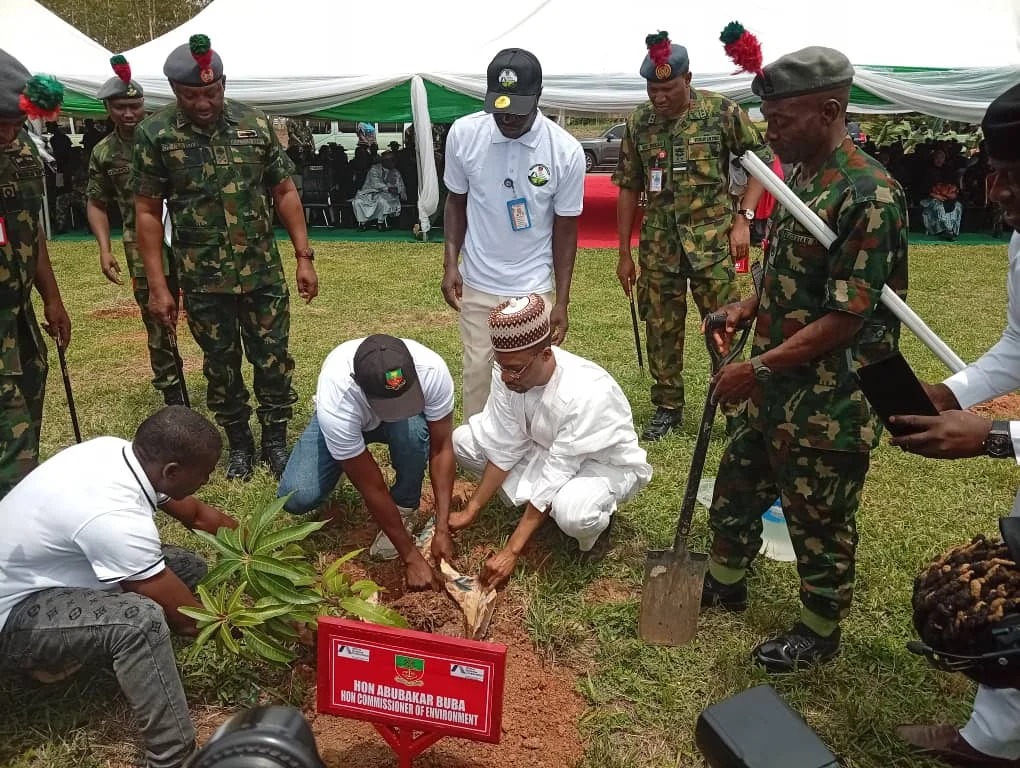
The Federal Government of Nigeria on Monday inaugurated a one-million-tree-planting campaign at the Nigerian Defence Academy in Kaduna as part of renewed efforts to address climate change, desertification, deforestation and biodiversity loss across the country.
The ambitious environmental initiative was launched at the NDA Biodiversity Conservation Centre through a partnership involving the Africa Finance Corporation, the Nigerian Defence Academy and Fifth Chukker.
The campaign is expected to contribute significantly to environmental sustainability by restoring degraded land, improving air quality and strengthening Nigeria’s resilience against the growing impacts of climate change.
Representing the Minister of Environment, Balarabe Lawal, the Kaduna State Commissioner for Environment, Abubakar Buba, described the project as a major environmental intervention capable of delivering both ecological and socio-economic benefits.
Speaking during the inauguration ceremony, Buba noted that Kaduna State and several other parts of the country were increasingly facing severe environmental pressures linked to climate change and unsustainable human activities.
According to him, advancing desertification in the northern parts of Kaduna State and persistent deforestation in the southern areas continue to threaten biodiversity, water resources and agricultural productivity.
He explained that environmental degradation has become a serious concern because of its direct impact on food security, public health, livelihoods and economic stability.
Buba stressed that tree planting remains one of the most effective and affordable strategies for mitigating climate change, preventing soil erosion and restoring damaged ecosystems.
He said the one-million-tree initiative demonstrates the commitment of the Federal Government and its partners to protecting the environment and promoting sustainable development.
The commissioner further noted that beyond environmental protection, the project would create awareness among young people and communities about the importance of conservation and responsible environmental practices.
According to him, educational institutions such as the Nigerian Defence Academy have an important role to play in promoting environmental stewardship and encouraging future leaders to prioritise sustainability.
He also praised the collaboration between government institutions, private sector organisations and civil society groups, describing it as essential for tackling environmental challenges that no single institution can solve alone.
Officials at the event explained that the initiative aligns with broader national and global efforts to combat climate change and achieve sustainable development goals related to environmental protection.
The tree-planting campaign is expected to support carbon absorption, improve biodiversity and contribute to the restoration of natural habitats affected by deforestation and land degradation.
Environmental experts at the launch highlighted the urgent need for increased afforestation across Nigeria, especially in regions vulnerable to desert encroachment and declining vegetation cover.
They warned that continued destruction of forests could worsen flooding, drought, food shortages and the loss of wildlife species if urgent interventions are not sustained.
Participants at the event also emphasised the importance of involving local communities, students and youth groups in environmental conservation programmes to ensure long-term success.
The NDA Biodiversity Conservation Centre, where the project was launched, was described as a strategic location for promoting research, conservation education and ecological restoration.
Representatives of the Africa Finance Corporation reportedly reaffirmed the organisation’s commitment to supporting climate-resilient projects and sustainable environmental initiatives across Africa.
They noted that environmental sustainability has become increasingly important for economic growth, infrastructure development and social stability on the continent.
Stakeholders at the event observed that Nigeria, like many developing countries, faces growing environmental threats linked to population growth, urbanisation, illegal logging and climate-related disasters.
They stressed that tree planting alone may not solve all environmental problems, but remains a critical step toward rebuilding ecosystems and reducing the harmful effects of climate change.
Observers say the initiative could also inspire similar programmes in schools, communities and institutions across the country as awareness about environmental sustainability continues to grow.
In recent years, Nigeria has experienced more extreme weather conditions, including flooding, rising temperatures and desert encroachment, prompting calls for stronger environmental policies and conservation efforts.
Environmental advocates have repeatedly urged governments at all levels to invest more in afforestation, renewable energy and climate adaptation strategies to protect vulnerable communities.
As the one-million-tree campaign begins, organisers expressed optimism that the initiative would not only improve the environment but also encourage a culture of environmental responsibility among Nigerians.
They maintained that sustained collaboration, proper monitoring and public participation would be crucial to ensuring the long-term success and impact of the project.