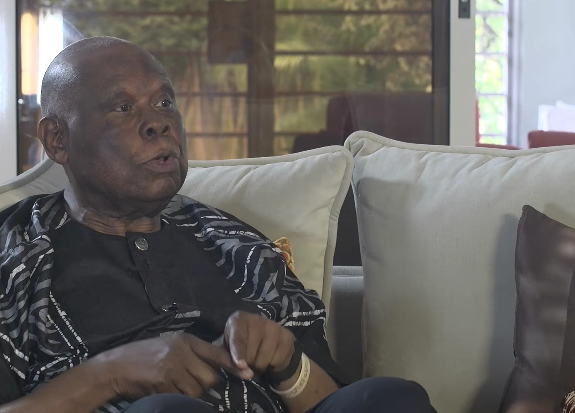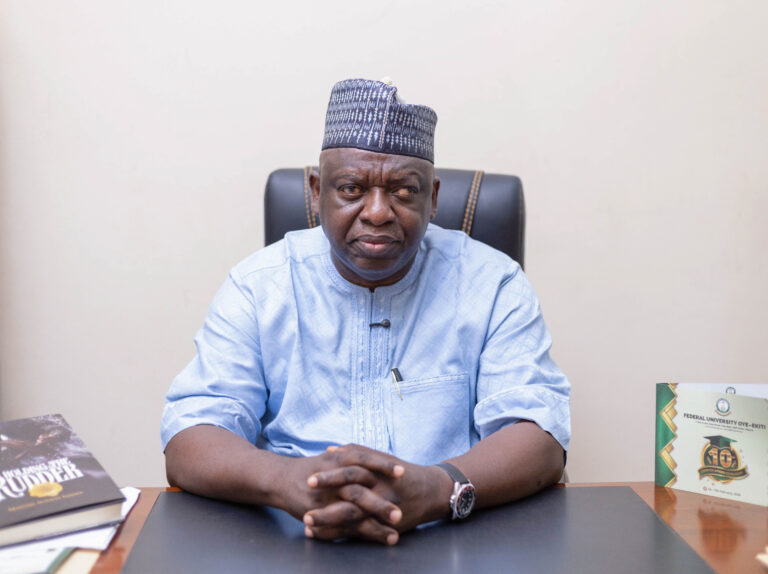
Joshua Ogunwole, a professor of Soil Science, is the new Vice Chancellor of Federal University of Oye Ekiti (FUOYE), succeeding Abayomi Fasina, a professor who steered the affairs of the institution for five years. A former Deputy Vice-Chancellor, Strategic Partnerships, Research, Innovation, and Linkages, and a former Vice-Chancellor of Bowen University, Ogunwole, in this interview with DevReporting, offers a glimpse into his journey from scepticism to stewardship, reflecting on loyalty, leadership, and the turbulent realities of university administration. Excerpt.
DR: Kindly walk us through your journey with FUOYE.
Ogunwole: I came to this university precisely on 2 October, 2016. Coming from Federal University, Dutsinma, where I spent three years, and Ahmadu Bello University (ABU), where I spent almost 20 years. When I came here, my impression was that I had come to the wrong place. This was because it wasn’t looking like a university. The members of staff were unruly; people even went as far as to put what they call an ‘otumokpo’ (sacrifice) at the gates. I looked at myself, and I said that am I really in the right place? I think maybe it has to do with how the university started and so on.
So, I was here until 31 July, 2018, before I took up the appointment as the vice chancellor of Bowen University. I took a leave of absence from FUOYE, and I went to Bowen for five years. So, I returned precisely on 31 August 2023. One thing I need to say is that FUOYE never left me. When I was leaving, the then vice chancellor, Professor Kayode Shoremekun, had a special get-together for me and gave me a befitting gift, a brand new big generator to go and start life at Bowen. All through my time at Bowen University, my predecessor, Professor Abayomi Fashina, would always attend our convocation. One way in which to show me and the world that we are still behind you and so on, and this I appreciate tremendously.
DR: When you returned in 2023, did you at any point envisage yourself becoming a Vice-Chancellor?
Ogunwole: Well, nobody has. Even the first one, I didn’t have it in mind. Actually, I decided I was just going to sit at one corner and if my service or suggestion is needed, I will quietly give my modest support and suggestion. But you see, the vice chancellor and I have known ourselves for over 20 years. We are the same professional colleagues, we became professors the same day. So, on 1 October 2007 he became professor at Ekiti State University, while I became professor on the same day at Ahmadu Bello University, Zaria.
So, we know ourselves when we meet at the Soil Science Society of Nigeria. When he comes most times to examine students in ABU, rather than stay in the hotel, he stays in my house. So, we’ve known ourselves as families across, but his second son graduated from Bowen, he studied Medicine. His wife also graduated from Bowen where she studied Medicine. But my plan when I was coming, was to support him that he would succeed. That was what was paramount in my heart. Particularly that he was facing several challenges.
Like I just mentioned where I was coming from, it is only Fasina who can be vice chancellor here at the time he was VC. I just mentioned to you how the university was when I met it, and so on, but he was able to integrate the good, the bad and the ugly. And in the process of integration and working, challenges started coming. So, my primary plan was to ensure that I give him every support. You see, it can be cold at the top, when you can’t trust anybody. I’ve been there, so I know what it is. So, when I returned, that was what I felt I was coming to do. Actually, I did that. To stand by him and help him to succeed because he did the same thing to me while I was at Bowen.
DR: Given your close relationship with the former VC, Mr Fasina, and the turbulence the university experienced during his tenure, what was going through your mind as those challenges unfolded? At any point, did you ever doubt his capacity to navigate the crises?
Ogunwole: No, I didn’t. Why I didn’t is that, I had a similar experience. I know it, I understand it, I’ve been there. I mean, somebody was paid, and that she should come to my office, first time check whether there is a camera, and if there is none, then she should return back to plan B, and the plan B was that, try to make advances at me, and if I refuse, she should tear her clothes and scream. One of the things with us in this country is that we always try to bring down our leaders, and even the public opinion poll will not support the victim in quote, because you are high there.
So, I knew there was hanky-panky going on somewhere. That I knew. I’ve been there; the only thing was that, in my own case, one of the people who hatched the plan got drunk in a bar and was talking loosely. So those who heard sent me a message. So, I was able to tell my people that I didn’t want to see this person. And then, while I was telling those in my office, they told me that I was late. They had made the first move, but we didn’t allow her in, and so on, and things like that. So, these are normal things people do because they want to hijack the leader and blackmail the leader to get some things they naturally would not have. So, I understand the game gameplay very well. And so, all I needed to do was to stand by him because I knew what was at stake, and what they were interested in.
DR: Looking at the former VC’s tenure, were there particular achievements that stood out to you or inspired you the most?
Ogunwole: Well, you see, for those of us who know the VC before, anything that Fashina tries to do, he is super passionate about it. I say super passionate. His own passion goes beyond ordinary. In the field of soil science, we call him ‘Fash the Bash,’ because he will bash anything on his way to get to where he is going. Now, he had this thing that impressed me, the massive infrastructural development. He opened up the roads. FUOYE was just one small place that looked like a glorified secondary school by the time I was leaving. But most times when I came here, during convocation and so on, he would ask someone to take me round, and I would see him opening the ring road, and so on.
When you open a ring road, the land is expanded for infrastructural development, and he has been aggressive with that. Another area that I am impressed with is in the area of academic development, and particularly accreditations. Fashina made sure that, in fact, for him, interim accreditation is a failure, as far as he is concerned. So, accreditation is another thing. Then, looking at the indices of a growing university, yes, he is bothered about how to push research, how to ensure that there are innovations, and how to promote partnerships. Last year, he had to move us to Rwanda, where we signed a memorandum of understanding (MoU) with two big universities in Rwanda. So, most of those indices make a university stand out. You will see him running in those directions to make sure that we are not lagging. And so, that is something that I wanted to applaud him for. In fact, I always wonder whether he sleeps.
DR: Now that you are stepping into this role following your predecessor’s impactful tenure, what is your core vision and plan for the university?
And, just where we are coming from, he pointed at me that this is the next Jagaban. I said, No, you are going with your Jagabanship because you are the only one who can go with that. You see, Fasina had grown this university tall. Alright? What I am coming to do is to give it a base. If you plant corn, and you plant it so tall, a small wind can blow it down if its base is not strong. So, what I am coming to do is to strengthen the base. He had moved us from about 20,000 students, and we are actually knocking almost a little over 60,000 now.
What I need to do now is to build the carrying capacity of this campus to be able to accommodate and take in the 60,000; otherwise, we are going to have issues like overcrowding, land erosion, and so on. So, if you don’t want environmental degradation and whatever, we must concentrate on broadening. We have grown tall, let’s broaden, so that we can carry our height. In several areas, that is what we will be coming to do. Ensuring that what we have achieved, we don’t drop, we don’t reduce, we keep moving up, sustainably moving up, while we are broadening our basis. That’s, in layman’s terms, what I think we will be doing in the next five years.
DR: Globally, universities are often known for specific areas of strength. From what we have seen, agriculture appears to be a key focus for this university. How do you intend to develop and position this area going forward?
Ogunwole: We are going to be opening an agro-allied company within the next two years by the grace of God. We have already made contact with buyers who are going to make big purchases from us. This year, we are going to do a massive production of soybeans, which we are going to be selling to oil companies, vegetable oil producing companies and so on. The company will be registered to handle these things so that the university is not distracted from its mandates. Once we start this, we will make it a limited liability company, with the university holding the controlling shares, and then, we give it out.
The second thing is that by the third year, by the grace of God, we are going to be opening neurosurgical products here. What I am saying is that, you know our people, when you talk about malaria fever, they would rather want to use the local medicine. I use it too. I steam with it. They work faster than taking all these chemicals into our body. Okay? So, but science has been able to help us to make them into healthy food which people can take and be healthy. So, that is actually what neurosurgical is all about. Mr Fashina already started by training 18 staff here on neurosurgical related whatever.
We will continue this year by equipping the laboratory we have. I have already worked to the point of producing one of these neurosurgical products but because we have not equipped the place, they had to stop at a point. Now, we are going to ensure that they can move on and one of the ways we want to encourage and motivate staff to be involved in that there is a percentage of whatever we make from there that goes to the team. But one thing this university will be known for is that, it is going to be a smart university.
Technology-wise, it will drive everything and by November this year, by the grace of God, this university will be run by enterprise resource package. Everything you want to know about what is happening in registry, just go online. There will be a good handshake between Bursary and Registry. Students are here at Registry, students are there at Bursary and everything will be digital. We felt that our university must be agile. Our university must be very responsive, and it must be cost effective running the operation of the university and that is one way to go.
DR: The university has recorded notable growth in revenue generation, which appears to reflect a collective institutional effort. Building on this momentum, what targets have you set, and what should we expect in the coming years?
Ogunwole: We are growing, and we intend to sustain that growth by expanding and supporting several start-ups. Beyond revenue generation, our goal is to build a strong institutional reputation. One key strategy is to encourage our students, especially as they graduate, to launch their own start-ups. To support this, we plan to establish a dedicated hub within the city where they can develop and grow their ideas. We plan to create dedicated spaces that can serve as laboratories, offices, and innovation hubs, where students can develop viable start-up ideas with the support of the facilities we provide. We should have about 10 to 15 per cent of the share of that company and so on. We keep encouraging that and inviting others to help us do that. Before we know it, we will have in four years our own Silicon Village.
DR: As your predecessor, Mr Fasina, steps out of office at 65 but remains active in academia, what role do you see him playing going forward, especially given your long-standing professional and personal relationship?
Ogunwole: I believe the future still holds significant opportunities for Professor Fashina. He possesses qualities that naturally attract responsibility and leadership. Having served as Chairman of the Committee of Deans of Agriculture in Nigeria, he was also a board member of the Agricultural Research Council of Nigeria. Given his experience and track record, I strongly believe the Federal Government will find him valuable in agriculture-related roles, where he can continue to contribute meaningfully to national development and the advancement of the sector.