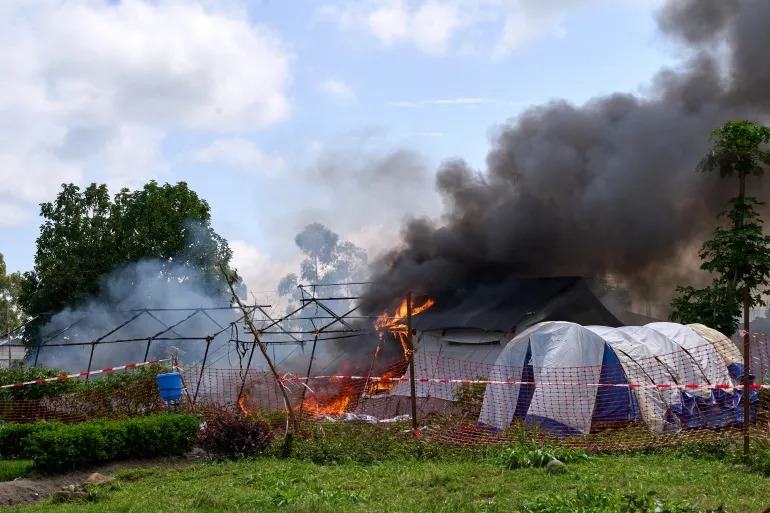
Fresh violence has erupted in the eastern part of the Democratic Republic of Congo as rioters set fire to hospital tents being used to isolate Ebola patients, deepening fears over the deadly outbreak that has already unsettled communities across the conflict-ridden region.
The attack occurred at Rwampara hospital in Ituri province, the epicentre of the latest Ebola outbreak, where angry residents stormed the treatment area and burnt down temporary tents erected for infected patients. Witnesses said panic and confusion spread rapidly as flames engulfed the makeshift structures, leaving behind only charred remains and twisted metal frames.
The unrest reflects growing distrust among local residents toward health authorities and the government’s handling of the outbreak. Many residents have become suspicious of emergency health measures, especially the hurried burials of those believed to have died from the viral haemorrhagic fever. In several communities, families have complained that relatives were buried quickly without traditional funeral rites, fuelling rumours and resistance.
Authorities said the riot broke out on Thursday amid rising tensions surrounding containment efforts.
The violence reportedly subsided only after soldiers were deployed to the hospital area to restore order and secure the premises. Military personnel have now been stationed around key health facilities and are also accompanying burial teams in an effort to prevent further attacks.
Health workers in the region are facing enormous challenges as they battle not only the deadly disease but also hostility from frightened residents. Some aid workers have reportedly gone into hiding after threats from mobs accusing them of spreading the illness or working with the government against local communities.
The Democratic Republic of Congo has experienced several Ebola outbreaks over the years, but experts say the latest crisis is particularly difficult because it is unfolding in an area plagued by armed conflict, poverty and weak healthcare infrastructure. Years of violence involving militias and rebel groups have left many communities deeply suspicious of state institutions and outsiders.
Medical officials warn that attacks on treatment centres could severely undermine efforts to contain the virus. Isolation tents and emergency facilities are crucial in preventing infected patients from spreading the disease to family members and healthcare workers. The destruction of the tents at Rwampara hospital has raised concerns about possible new infections if suspected patients flee or are unable to receive proper care.
Ebola is a highly infectious disease transmitted through direct contact with bodily fluids of infected persons. Symptoms include fever, vomiting, diarrhoea and internal bleeding. Without swift medical intervention, the disease can be fatal.
International health agencies and humanitarian organisations have repeatedly stressed the importance of community cooperation in controlling outbreaks. However, misinformation and fear continue to hamper response efforts in several affected communities.
Residents in parts of Ituri province say they are frustrated by what they see as poor communication from authorities. Some locals claim they do not fully understand the nature of the disease or why strict burial measures are necessary. Others fear that once relatives are taken to treatment centres, they may never see them again.
Community leaders and religious figures are now being urged to help calm tensions and encourage residents to cooperate with health officials. Authorities hope that increased public awareness campaigns and stronger security around medical facilities will prevent further violence.
Despite the destruction at the hospital, emergency response teams have vowed to continue containment efforts. Health workers are reportedly assessing the damage while plans are underway to replace the burnt tents and resume treatment operations.
The latest violence underscores the enormous difficulties facing health authorities in the Democratic Republic of Congo, where deadly disease outbreaks often intersect with insecurity, public mistrust and political instability. As fears continue to spread across affected communities, officials warn that restoring public confidence may prove just as important as medical treatment in stopping the Ebola epidemic.