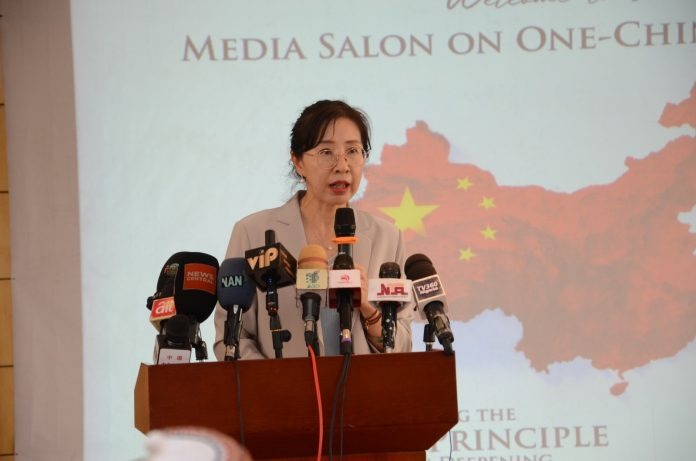
During a media salon in Abuja on May 14, Chinese Counselor Dong Hairong reaffirmed that the One-China Principle remains the non-negotiable foundation of their relationship.
Nigeria has consistently upheld this since 1971, treating Taiwan as an inalienable part of China and maintaining only non-diplomatic trade relations with the island.
This political alignment has paved the way for massive Chinese involvement in Nigeria’s critical sectors, as 53 out of 54 African nations now adhere to this policy (with Eswatini being the sole exception).
A major economic shift occurred on May 1, 2026, when China implemented a zero-tariff treatment for exports from 53 African countries, including Nigeria.
This policy is designed to balance the trade deficit by allowing Nigerian agricultural products specifically sesame, ginger, cocoa, and cashew nuts to enter the Chinese market duty-free.
Bilateral trade has surged, exceeding $22 billion in the most recent 10-month reporting period, marking a 30% year-on-year increase.
Beyond hard infrastructure, the 2026 China Tourism Day celebrated in Abuja on May 15 highlighted a “bridge of mutual understanding.”
Both nations are exploring joint heritage protection, linking landmarks like Nigeria’s Zuma Rock and Osun-Osogbo Sacred Grove with China’s Great Wall for tourism promotion.
China has pledged to support Nigeria’s creative economy through “China-Nigeria Film Week” initiatives and hospitality training via the National Institute for Hospitality and Tourism (NIHOTOUR).
The relationship in 2026 is characterized by a “pragmatic pattern.” Nigeria is leveraging Chinese capital and technical expertise to fix its infrastructure deficit, while China is opening its massive consumer market to Nigerian non-oil exports to ensure a more sustainable, long-term trade balance.