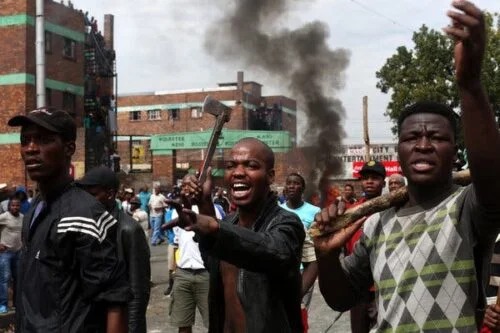
There is an uncomfortable truth that must be confronted: what South Africa once endured under Apartheid now echoes, in altered form, within its own society.
Xenophobia—particularly as it manifests against fellow Africans—can be understood as a reframed, internalized version of Apartheid. The actors have changed, but the underlying impulses of exclusion, hierarchy, and fear remain disturbingly familiar.
Under Apartheid, oppression was explicitly racial—white supremacy codified into law and daily life. Today’s xenophobic violence, however, is driven less by race than by a perceived hierarchy of nationality and economic worth within the indigenous Black population. Some Black South Africans, consciously or not, project a sense of relative privilege within the African context, creating the illusion of South Africa as a promised land besieged by outsiders.
This illusion fuels resentment. Migrants from across the continent—many fleeing economic hardship or instability—are accused of stealing jobs, undercutting wages, or dominating informal trade. Yet this narrative collapses under scrutiny. South Africa’s economy is also significantly shaped by Indian, Chinese, White and Lebanese entrepreneurs. Rarely, however, do we witness mobs turning their anger toward these communities. Instead, the fury is disproportionately directed at fellow Africans.
This selective hostility suggests that what is unfolding is not merely xenophobia in its broadest sense, but something more specific—what may rightly be called Afrophobia: a fear, suspicion, or rejection of African “others.” It is a tragic paradox—victims of historical exclusion reproducing new forms of exclusion against those who look like them, speak like them, and share a common continental identity.
Afrophobia is not born in a vacuum. It feeds on economic frustration, weak state capacity, and competition over scarce resources. But it also draws from deeper psychological and historical currents. The legacy of apartheid did not vanish with its legal dismantling; it lingers in patterns of thought, in social hierarchies, and in unresolved trauma. Systems of division, once institutionalized, rarely disappear overnight—they mutate.
Even more troubling are the symbolic contradictions that persist within South Africa. The reported existence of enclaves such as Orania—where racial exclusivity continues in practice—serves as a stark reminder that the ideals of a fully inclusive society remain unfulfilled. While not equivalent in origin or scale, such spaces echo the same logic of exclusion that underpins xenophobic attacks: a refusal to accommodate difference, a retreat into insularity.
To be clear, xenophobia does not define South Africa or its people. Many South Africans continue to embody the spirit of solidarity that once inspired the continent and the world. But the persistence—and periodic eruption—of anti-immigrant violence points to a deeper national struggle.
What South Africa faces is not merely a policing problem or an immigration debate; it is a moral and psychological crossroads. The country has made extraordinary strides since the end of apartheid, yet it has not fully healed from its wounds. In some respects, the nation appears to be responding to its past rather than transcending it.
True liberation is not only the dismantling of oppressive systems; it is also the transformation of the mindset those systems leave behind. Until that transformation is complete, the danger remains that yesterday’s victims may, in moments of frustration and fear, reproduce the very patterns they once resisted.
South Africa’s story has long been one of resilience and hope. To preserve that legacy, it must now confront a difficult question: how to build a society that not only rejects apartheid in law, but also in spirit—one that replaces fear with solidarity, and exclusion with a renewed commitment to African unity.
Fr. Anwuchie is a Nigerian Catholic missionary based in Niger Republic.