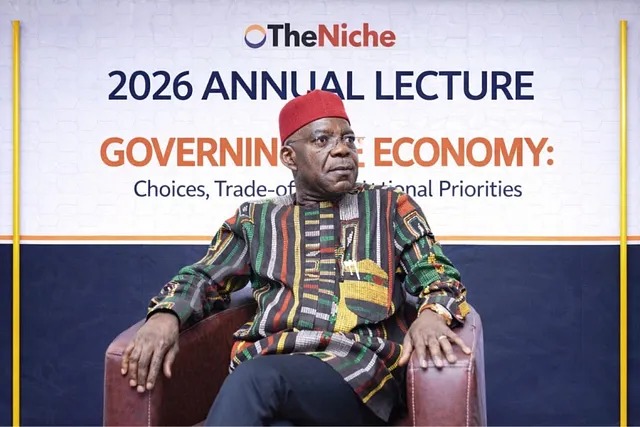
Governor Alex Otti’s Warning to Nigeria and the Choice Before Us
By Agbeze Ireke Kalu Onuma, AI-KO
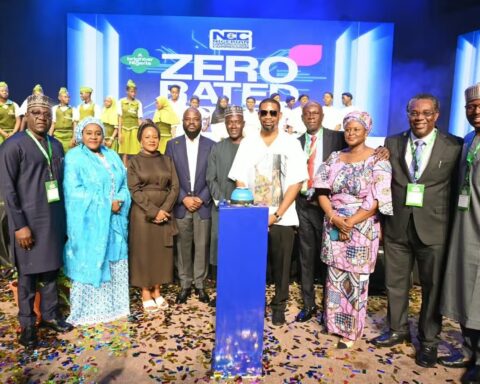
I remember very clearly what it felt like walking into the Nigerian Institute of International Affairs that day. For once, I wasn’t rushing. After attending the previous lectures, I had assumed people would stroll in late as usual, so I took my time. But the moment I stepped into the building, I realized I had miscalculated. The hall was already full – completely full – and not with random attendees. These were people whose names carried history and influence: Adm. Madueke, Gen. Ike Nwachukwu, Dr. G. S. Ihetu, Chief Okey Nwadinobi, Dr. Uma Eleazu, Chief Ebueme Ezikpe, Adm. Iwuha, and many others. They were all seated, alert, and fully present.
What struck me most was the atmosphere. Nobody was pretending to be interested. Nobody was distracted. The room felt charged with a seriousness I hadn’t encountered in a long time. People had come because they expected something meaningful, and you could feel that expectation in the air.
Like the previous four lectures, I came simply to listen. The topic mattered, yes, but the people involved mattered even more. His Royal Majesty, Khalifa Muhammadu…
I write this as someone who has spent years observing Nigeria – its potential, its struggles, and the wide gap between what it could be and what it often chooses instead. That gap can be discouraging. It can make you numb. But that day, something shifted for me.
It wasn’t because anyone made dramatic statements or promised miracles. It wasn’t because the hall was filled with dignitaries. It was something simpler: an elected leader stood up and spoke honestly. No exaggerations. No excuses. No attempt to impress. Just clarity and truth.
Sitting there, I realized how rare that has become – and how powerful it still is when it happens.
That day reminded me that sincerity in leadership still matters, and that when people sense it, they show up early, they pay attention, and they leave with something they didn’t come with.
For me, that “something” was a quiet but real sense of hope.
The Governor opened his lecture with a kind of intellectual demolition – quiet, swift, and so precise that I suspect many people in the room did not immediately grasp what had just happened. He began with a single line: “there is no silver bullet for solving Nigeria’s many economic challenges because economics is about cold, hard facts, not vanities”. It sounded almost casual, but it was anything but. In that one sentence, he dismantled an entire tradition of political promise‑making that has shaped our public life for decades.
The more I thought about it, the more I realised how much weight that sentence carried. For years, Nigerians have been conditioned to believe in political shortcuts – grand declarations, sweeping promises, and magical timelines. We have been told that prosperity can be summoned by decree, that poverty can be erased by slogans, that growth can be manufactured by wishful thinking. And because these promises are repeated every election cycle, they begin to feel normal, even when experience tells us otherwise.
This is where the political scientist Richard Joseph’s idea of prebendalism becomes relevant. In his 1987 study of Nigerian politics, he described a system in which public office is treated as a channel for distributing resources to one’s ethnic or communal base. Over time, this logic has shaped not only how leaders behave but also how citizens expect leaders to behave. Elections become less about policy and more about access. Campaigns become less about competence and more about patronage. And in this environment, silver‑bullet promises thrive because they offer the illusion of transformation without the discipline required to achieve it.
Our election seasons have become carnivals of magical thinking. Aspirants arrive with slogans that promise the impossible: trillion‑dollar GDP targets within a few years, poverty eradication on a scale that defies economic reality, and other declarations that sound impressive but collapse under scrutiny. These promises function like talismans – objects meant to inspire belief rather than deliver results. They are designed to excite, not to explain. They are meant to win applause, not to withstand analysis.
What Otti did in his opening statement was to strip these illusions bare. By calling them vanities, he forced the audience to confront the emptiness behind the rhetoric. He reminded us that economics does not respond to emotion, identity, or wishful thinking. It responds to data, discipline, and decisions. It responds to the hard work of building institutions, not the theatrics of campaign platforms. It responds to continuity, not improvisation.
In that moment, he was not merely criticising political culture. He was challenging the mindset that sustains it. He was asking the audience – and by extension, the country – to let go of the comforting fiction that complex problems can be solved with simple promises. He was insisting that we acknowledge the reality we have spent years avoiding: that development requires more than ambition. It requires honesty. It requires patience. It requires the willingness to confront facts even when they are inconvenient.
And perhaps that is why his opening line felt so significant. It was not dramatic. It was not loud. But it was a quiet refusal to participate in the rituals of exaggeration that have defined Nigerian politics for so long. It was a reminder that progress begins with truth, and truth begins with the courage to call vanity what it is.
For decades, Nigerians have been encouraged to believe that one dramatic action – a new leader, a new policy, a new loan, a new announcement – would suddenly turn everything around. We have been conditioned to expect instant transformation, as though national progress works like flipping a switch. That belief has shaped our politics, our expectations, and even our frustrations. But as Otti pointed out, that belief is not real hope. It is a trap that keeps us waiting for something that will never come in the way we imagine.
What stood out to me was that he didn’t swing to the opposite extreme either. He didn’t say the country is doomed or beyond repair. He didn’t join the chorus of people who have given up completely. Instead, he positioned himself in the difficult middle ground – the space where real, long-term work actually happens. It is not a comfortable place. It is not a place that earns applause quickly. But it is the only place where progress can be built.
He explained that he would not pretend that a turnaround is just around the corner. He said doing so would be dishonest, and he refused to mislead people. At the same time, he made it clear that he would not surrender to despair. He would not speak as though nothing can change. He insisted on holding both truths at once: that the road ahead is long, and that the road is still worth walking.
That balance – between realism and hope – is something many Nigerians understand deeply. It is where most of us live every day. We know the problems are serious. We know they will not disappear overnight. But we also know that giving up is not an option. We continue to believe that improvement is possible, even if it is slow, even if it is hard, even if it demands more patience than we would like.
The Nobel laureate economist Amartya Sen, in Development as Freedom (1999), argued that development must be understood as the expansion of human capabilities, not merely the growth of GDP. Reading Otti through Sen’s lens, what emerges is a leader wrestling with the distinction between palliatives and transformation, between the optics of governance and the unglamorous substance of institutional reform. His refusal to offer a “turnaround is imminent” narrative is itself a form of respect for the intelligence of his audience.
Then came the historical pivot that I found most devastating, perhaps because it was delivered with such elegant understatement. “This is not the country our parents envisioned on Independence eve in 1960,” he said. The room did not erupt. There was no applause. Instead, there was a collective intake of breath, the kind of silence that descends when a truth too heavy for casual acknowledgment has been spoken. What was that vision? It was the vision captured by Chinua Achebe in The Trouble with Nigeria (1983) – a slender volume whose diagnosis remains tragically current four decades later. Achebe wrote: “The trouble with Nigeria is simply and squarely a failure of leadership.
There is nothing basically wrong with the Nigerian character. There is nothing wrong with the Nigerian land or climate or water or air or anything else. The Nigerian problem is the unwillingness or inability of its leaders to rise to the responsibility, to the challenge of personal example which are the hallmarks of true leadership.” Otti’s lament that our parents envisioned something else is an invitation to hold our present reality against the photograph of that dream and measure the deficit.
When he said the world “has moved on, hoping that someday, our country may catch up but whether that day would be in this decade or in the coming century, or perhaps never, will depend largely on what we do in the days and years that follow,” I could not help but think of South Korea. In 1960, Nigeria’s GDP per capita was comparable to South Korea’s. In 2023, South Korea’s nominal GDP per capita was over $33,000; Nigeria’s hovered near $1,600 after the naira float. The divergence is not an act of God; it is the accumulated arithmetic of political choices.
This is the intellectual hinge upon which the entire lecture swung: the direct, unmediated correlation between political choices and economic outcomes. The Governor was at pains to clarify that he is not peddling the simplistic Great Man theory of history. “While I would not be overly simplistic to suggest that one good leader would make all our problems disappear, in fact that thinking may be at the heart of our present challenges,” he said. This is a profound admission that deserves pause. What if our messianic waiting – our perennial search for a political saviour – is itself a pathology?
What if the very cultural expectation that a single transformative figure will descend from the heavens to fix everything is what has enabled the serial emergence of authoritarian pretenders, from military dictators to civilian despots in democratic clothing? The political philosopher John Dunn, in Setting the People Free: The Story of Democracy (2005), traces how democracy has survived not by producing philosopher-kings but by building resilient institutions that constrain even the well-intentioned and evict the malignant. Otti’s emphasis on “a good leadership system across board” rather than a single redeemer aligns with the global evidence that what distinguishes successful developmental states – from Botswana to Singapore – is not individual genius but institutional integrity.
Listening to him, I felt that he was describing the emotional reality of millions of people. Nigerians who wake up each morning determined to keep going, even when the news is discouraging. Nigerians who refuse to lie to themselves about the challenges, but also refuse to let those challenges define the future. Nigerians who understand that progress is not a sudden event but a steady, deliberate effort.
In that moment, Otti wasn’t offering a grand promise. He wasn’t offering a dramatic prediction. He was offering something more valuable: honesty about where we are, and clarity about what it will take to move forward. And sometimes, that is exactly what a country needs to hear – not fantasy, not despair, but a grounded truth that leaves room for genuine hope.
What stayed with me next was the way he drew a straight, unbroken line between politics and the everyday cost of living. He didn’t raise his voice or dramatize anything. He simply explained, in a steady tone, that the foundation of any economy – good or bad – is built on political decisions. It was a simple point, but the simplicity made it even more striking. Many of us in Nigeria talk about the economy as if it is something that happens on its own, like rainfall or harmattan. We treat rising prices, failing infrastructure, and unemployment as natural disasters that appear without warning and without human involvement.
But Otti reminded the room that nothing about our economic reality is accidental. Behind every broken road is a contract that was awarded or ignored. Behind every unpaid salary is a budget that was mismanaged. Behind every factory that shut down is a policy that discouraged investment or a leader who looked the other way. Behind every child who drops out of school is a decision about funding, priorities, or accountability. These outcomes are not mysteries. They are the direct results of choices made by people in positions of authority – people who either lacked competence, lacked integrity, or lacked both.
To make the point clearer, he referenced the experience of Abia State between 2015 and 2023. He didn’t bring it up to attack anyone personally or to score political points. Instead, he used it as an example of what happens when the political process breaks down. He described it almost like a case study – a controlled experiment showing the consequences of elections that do not reflect the will of the people. When leadership is produced through backroom deals instead of genuine votes, he said, the result is predictable: governance collapses. The stolen mandate produced a government that abandoned basic services.
Urban waste management collapsed – a seemingly mundane metric until you have lived in a city being consumed by its own refuse. Workers and pensioners were denied their entitlements. Entrepreneurs fled. “Abia,” he said, “is proof that economics cannot be separated from politics.” I would go further: Abia between 2015 and 2023 is a controlled experiment demonstrating what happens when the electoral process is corrupted. The capital flight, the human capital haemorrhage, the infrastructural decay – these were not natural disasters.
They were the downstream consequences of a tainted political transaction. The political economist Daron Acemoglu and the development economist James Robinson, in Why Nations Fail (2012), would recognise this narrative immediately. Extractive political institutions, they argue, inevitably produce extractive economic institutions. A government that comes to power through the subversion of the popular will cannot, by its very nature, govern in the public interest. To do so would be to betray the logic of its own emergence.
And he listed what that collapse looked like in practical terms. Urban waste management came to a halt. Public infrastructure was left to decay. Workers and pensioners went months, even years, without their rightful payments. Businesses that once created jobs and paid taxes packed up and left. Communities that should have been growing instead became stagnant. None of this happened by accident. None of it was inevitable. It was the outcome of political decisions made without accountability.
Otti emphasized that this was not a matter of opinion. It was not speculation. It was the lived experience of an entire state over nearly a decade. People saw it. People felt it. People endured it. And when he spoke about it, he did so with the clarity of someone who had studied the situation closely and understood its implications.
His message was simple but powerful: the economy is not separate from politics. The price of food, the state of our roads, the quality of our schools, the reliability of public services – these are all shaped by the choices of those who hold political power. When elections are credible and leaders are accountable, progress is possible. When elections are manipulated and leaders are insulated from consequences, decline is almost guaranteed.
Listening to him, it became clear that he wasn’t just describing the past. He was offering a framework for understanding the present and thinking about the future. He was saying, in effect, that if we want better economic outcomes, we must first demand better political decisions. And if we want better political decisions, we must insist on a political process that reflects the will of the people.
It was a reminder that felt both sobering and necessary. And it set the stage for everything else he would go on to say.
As I listened, my mind went back to the many World Bank reports I’ve read over the years – reports that consistently place Nigeria in the bottom ten percent of countries when it comes to government effectiveness and control of corruption. Those rankings are not just statistics on a page. They are not academic exercises meant for policy experts alone. They explain, in very practical terms, why daily life in Nigeria looks the way it does.
They explain why a country blessed with eighty‑four million hectares of arable land still struggles to feed itself and continues to import basic food items. They explain why a nation with one of the largest gas reserves in the world cannot provide stable electricity to homes, hospitals, and businesses. They explain why a country filled with young people – energetic, creative, and eager to work – still battles with staggering levels of unemployment. These are not coincidences. They are outcomes.
Otti’s lecture made those numbers feel less like distant global rankings and more like a mirror held up to our reality. He didn’t treat the statistics as abstract indicators. He used them to show how decisions made at the top filter down into the everyday experiences of millions of people. He wasn’t simply pointing out what is wrong. He was mapping out the chain of events that leads from political choices to economic consequences.
He laid it out plainly: when politics goes wrong, leadership goes wrong. When leadership goes wrong, institutions weaken. And when institutions weaken, citizens pay the price. It is a sequence that repeats itself across sectors and across states. You can trace it from agriculture to education, from power supply to public safety. The pattern is the same.
He reminded us that this chain of cause and effect is not broken by luck or by waiting for things to “sort themselves out.” It is broken by deliberate choices – choices made by leaders who understand their responsibility, and choices made by citizens who insist on accountability. Progress does not happen because a country is naturally blessed. It happens because people decide to build systems that work.
Listening to him, I realized how often we treat Nigeria’s problems as if they are mysterious or unexplainable. But when you follow the chain he described, the picture becomes clearer. Poor governance leads to weak institutions. Weak institutions lead to poor service delivery. Poor service delivery leads to frustration, poverty, and stagnation. And all of it begins with decisions – some made openly, many made quietly, but all made by human beings.
Otti’s point was not to overwhelm the room with blame. It was to show that the problems we face are not inevitable. They are the result of choices, and because they are the result of choices, they can be changed by choices. That is the part that stayed with me. It was a reminder that while the challenges are serious, they are not beyond understanding, and they are not beyond correction.
In that moment, the statistics I had read for years stopped feeling like distant warnings. They became a clear explanation of how we got here – and a guide to what must change if we want a different future.
What came next in his lecture forced the entire room to look inward. Governor Otti shifted the focus from leaders to citizens, and he did it in a way that was direct without being accusatory. He spoke about voter turnout – how it has steadily collapsed from 57 percent in 2011 to under 30 percent in 2023. He paused on that number long enough for everyone to absorb it. In a country with tens of millions of registered voters, more than seventy percent now choose to stay home on election day. When you think about it that way, the implications become hard to ignore. If most people refuse to participate, what mandate can any leader honestly claim? And even more uncomfortable: what moral ground do the majority, who opted out, have to challenge the outcome?
The political scientist Michael Bratton, in Voting and Democratic Citizenship in Africa (2013), building on Afrobarometer data, found a disturbing correlation across the continent: the withdrawal of citizens from electoral participation tends to accelerate the very governance failures that prompted the withdrawal in the first place, creating a downward spiral of mutual alienation between the governors and the governed. Otti named this dynamic with unflinching precision: “If we treat election seasons as bazaars, a time to extract and squeeze whatever we can out of the system, it becomes inevitable that the primary pursuit of those who win elections would not be to serve the community, but to recoup what has been invested and stack up resources for the next round of polls.”
Otti didn’t soften the point. He described the situation with a level of honesty that many public figures avoid. He said that when citizens treat elections as opportunities to collect handouts, favors, or quick gains, the entire system becomes distorted. Elections stop being civic exercises and start looking like marketplaces. And once that happens, the logic of governance changes completely. Leaders who emerge from such a process do not feel accountable to the public. They feel accountable to the deals that brought them into office.
He explained it in simple terms. If a politician spends money to secure votes, that politician will naturally see the office as an investment. And like any investor, he will expect returns. Those returns will not come from serving the public good. They will come from diverting resources, awarding inflated contracts, and building war chests for the next election cycle. In that kind of environment, public interest becomes an afterthought. The community becomes secondary. The goal becomes survival and profit.
Otti called this dynamic what it truly is: a political economy that harms everyone. It is a cycle in which both the voter who sells his vote and the politician who buys it are participating in a transaction that ultimately destroys the very system they depend on. The voter sees the election as a chance to make a little money. The politician sees it as a business venture. But the public good – the roads, the schools, the hospitals, the jobs – has no buyer. And because nobody has invested in it, nobody feels responsible for delivering it.
He made it clear that this is not just a theoretical problem. It is a pattern that repeats itself across states and across election cycles. When citizens disengage or participate only for personal gain, they weaken their own ability to demand accountability. When leaders rise to power through compromised processes, they enter office already disconnected from the people they are meant to serve. And when both sides accept this arrangement, the result is predictable: poor governance, declining institutions, and a society that keeps circling the same problems.
Listening to him, it became obvious that he wasn’t blaming citizens for everything. He was showing how the choices of leaders and the choices of voters interact. He was saying that democracy is not something that happens to us; it is something we shape through our actions or our inaction. When we withdraw, the system deteriorates. When we participate with the wrong motives, the system becomes corrupted. And when the system becomes corrupted, the consequences show up in our daily lives.
His message was simple but powerful: if we want better leadership, we must first change the way we approach elections. We cannot demand integrity from leaders while treating the electoral process as a bargaining opportunity. We cannot expect accountability from people we did not hold accountable at the ballot box. And we cannot complain about outcomes we refused to influence.
It was a sobering reminder, but also an important one. Because it suggested that the path to better governance does not begin with waiting for a perfect leader. It begins with citizens deciding that their votes are not commodities. It begins with participation rooted in responsibility, not transaction. And it begins with understanding that democracy only works when the people who are supposed to drive it actually show up.
For years, I have tried to understand the relationship between poverty, politics, and the choices people make at the ballot box. I have read studies, followed elections closely, and watched how things unfold in local governments, state assemblies, and even at the national level. Over time, I formed certain suspicions about why our political culture looks the way it does. But it wasn’t until Governor Otti spoke that day that I felt those suspicions confirmed with clarity.
He said something that cut through the usual explanations. Poverty, he argued, does not automatically produce the kind of political behaviour many assume. It is not as simple as saying, “People are poor, so they vote this way.” In fact, some of the poorest communities in Nigeria consistently report the highest levels of vote buying. That reality forces a deeper question: why does this happen, and what does it mean for the future?
He described a pattern that is both familiar and troubling. In many places, a small cash handout – sometimes as little as five thousand naira – becomes a substitute for the social contract that should exist between citizens and the state. Instead of expecting reliable public services, functioning schools, or accountable leadership, the voter receives a temporary benefit. It is quick, it is tangible, and it fills an immediate need. But it also comes with a hidden cost.
When a voter accepts that money, the transaction does not end at the polling unit. It sets off a chain of consequences that lasts far longer than the moment of exchange. The politician who paid for the vote now sees the office as an investment. The voter, knowingly or not, has helped grant a four‑year licence to misuse public resources. And the children of that voter – who had no say in the transaction – inherit the long-term effects: underfunded schools, poor healthcare, limited opportunities, and a future shaped by decisions made long before they were old enough to understand them.
That is the real cost of that small note. Spread out over four years, and then over the next generation, it becomes far more expensive than it appears in the moment. It is a cost measured not in naira but in lost potential.
What struck me most was that Otti did not try to flatter the audience or place all the blame on politicians. He did something harder. He included all of us in the problem. He pointed out that the political culture we complain about is one we also participate in – through our choices, our silence, or our willingness to accept short-term gains at the expense of long-term progress.
That is why his lecture went beyond economics. It was not just a discussion about budgets, policies, or growth rates. It was a moral examination of how societies decline and how they can rebuild themselves. He challenged the idea that citizens are merely victims of bad leadership. He suggested that we are also actors in the system, and that our decisions – big and small – shape the quality of governance we receive.
Listening to him, it became clear that the conversation about Nigeria’s future cannot be limited to technical solutions or economic reforms. It must also include an honest look at our collective behaviour. Because if the political marketplace continues to function the way it does, no policy, no reform, and no leader will be able to deliver the kind of change we claim to want.
In that sense, his lecture was not only informative. It was a call to reflection. A reminder that progress requires more than criticism of those in power. It requires citizens who understand the weight of their choices and the long-term consequences of treating elections as transactions.
And that, more than anything, is what made his message resonate. It was not comfortable. But it was necessary.
When the Obi of Onitsha rose to speak after the Governor, the atmosphere in the hall shifted immediately. He had arrived midway through the lecture, but his presence did not require an introduction or any effort to command attention. The moment he stood, the room instinctively settled. People straightened in their seats, conversations stopped, and every eye turned toward him. It was the kind of quiet that comes not from fear or formality, but from recognition – recognition of someone whose voice carries weight.
He began by thanking the organisers and acknowledging the quality of the Governor’s presentation. He described the lecture as an example of what public dialogue in Nigeria should look like: grounded in facts, focused on solutions, and free from the personal attacks that often dominate national discussions. His words were measured, but they carried a sense of approval that felt earned rather than polite.
Then his tone changed. He looked around the hall, taking in the faces of the audience, and delivered a statement that immediately sharpened the room’s attention. He said there is far too much politics in Nigeria and far too little governance. He didn’t raise his voice, but the simplicity of the statement made it land with force. It was the kind of observation that many people feel but rarely articulate so plainly.
He went on to explain what he meant. Politics, in its true form, is supposed to be the process of making decisions that improve the lives of citizens. It is meant to be a tool for organising society, allocating resources, and solving problems. But what exists today, he said, is something very different. Instead of a system focused on public service, we have a constant contest for power. Instead of thoughtful decision-making, we have endless manoeuvring. Instead of governance, we have a cycle of competition that never pauses long enough to produce results.
He described it as a carnival – no rules, no discipline, no shared purpose. The political class, he said, has become consumed by elections. They think about elections when they wake up, talk about elections throughout the day, and spend their entire time in office preparing for the next one. Four years become a campaign period, not a governing period. And in the process, the original purpose of seeking office is forgotten.
To illustrate the point, he gave examples that anyone following Nigerian news would recognise. In the same week, he said, you can hear about multiple political crises unfolding across different states. Lawmakers impeaching speakers. Governors clashing with their deputies. Parties splitting into rival factions. Court cases multiplying. Political drama dominating headlines. But if you step away from the noise and visit the places where ordinary people live and work, a different picture emerges.
In the villages, the roads remain broken. In the markets, traders struggle with poor infrastructure. In the schools, teachers wait for salaries that never come on time. In the hospitals, basic supplies are missing. Farmers cannot move their produce because the roads to the cities are in terrible condition. These are the issues that affect daily life, yet they receive far less attention than the political battles that fill the airwaves.
That, he said, is the real tragedy. Politics has become the loudest sound in the country, drowning out the quiet but essential work of governance. The noise is constant, but the signal – the actual delivery of public services – is faint.
He then turned to a structural issue that he believes contributes to this cycle. The political system, he said, is designed in a way that makes it extremely difficult for anyone outside the major parties to run for office. The constitution requires candidates to be sponsored by political parties, which means independent candidates are effectively shut out. As a result, the same networks of insiders, financiers, and power brokers dominate the political space year after year. They recycle themselves, confident that the public has limited alternatives.
Because of this, he argued, many politicians do not fear the electorate. They know that voters often have to choose between the same familiar options, even when those options have failed repeatedly. This lack of competition weakens accountability and reduces the incentive to govern well.
That is why, he said, it is time for the constitution to allow independent candidacy. Allowing individuals to run without party sponsorship would open the political space. It would give citizens more choices. It would force political parties to improve their internal processes. It would encourage candidates to build credibility based on their own track records rather than relying solely on party structures. And most importantly, it would shift the focus from political strategy to actual governance, because independent candidates cannot hide behind party machinery.
He ended with a simple but powerful idea: let the people choose freely. Not between two familiar options that inspire little confidence, but from a wider pool of capable individuals who are willing to serve. The country, he said, has more talent than its political system currently allows. Opening the door to independent candidates would give that talent a chance to emerge.
After the Obi returned to his seat, my mind drifted back to something Governor Otti had said earlier about what he called the “Abia model.” It struck me because he did not present it as a miracle or a flawless transformation. He was careful, almost deliberate, in avoiding exaggerated claims. He made it clear that investors were not suddenly rushing back to Aba because the state had become perfect overnight. Instead, he said they were returning because they had noticed a shift – a change in the attitude and posture of the current leadership.
That word he used, disposition, stayed with me. It may sound simple, but in governance it carries enormous weight. Disposition is not about slogans or speeches. It is about the way leaders approach their responsibilities. It is about whether they treat public office as a personal entitlement or as a trust held on behalf of the people. And according to Otti, what investors were responding to was not perfection, but a visible change in how the government now conducts itself.
He listed some of the changes that had begun to take shape. Streets that had long been neglected were now cleaner. Projects that used to stall endlessly were being completed with consistency. Security, which had been a major concern, was receiving sustained attention. There was a seriousness in the air – a sense that the government was actually working, not just talking. None of these improvements were dramatic or magical. They were the predictable results of leadership that understands what stewardship means.
In a country where public office is often treated as a reward rather than a responsibility, even basic stewardship can feel transformative. And that was part of Otti’s point. He was not claiming to have reinvented governance. He was showing what becomes possible when leaders simply do the work they are meant to do.
He gave examples of policies that reflected this shift. One was the central motor vehicle management policy, which reduced the number of official cars and cut unnecessary costs. Another was the introduction of technology tools that helped identify and eliminate ghost workers – people who existed only on paper but collected salaries in real life. Removing them saved the state significant amounts of money, money that could then be redirected to actual needs.
He also spoke about internal revenue. Over a period of thirty‑five months, the state’s internally generated revenue had grown by more than three hundred percent. What made this notable was that the increase did not come from aggressive taxation or pressure on citizens. Instead, people were more willing to pay because they could see where their money was going. They saw roads being fixed, schools being attended to, and public services improving. When citizens see results, compliance becomes easier.
This aligns with research from many parts of the world. People are not naturally opposed to paying taxes. What they resist is waste – waste of their money, waste of their effort, waste of their trust. When they believe their contributions are being used responsibly, they participate more willingly. When they see transparency and accountability, they feel a sense of ownership in the system.
Listening to Otti, it became clear that the Abia model was not about grand achievements. It was about restoring the basic relationship between government and citizens. It was about showing that leadership, when done with integrity and focus, can rebuild confidence. It was about proving that progress does not always require massive resources; sometimes it simply requires a change in attitude.
And as I reflected on his words, I realised that this was the thread running through the entire lecture: the idea that governance begins with disposition. When leaders approach their roles with seriousness, humility, and a sense of duty, the effects ripple outward. Investors notice. Citizens notice. Institutions begin to function. And slowly, the environment changes.
It was a reminder that while Nigeria’s challenges are large, the starting point for addressing them is not complicated. It begins with leadership that understands stewardship. And in a context where that has been rare, even modest improvements can feel like a revolution.
As the hall settled again after the Obi’s remarks, my mind returned to something Governor Otti had said earlier about what he called the Abia model. His description of it had stayed with me, not because he presented it as a flawless blueprint, but because he was careful to avoid exaggeration. He did not claim that Abia had suddenly become a model state or that every problem had been solved. Instead, he acknowledged the limits of what had been achieved so far. Investors were not returning to Aba because everything was perfect. They were returning because they had noticed a shift in the attitude of those in charge.
That distinction mattered. It showed that he understood the difference between short-term enthusiasm and long-term credibility. He used the word disposition to describe what had changed, and the more I thought about it, the more accurate it seemed. Disposition is not about grand speeches or dramatic gestures. It is about the everyday posture of leadership – how leaders think, how they act, how they treat public office, and how they respond to the responsibilities placed on them. When leaders stop treating government as a personal inheritance and start treating it as a public trust, people notice. Investors notice. Citizens notice. Institutions notice.
Otti listed some of the practical changes that had taken place: cleaner streets, projects completed on schedule, a renewed focus on security, and a seriousness in governance that had been missing for years. None of these achievements were extraordinary on their own. They were the kinds of things that should be normal in any functioning system. But in a context where such basics had been neglected for so long, their return felt significant. They were signs of a government that understood stewardship.
And in Nigeria, stewardship is not a small thing. It is often the difference between progress and stagnation.
But as I listened, a question kept pressing itself into my thoughts: Can the Abia model scale to the national level? It is one thing for a state to experience a shift in leadership culture. It is another for that shift to survive beyond one administration or spread across thirty-six states and the federal government. This is where the challenge becomes more complex.
Sociologists talk about something called the “routinisation of charisma” – the difficulty of turning the credibility or effectiveness of one leader into lasting institutional norms. Nigeria has seen this challenge play out repeatedly. A leader arrives with strong credentials, a reputation for competence, and a clear vision. For a while, things improve. But when that leader leaves office, the reforms often fade, swallowed by the same political logic that existed before.
Otti seemed aware of this danger. Throughout his lecture, he kept returning to the importance of systems, institutions, and processes. He did not present himself as the solution. Instead, he emphasised the need to build structures that would outlive him. That emphasis suggested a leader who had studied the failures of those who came before him.
And the evidence from across Nigeria’s states is sobering. Over the years, several governors have entered office with reputations for technocratic skill and reform-minded leadership. Their early years often brought hope. Lagos under Fashola, Kaduna under El‑Rufai, Edo under Oshiomhole – each of these periods was marked by a sense of possibility. Yet each one left behind a legacy that was mixed, complicated, and in some cases reversed by successors. The lesson is clear: personal credibility is not enough. Without strong institutions, reforms rarely survive.
That is why one sentence in Otti’s lecture stood out to me more than any other. He said, almost casually, that the events of the last thirty‑five months had shown that when politics is done properly, it expands economic opportunities for everyone. It was a simple statement, but it carried a deeper message. Thirty‑five months is not a long time. It is long enough to show direction, but far too short to claim victory. It is a realistic timeframe, not a boastful one.
I go back to the counter-narrative the Governor offered, which I had mentioned above in passing – the Abia of the last 35 months – is more interesting for its methodology than its claims. He was careful not to promise paradise. “The investors are not returning to Aba because everything has suddenly turned perfect,” he said. “No, they are coming back because they have seen a clear difference in the disposition of the current leadership.” The word “disposition” is doing heavy intellectual work here.
It echoes the late political scientist Aristide Zolberg’s concept of “the political moment” – that window when a shift in elite orientation can re-signal a jurisdiction’s intentions to capital, both human and financial. Otti’s litany of changes – cleaner urban streets, consistent capital project delivery, commitment to security – reads like a checklist from the good governance literature that emerged from the East Asian developmental experience.
The economist Ha-Joon Chang, in Kicking Away the Ladder (2002), documented how the now-developed nations achieved their transformation not through the laissez-faire prescriptions they now export but through deliberate state intervention, institutional capacity-building, and a leadership cadre with a developmental orientation. When Otti insisted that “political office holders are actually servants of the people, not their masters,” he was articulating the ideological precondition for developmental bureaucracy – a concept the late South Korean President Park Chung-hee’s economic planners would have recognised, even if the democratic context differs.
And that humility matters. It stands in contrast to the sweeping promises and unrealistic timelines that often dominate political speeches in Nigeria. Instead of claiming that transformation is around the corner, he acknowledged that progress takes time. Instead of presenting a finished product, he presented a work in progress. That honesty, in itself, was refreshing.
As I reflected on his words, I realised that the real test of the Abia model is not whether it produces immediate perfection. The real test is whether it can build habits, systems, and expectations that endure beyond one administration. If it can do that, then it offers lessons for the rest of the country. If it cannot, then it becomes another example of how difficult it is to turn good leadership into lasting governance.
Either way, the conversation he started is one the country needs.
At some point in the lecture, the Governor shifted into a mode of reflection that is not common in public discussions. It wasn’t dramatic, and it wasn’t abstract. It was simply thoughtful in a way that made the room quiet down and listen more closely. He began by challenging a familiar assumption: that development is the same thing as economic growth. In many conversations across the country, GDP is treated as the ultimate measure of progress. If the number goes up, we celebrate. If it goes down, we panic. But Otti argued that this view is incomplete.
He explained that in modern economic thinking, development is not just about the size of the economy. It is about the lived experiences of the people who make up that economy. It is about whether more people are finding work, whether poverty is being reduced in a sustained way, whether inequality is shrinking rather than widening, and whether opportunities are expanding for those who have historically been left behind. Growth without improvement in people’s lives, he said, is not development. It is simply movement on paper.
This idea is not new. Institutions like the United Nations Development Programme have been saying it for decades. And Nigeria’s own ranking on the Human Development Index – 163 out of 191 countries – reinforces the point. The number is not just a statistic. It is a reminder that a country can record economic growth while its citizens experience declining welfare. It is possible for GDP to rise while unemployment rises too. It is possible for national income to increase while access to healthcare, education, and basic services deteriorates. Nigeria has lived through this contradiction for years.
The development economics literature offers ammunition for both sides of this debate. On one hand, the randomised control trials pioneered by the 2019 Nobel laureates Esther Duflo and Abhijit Banerjee at the Abdul Latif Jameel Poverty Action Lab (J-PAL) have demonstrated that direct cash transfers to poor households can produce measurable improvements in nutrition, school attendance, and asset accumulation without the work-disincentive effects that critics fear. On the other hand, the limitations of cash transfers as a structural transformation tool are well-documented: they can alleviate the symptoms of poverty without altering the productive structure of an economy that generates poverty.
The Governor’s position seems to align more closely with the “developmental state” literature that emerged from the East Asian experience, where resources were directed not primarily to consumption subsidies but to industrial policy, infrastructure development, and human capital formation. The World Bank’s 2024 Nigeria Development Update, titled “Staying the Course: Progress Amid Pressing Challenges,” noted that while Nigeria’s cash transfer programme reached 15 million households, its fiscal sustainability was in question given the country’s revenue-to-GDP ratio of approximately 9% – one of the lowest in the world. Otti’s insistence on “returns and sustainability” as the criteria for evaluating social programmes is not ideological dogma; it is fiscal realism dressed in moral concern.
Otti used this context to question a long‑standing approach to poverty reduction in the country: the reliance on consumption subsidies and cash transfers as the primary tools for helping the poor. These policies are often defended as compassionate, and anyone who questions them risks being labelled insensitive. But he asked whether it makes sense, in the long run, to commit large sums of money to short‑term consumption. He asked whether the same resources, if invested transparently in agriculture, power, or public works, could create jobs that offer dignity and stability rather than temporary relief.
He was not dismissing the need for support. He was asking whether the form of support we have normalised is the most effective. He pointed out that when funds are used to build systems that generate employment, the benefits multiply. A job created today can support a family for years. A functioning agricultural system can feed communities and create markets. A reliable power supply can unlock entire industries. These are long‑term gains that outlast any one‑time cash transfer.
To make the point clearer, he used a simple metaphor. He said the real goal should be to teach the hungry how to bake their own bread, not to hand out small loaves occasionally. The metaphor was straightforward, but it captured the difference between temporary relief and sustainable empowerment. One approach fills a gap for a moment. The other builds capacity for a lifetime.
What made this part of the lecture stand out was not the complexity of the ideas but the clarity with which they were presented. He was not attacking existing policies. He was inviting the audience to think about alternatives. He was asking whether the country’s resources could be used in ways that produce deeper, more lasting change. And he was doing so in a manner that connected economic theory to everyday reality.
As I listened, I realised that this was the heart of his argument: development is not measured by how much money a government spends, but by what that spending achieves. It is not measured by how loudly leaders talk about growth, but by how many people feel the effects of that growth in their daily lives. It is not measured by temporary relief, but by long‑term opportunity.
In a country where policy debates often revolve around short‑term fixes, his insistence on long‑term thinking felt both necessary and overdue. It was a reminder that development is not a slogan. It is a process. And that process must be built on choices that prioritise people, not just numbers.
In the days after the lecture, I kept returning to that metaphor about teaching people to bake their own bread. It stayed with me not because it was clever, but because it captured a debate that has shaped development policy for decades. I found myself thinking about the research I’ve read over the years, the arguments on both sides, and how Otti’s position fits into that larger conversation.
This is where Otti’s argument aligns with what scholars call the “developmental state” tradition. In that tradition, governments prioritise investments that expand the productive capacity of the economy – investments in infrastructure, industrial policy, and human capital. Instead of focusing primarily on consumption subsidies, they direct resources toward sectors that create jobs, raise incomes, and build long-term competitiveness. It is a strategy that requires discipline, patience, and a willingness to resist the political temptation of quick fixes.
Nigeria’s fiscal reality makes this debate even more urgent. With one of the lowest revenue-to-GDP ratios in the world, the country does not have the luxury of spending large sums on programmes that do not generate lasting returns. Every naira spent must be justified not only by its immediate impact but by its long-term value. In that context, Otti’s insistence that social programmes be evaluated through the lens of sustainability is not ideological rigidity. It is a recognition of the country’s financial constraints.
He was essentially saying that compassion must be paired with strategy. Helping people in the short term is important, but helping them build the capacity to support themselves is even more important. Direct cash transfers can provide temporary relief, but investments in agriculture, power, and public works can create jobs that lift entire communities. They can build systems that continue to generate value long after the initial investment has been made.
That is why his metaphor was so effective. Teaching people to bake their own bread is not about withholding help. It is about offering a different kind of help – one that empowers rather than sustains dependency. It is about shifting from a model of periodic relief to a model of lasting opportunity. It is about recognising that dignity comes not from receiving a small loaf occasionally, but from having the means to produce bread consistently.
As I reflected on this, I realised that his argument was not simply economic. It was moral. It was about the responsibility of leaders to use limited resources in ways that create the greatest long-term benefit. It was about the responsibility of society to think beyond immediate gratification. And it was about the responsibility of policymakers to design programmes that build capacity rather than reinforce vulnerability.
In a country where poverty is widespread and the pressure for quick solutions is intense, this kind of long-term thinking is difficult. But it is necessary. And that, I think, is what made this part of the lecture stand out. It challenged the audience to rethink what it means to help the poor. It asked us to consider whether our current approach is truly serving the people we claim to care about.
It was a reminder that development is not just about spending money. It is about spending money wisely. And in a context like Nigeria’s, wisdom is not optional. It is essential.
When the Governor turned to the subject of abandoned projects, the room seemed to tighten. It was one of those issues everyone knows about, everyone complains about, yet somehow remains strangely absent from serious national debate. He described it as a crisis so widespread and so quietly destructive that it deserves a dedicated public inquiry of its own. And he was right. The scale alone is staggering. Various reports estimate that Nigeria has more than fifty‑six thousand abandoned projects scattered across the country. The cost of completing them runs into trillions of naira – money that has already been allocated, already been spent in part, and yet has produced nothing of value.
As he spoke, it became clear that each abandoned project is not just a failed construction site. It is a symptom of a deeper problem, the same problem he had been diagnosing throughout the lecture: the habit of successive administrations to prioritise new projects over completing existing ones. The logic behind this habit is painfully familiar. New projects offer opportunities for political credit. They offer opportunities for new contracts. They offer opportunities for ribbon‑cutting ceremonies and headlines. Completing an old project, on the other hand, offers none of these rewards. And so the cycle continues – new projects are launched, old ones are forgotten, and the backlog grows.
Otti proposed a simple but powerful solution. No project, he said, should be initiated without full funding secured upfront as a first‑line charge. In other words, if the money to complete a project is not already available, the project should not begin. And second, no new project of a similar nature should be introduced until the earlier ones have been completed. These principles sound obvious, almost basic, yet in the Nigerian context they feel almost radical. They challenge the political incentives that have shaped public spending for decades.
But as he pointed out, these principles are not radical at all. They are the bare minimum of responsible governance. They are what any serious system should require. Because every abandoned project represents a loss far greater than the money wasted. Every abandoned hospital is a life that could have been saved but wasn’t. Every abandoned road is a business that never opened, a farmer who couldn’t reach a market, a community cut off from opportunity. Every abandoned school is a generation of children denied the environment they need to learn and grow.
These are not abstract losses. They are real, measurable, and deeply felt. And they accumulate year after year, administration after administration, until the country is filled with half‑built structures that stand as physical reminders of broken promises.
Otti’s point was that governance in Nigeria has too often been treated as performance rather than responsibility. Leaders announce projects to demonstrate activity, not to deliver outcomes. They focus on visibility rather than completion. They prioritise political gain over public value. And the result is a landscape littered with unfinished work.
What made this part of the lecture so striking was the way he connected the issue to the broader theme of the day: the need for systems, not personalities. Abandoned projects are not caused by a lack of ideas or a lack of resources. They are caused by a lack of discipline, a lack of continuity, and a lack of institutional safeguards. They are the predictable outcome of a political culture that rewards beginnings but does not reward endings.
As I listened, I realised that the scandal of abandoned projects is not just a governance failure. It is a moral failure. It reflects a disregard for the people who depend on those projects. It reflects a disregard for public funds. And it reflects a disregard for the future.
Addressing this crisis will require more than speeches. It will require rules that bind administrations, systems that enforce continuity, and a political culture that values completion as much as initiation. But the first step is acknowledging the scale of the problem. And in that lecture hall, Otti did exactly that.
When the Governor shifted to the subjects of power and transportation, the tone of the lecture changed. It became more urgent, more practical, and more directly connected to the daily frustrations that shape life and business across the country. He began with a point that should be obvious but is still avoided in many official conversations: no country can build a serious industrial future on generators. It is a truth that has been repeated for years, yet it remains largely unaddressed in policy and planning.
He cited an estimate that Nigeria loses around twenty‑nine billion dollars every year because of inadequate power supply – roughly six percent of the country’s GDP. That figure is not just a statistic. It represents factories that cannot operate, businesses that cannot expand, hospitals that cannot function reliably, and households that spend a significant portion of their income on alternative power. It represents lost productivity, lost investment, and lost opportunities. In other words, power is not a side issue. It is the foundation on which every other sector depends.
Against this backdrop, he described the partnership with Geometric Power in Aba. The project is designed to generate and distribute dedicated electricity within a defined area, ensuring that businesses and households receive stable power without depending on the national grid. It is one of the first initiatives of its kind in the country, and it demonstrates what subnational governments can do when they stop waiting for federal intervention and start using the tools available to them. The Electricity Act of 2023 has opened the sector to more state‑level participation, allowing states to create their own electricity markets and regulatory frameworks. Otti was not speaking about a distant possibility. He was speaking about a real window for reform that already exists.
The same level of seriousness appeared when he turned to transportation. He did not treat transport as a matter of prestige projects or ribbon‑cutting ceremonies. Instead, he linked it directly to food supply, employment, production costs, and the overall cost of living. In an economy where logistics inefficiency inflates prices, isolates producers, and discourages manufacturers, transportation is not decorative infrastructure. It is a core economic driver.
He pointed out that when farmers cannot move their produce efficiently, food prices rise. When manufacturers face high transport costs, their goods become less competitive. When workers spend hours navigating poor transport systems, productivity declines. These are not abstract connections. They are the daily realities that shape the economy from the ground up.
Then he made a statement that cut through the usual excuses. He said that nothing will change if the most reliable public transport options remain commercial motorcycles, tricycles, and minibuses. These modes of transport are widespread, but they cannot support the demands of a modern economy. They are not designed for mass movement, they are not efficient for long distances, and they cannot carry the volume required for industrial growth. His point was simple: a country cannot aspire to modern economic performance while relying on transport systems that are fundamentally limited.
He mentioned the investment in electric buses as a step toward modernisation. It is a forward‑looking initiative, especially in a world where energy efficiency and environmental considerations are becoming more important. But he also made it clear that buses alone will not transform the system. The real shift will come when the country commits to rail as the backbone of industrialisation. Rail reduces transport costs, connects production centres to markets, and moves goods and people at a scale that road‑based systems cannot match.
What made this part of the lecture compelling was the way he connected infrastructure to economic outcomes. He was not talking about power and transport as isolated sectors. He was talking about them as the engines that determine whether businesses can grow, whether jobs can be created, and whether the cost of living can be stabilised. He was talking about the practical foundations of development.
As I listened, it became clear that his argument was not about grand projects or dramatic announcements. It was about the basics – power that works, transport that moves people and goods efficiently, and systems that support productivity rather than undermine it. These are the elements that determine whether an economy can compete, whether investors feel confident, and whether citizens experience real improvements in their daily lives.
In a country where discussions about development often drift into slogans, this focus on fundamentals felt necessary. It reminded the audience that progress begins with infrastructure that functions, not with promises that sound impressive. And it set the stage for the broader question that hovered over the entire lecture: what would Nigeria look like if these basics were finally taken seriously?
When the Governor turned to the subject of security, his tone shifted noticeably. He was careful, measured, and deliberate. It was clear he understood the sensitivity of the topic, yet he did not shy away from making a firm case for state police. He began by stating a truth that is widely acknowledged but often glossed over in policy discussions: insecurity is not just a social problem; it is an economic one. It slows growth, discourages investment, drives talent away, and leaves productive assets idle. Insecurity is not only about safety – it is about whether an economy can function at all.
“Insecurity stifles economic growth, steals talents and keeps production assets dormant,” he stated. The numbers are staggering. According to the Institute for Economics and Peace’s Global Terrorism Index and Nigeria’s own budgetary documents, the country has spent an estimated over N13 trillion on security in the last decade, resources that could have transformed education, health, and infrastructure. The economic geography of violence that has emerged – with large swathes of the North rendered economically dysfunctional by insurgency and banditry – represents a direct assault on national productivity. Otti’s support for state police aligns with a growing consensus among economic managers that the current centrally-controlled policing model is structurally incapable of addressing the diverse security challenges across Nigeria’s 923,768 square kilometres and 36 states.
It was in this context that he addressed the question of policing. His support for state police was not presented as a magic solution. Instead, he framed it as a structural adjustment that aligns with Nigeria’s size, diversity, and security realities. He noted that the current policing model – centrally controlled, centrally funded, centrally directed – was designed for a different era and a much smaller population. Today, Nigeria spans over nine hundred thousand square kilometres, with thirty‑six states and hundreds of distinct communities. Expecting a single, centralised police structure to understand and respond effectively to such varied security challenges is increasingly unrealistic.
He pointed out that many analysts, policymakers, and security experts now agree that the current constitutional arrangement centralises policing in ways that no longer match the country’s complexity. Localised threats require localised responses. Communities need security actors who understand their terrain, their culture, and their specific vulnerabilities. A one‑size‑fits‑all model cannot deliver that.
Yet, what made his argument compelling was his restraint. He did not claim that state police would solve all security problems. He did not present it as a cure‑all or a quick fix. Instead, he acknowledged its limitations. He said that state police would not eliminate insecurity, but it could improve responsiveness, broaden stakeholder involvement, and create a more flexible security architecture. In other words, it would not solve everything, but it could solve something – and that something matters.
That humility strengthened his credibility. It showed that he was not selling a grand promise but offering a practical adjustment. He recognised that security reform must be approached with caution, with safeguards, and with a clear understanding of the risks. But he also recognised that doing nothing is no longer an option.
He connected this argument to the broader theme of the lecture: the need for systems that reflect Nigeria’s realities rather than inherited structures that no longer serve their purpose. Just as power and transportation require decentralised innovation, security requires decentralised capacity. Just as economic development depends on infrastructure that works, national stability depends on security institutions that can adapt.
Listening to him, it became clear that his position was not driven by ideology. It was driven by practicality. It was driven by the recognition that Nigeria’s challenges cannot be addressed with outdated tools. And it was driven by the belief that reform must begin with honest assessment rather than political defensiveness.
In a country where security discussions often become polarised or overly simplistic, his balanced approach felt refreshing. He acknowledged the scale of the problem, recognised the limits of existing structures, and proposed a path forward that was neither reckless nor timid. It was a call for reform grounded in realism.
And as he moved on to the next part of his lecture, it was clear that this theme – practical reform rooted in honest diagnosis – would continue to shape everything he said.
As the lecture began to wind down, its tone shifted in a way that was impossible to miss. What had started as an economic and institutional analysis gradually took on a more civic character. By the final stretch, the message had become unmistakably educational – almost a public lesson in democratic responsibility. The year 2027 sat in the background of his remarks, not mentioned as a campaign target, but as a reminder of the next major national decision point. It hovered over the conversation like a date the country cannot afford to approach casually.
Otti’s point was straightforward: elections are never just about politics. They are always, at their core, about economics. The ballot is a decision about the direction of livelihoods, the stability of households, and the opportunities available to future generations. He framed it in simple contrasts. Poverty will be on the ballot. Prosperity will be on the ballot. Prudence will be on the ballot. Recklessness will be on the ballot. Security will be on the ballot. Anxiety will be on the ballot. These were not slogans. They were reminders that every electoral choice carries consequences that extend far beyond party colours or campaign rhetoric.
What made this section of the lecture striking was that it did not sound like a campaign speech. It sounded like civic instruction. He was urging the public to rethink how they interpret elections. Instead of viewing them as tribal contests, emotional battles, or moments for dramatic expression, he encouraged people to see them as referendums on institutional direction. Elections, he suggested, are decisions about systems – about whether the structures that shape daily life will improve, stagnate, or deteriorate.
This touched on one of the country’s long‑standing democratic weaknesses: the tendency to disconnect electoral choices from policy outcomes. Too often, elections are personalised. Candidates become symbols of identity rather than managers of public resources. Ethnic and regional loyalties overshadow questions about competence, priorities, and governance. The emotional intensity of campaigns often replaces sober evaluation of what is at stake. As a result, the link between voting decisions and economic realities becomes blurred.
Otti’s lecture attempted to correct that disconnect. He reminded the audience that investors – both foreign and domestic – interpret electoral outcomes as signals. They look for cues about stability, predictability, and competence. They pay attention to whether the political environment suggests continuity or disruption. They respond not to noise, but to patterns that indicate whether the economy will be managed responsibly. This is not speculation; it is a well‑documented feature of investment behaviour around the world.
He emphasised that this applies not only to international investors but also to domestic ones. Local investors often understand the terrain more intimately. They know the risks more personally. They feel the consequences of political instability more immediately. When elections produce uncertainty, they hesitate. When elections produce clarity and confidence, they invest. In this sense, the ballot is not just a political instrument. It is an economic signal.
By framing elections this way, Otti was encouraging a shift in mindset. He was asking citizens to see themselves not only as voters but as participants in shaping the economic future of their communities. He was asking them to recognise that their choices influence the environment in which businesses operate, jobs are created, and public services are delivered. He was asking them to understand that governance outcomes are not accidents – they are the cumulative result of electoral decisions.
This part of the lecture felt like a call to maturity. It was an invitation to move beyond the emotional and symbolic dimensions of politics and toward a more analytical, outcome‑oriented approach. It was a reminder that democracy is not only about choosing leaders; it is about choosing the conditions under which society will function.
As he concluded this section, the message was clear: elections matter not because they determine who wins, but because they determine how the country works. And in a nation where economic challenges are deeply intertwined with political choices, understanding that connection is essential.
As the Governor approached the end of his lecture, the tone shifted once more. What had begun as an economic analysis and evolved into a civic lesson now took on a deeper, almost moral dimension. It was no longer just about policy or governance. It was about responsibility – collective responsibility – and the uncomfortable truth that individual success does not shield anyone from the consequences of national failure.
He shared a lesson he said he learned at Harvard Business School: individual brilliance does not excuse one from the shame of collective failure. It was a simple sentence, but it carried the weight of a national diagnosis. He asked, in effect, what it means for a country to produce world‑class professionals – neurosurgeons leading departments at Johns Hopkins, software engineers building products in Silicon Valley, economists shaping global policy at major institutions – while their homeland continues to struggle with basic governance challenges.
The contrast is stark. Nigerians excel in some of the most competitive environments in the world. They lead teams, innovate, solve complex problems, and rise to the top of their fields. Yet the country they come from remains burdened by issues that seem solvable when viewed against the backdrop of the talent it exports. This contradiction – Nigerian excellence abroad and Nigerian dysfunction at home – is one of the central puzzles of the national story.
Otti did not claim to have the answer. No single lecture could resolve a paradox that has shaped decades of public debate. But he named it clearly, and naming it matters. It forces a reckoning with the idea that the problem is not a lack of ability. Nigerians have demonstrated ability everywhere they have been given structure, opportunity, and accountability. The problem is not a shortage of ideas either. The country is full of thinkers, innovators, and reformers. The problem lies elsewhere.
He suggested, implicitly, that the real deficit is organisational. Nigeria struggles not because its people lack talent, but because its systems lack coherence. It is not the absence of ideas that holds the country back; it is the absence of institutions capable of turning those ideas into reality. Talent without structure becomes scattered. Ideas without systems remain theoretical. Energy without organisation becomes frustration.
This was the twist that elevated his closing remarks beyond motivation. He was not simply urging citizens to be patriotic or hardworking. He was pointing to a deeper truth: that a nation’s success depends on its ability to organise its strengths, not merely to possess them. A country can be full of brilliant individuals and still fail collectively if its institutions are weak, its processes inconsistent, and its governance fragmented.
By framing the issue this way, he shifted the conversation from blame to responsibility. The question is not why Nigerians excel abroad. The question is why the same excellence does not translate into national progress at home. And the answer, he suggested, lies in the systems that shape behaviour, allocate resources, and determine whether good ideas can scale.
As he concluded, the message lingered: Nigeria is not poor in talent. It is poor in organisation. It is not empty of ideas. It is constrained by the absence of structures that allow those ideas to grow. And until that gap is addressed, individual brilliance will continue to coexist with collective underperformance.
It was a sobering reminder, but also a hopeful one. Because if the problem is organisational, then it is solvable. Systems can be built. Institutions can be strengthened. Processes can be reformed. And when that happens, the excellence Nigerians display around the world can finally find expression at home.
As I stepped out of the NIIA auditorium, I found myself slowing down, almost unconsciously, as if my mind needed a moment to catch up with everything I had just heard. The building itself carries a certain symbolism – this is the place from which Nigeria’s foreign policy is meant to be projected to the world, the place where the country’s intellectual and diplomatic posture is shaped. Yet the paper delivered inside that hall felt even larger than its setting. It carried implications that reached far beyond foreign policy. It held the seeds of a national conversation that, if taken seriously, could reshape how Nigeria thinks about development, governance, and its place in the global order.
But as I walked toward the exit, two contradictory thoughts kept circling in my mind.
The first was admiration. Genuine admiration. It is not often that a serving governor takes the time to deliver a lecture that is substantive, intellectually grounded, and free of the usual political theatrics. This was not a campaign rally disguised as a policy speech. It was not a catalogue of achievements designed to impress or intimidate. It was a serious attempt to diagnose the structural roots of Nigeria’s economic challenges. The language was precise, drawing from economics, political theory, and institutional analysis, yet it remained accessible to anyone willing to listen attentively. It was the kind of address that suggested preparation, reflection, and a willingness to engage with complexity rather than avoid it.
But then came the second thought, and it was harder to shake off. How many of the people who most needed to hear this were actually in the room? How many federal ministers were present? How many members of the National Assembly? How many state legislators, party leaders, or senior policymakers even knew that such a gathering was taking place? How many of them realised that conversations like this – serious, sober, and grounded in evidence – are possible outside the echo chambers of outrage, cynicism, and despair that dominate so much of our public discourse?
The contrast was unsettling. Inside the hall, there had been clarity, analysis, and a sense of purpose. Outside the hall, the machinery of governance continued as usual, often driven by noise rather than thought, by reaction rather than reflection. It made me wonder whether the people with the power to act on these ideas were even aware of them. Whether they understood that the country’s challenges require more than slogans and improvisation. Whether they recognised that the kind of thinking displayed in that lecture is not a luxury – it is a necessity.
As I walked away from the auditorium, that tension stayed with me. Admiration for what I had heard. Concern about who had not heard it. And a quiet hope that somehow, the ideas shared in that room would travel farther than the walls that contained them.
As I stepped out of the NIIA auditorium, another image kept replaying in my mind: the Emir of Kano and the Obi of Onitsha seated side by side on the same stage. Two traditional rulers from regions that are so often portrayed as fundamentally opposed, as if their histories and identities cannot coexist without tension. Yet there they were – calm, dignified, and fully present – lending their moral authority to a conversation about economic governance and national renewal. It was a quiet but powerful symbol, one that lingered long after the applause faded.
The more I thought about it, the more it struck me that perhaps the most radical thing about the entire afternoon was not any single argument in the Governor’s lecture. It was the gathering itself. It was the fact that serious people – leaders, scholars, professionals, citizens – could still come together in Nigeria to discuss serious issues without the conversation collapsing into bitterness, suspicion, or ethnic accusation. In a country where public discourse is often reduced to shouting matches and tribal reflexes, the simple act of sitting together to think felt almost revolutionary.
That, in itself, is a form of hope. Not the shallow hope of campaign jingles or political slogans. Not the sentimental hope that pretends everything will be fine. This was a different kind of hope – the disciplined, demanding kind. The kind that acknowledges how deep the problems run, how long the road is, and how much work remains. The kind that insists on trying anyway, even when the evidence encourages resignation. It was the hope that comes from seeing people choose dialogue over division, substance over noise, and reflection over reflex.
And as I reflected on the afternoon, I realised that this atmosphere did not happen by accident. It was the product of deliberate effort. The energy, drive, and imagination of Mr. Ikechukwu Amaechi, the Editor of The Niche, and his team were evident in every detail – from the choice of speakers to the structure of the programme to the seriousness of the audience. They created a space where thoughtful conversation could breathe, where ideas could be tested, and where the country’s challenges could be confronted without defensiveness or despair.
In a time when many Nigerians feel overwhelmed by the scale of national dysfunction, this gathering offered a reminder that intellectual life is still possible here. That civic engagement is still possible. That cross‑regional solidarity is still possible. And that conversations rooted in evidence, humility, and shared purpose can still take place.
As I walked away from the auditorium, that image of the Emir and the Obi remained with me – not as a sentimental gesture, but as a quiet argument for what Nigeria could be if it chose to be guided by reason rather than fear, by cooperation rather than suspicion, and by seriousness rather than spectacle.
It was a reminder that even in difficult times, the seeds of renewal can still be planted. And sometimes, all it takes is a room full of people willing to listen, think, and imagine something better.
As I reflected on the final moments of the lecture, it became clear that what Governor Otti offered was not a neat blueprint or a ready‑made master plan. It was something more challenging and, in many ways, more valuable: a provocation. A deliberate push to rethink the country we keep losing and the country we insist we still want. His closing argument forced the audience to confront an uncomfortable truth – Nigeria is not inevitable. Nothing about its current trajectory is fixed. Decline is not destiny. Collapse is not compulsory. Nations do not drift into failure by accident, and they do not rise by accident either. They rise or fall on the strength of their institutions, the discipline of their leaders, and the vigilance of their citizens.
He reminded us that the real question is not whether Nigeria can change. The real question is whether Nigerians want change badly enough to endure the discomfort that meaningful change requires. Because change, in any serious sense, is never a speech. It is never a slogan. It is never a campaign promise wrapped in applause. Change is a trade‑off. Change is sacrifice. Change is discipline. Change is accountability. Change is the slow, often frustrating work of building systems that outlast individuals and resist the temptations of shortcuts.
He was asking the audience to confront the difference between aspiration and commitment. Many Nigerians say they want a better country. But wanting is not the same as choosing. And choosing is not the same as enduring. Real change demands endurance – the willingness to push through the resistance that always accompanies reform. It demands the patience to build institutions brick by brick, even when the results are not immediately visible. It demands the courage to insist on rules, processes, and standards, even when they inconvenience powerful interests or disrupt familiar habits.
In that sense, his lecture was not merely a critique of the state of the nation. It was a challenge to the national psyche. It asked whether we are prepared to accept that progress requires more than outrage, more than commentary, more than wishful thinking. It requires the kind of collective discipline that has been in short supply. It requires citizens who understand that governance is not theatre, that institutions matter more than personalities, and that systems – not sentiments – determine whether a country thrives or collapses.
By framing change as a trade‑off rather than a miracle, he stripped away the illusion that transformation can be painless. He reminded us that every society that has successfully rebuilt itself has done so through choices that were difficult, unpopular, and often resisted at first. He reminded us that the work of nation‑building is not glamorous. It is slow, repetitive, and sometimes thankless. But it is the only path that leads to durable progress.
Over these past few days, that message stayed with me. It was not comforting, but it was clarifying. It forced me to think about what we, as citizens, are willing to tolerate, what we are willing to demand, and what we are willing to sacrifice. It forced me to consider whether we truly want the Nigeria we claim to desire – or whether we prefer the illusion of change without the cost of it.
And perhaps that is the real value of the lecture. Not that it provided answers, but that it asked the right questions. Not that it offered a roadmap, but that it challenged us to decide whether we are ready to walk the road at all.
As the lecture drew to its final moments, the Governor’s closing words carried a clarity that cut through the room. He reminded us that the world will not pause on our behalf. Global progress will not slow down to accommodate our delays. History will not soften its judgment simply because our challenges feel overwhelming. And destiny – whatever we imagine it to be – will not intervene to save us from the consequences of our own choices. If Nigeria is to be rescued, it will be rescued by Nigerians. That responsibility cannot be outsourced, postponed, or wished away.
He made it clear that the work of rebuilding a nation does not begin with grand declarations. It begins with the choices we make every day – at the ballot box, in our communities, in our institutions, and in the quiet, unseen spaces where character is formed. Nations are not built only in parliaments or state houses. They are built in the conscience of citizens who refuse to accept mediocrity, in the character of leaders who choose service over self, and in the courage of ordinary people who insist on accountability even when it is inconvenient.
When Governor Alex Otti concluded his lecture, he did so with a simple gesture: he thanked the audience and invoked God’s blessing on Nigeria. It was a familiar ending, but it carried a different weight after everything he had said. As I listened, I found myself hoping that if the Almighty was indeed listening, He would grant us something more valuable than miracles. Miracles, after all, can be misinterpreted or wasted. What we need is clarity – clarity to understand that the link between our political decisions and our economic realities is not vague or mysterious. It is direct. It is measurable. It is as unforgiving as a mathematical equation.
Every election day, we are solving for a variable. And the result of that equation determines whether our children will inherit a functioning nation or a cautionary tale. Whether they will inherit opportunity or obstacles. Whether they will inherit a country that rewards effort or one that punishes it. Whether they will inherit a place they can build a life in, or one they must escape from.
That is the true weight of our choices. That is the burden of citizenship. And that is the message I carried with me as I left the auditorium.
Postscript: Days After, A Quiet Reckoning
Several days have passed since that afternoon at the NIIA, and the noise of daily life has slowly returned to its usual volume. Yet the lecture – and everything it stirred – has refused to leave me. It sits with me in quiet moments, not as a memory of an event, but as a reminder of what I have tried to do in this review: to hold up a mirror to us, to our habits of thinking, to our expectations of leadership, and to the country we insist we want but rarely commit to building.
In the days since, I have realised that what struck me most was not the statistics, not the policy arguments, not even the symbolism of who sat beside whom. It was the simple fact that for a brief moment, seriousness felt possible again. Thoughtfulness felt possible. A conversation about Nigeria that did not collapse into cynicism or tribal reflexes felt possible. And that possibility has lingered with me more than any single line from the lecture.
Writing this review has been my attempt to preserve that feeling – to stretch it, examine it, and offer it back to anyone willing to pause long enough to consider what it means. I have tried to capture not just what was said, but what it demanded of us. Because beneath all the analysis, the lecture left me with one unavoidable truth: Nigeria will not change because a governor gave a good speech. Nigeria will change only if Nigerians decide that speeches are not enough.
And that is where my reflection has settled these past few days. On us. On our role. On the uncomfortable truth that we cannot keep outsourcing responsibility to leaders while refusing to confront our own part in the story. We cannot keep demanding transformation without accepting the discipline that transformation requires. We cannot keep lamenting decline while participating in the habits that sustain it. We cannot keep praying for miracles while ignoring the clarity that is already in front of us.
If there is anything I hope this review has achieved, it is to remind us that the connection between our choices and our outcomes is not abstract. It is direct. It is measurable. It is unforgiving. And it is ours.
So this postscript is not about the lecture anymore. It is about the country that lecture asked us to imagine – and the citizens we must become to make that imagination real. It is about the courage to demand better, the patience to build better, and the honesty to admit when we are standing in our own way.
Nigeria will not wait for us. The world will not slow down for us. And history will not soften its judgment because our challenges feel heavy. If we want a different future, we must choose it – deliberately, repeatedly, and with the understanding that no one is coming to save us from the consequences of our own decisions.
The work begins with us. In our votes. In our communities. In our institutions. And in the quiet places where nations are truly built: our conscience, our character, and our courage.
If this review has done anything, I hope it has reminded us that the possibility of renewal still exists. But possibility is not destiny. It is an invitation. And the question now is whether we will accept it.
Thank you Alex for reminding us of what Possible looks like.
Agbeze Ireke Kalu Onuma, AI‑KO