By Charles Obiajulu Ugwu – PhD
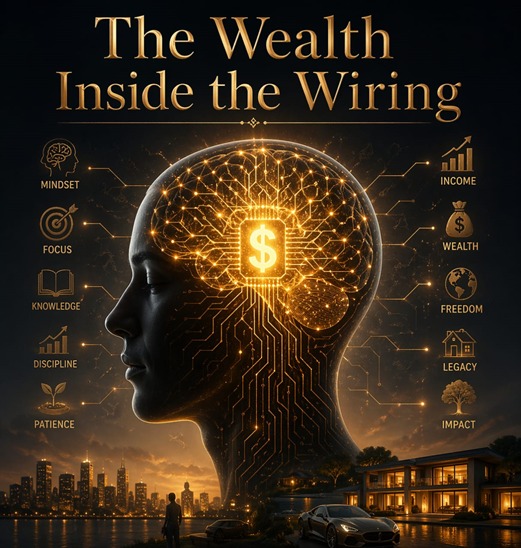
Nobody gets rich by accident. But very few people get rich by effort alone either. That uncomfortable gap between those two statements is where this essay lives.
We have spent generations celebrating the wrong thing about wealthy people. We applaud their results, study their habits, imitate their morning routines, and read their biographies as though proximity to their story will transfer some residue of their success. What we rarely do is look closely enough at what is actually happening inside them, the orientation, the specific way they process the world, that produces those results in the first place. We mistake the fruit for the root.
Consider what the word rich actually means in practice. Not the magazine version, not the inheritance version, but the version you encounter when you watch someone in their natural environment quietly accumulating advantage while everyone else around them is working just as hard and arriving at less. The person who enters a room and somehow leaves with more than they came with. The one whose resources seem to grow not just when conditions are favourable but also when they are not. What is actually happening there?
It is not simply intelligence. The world is full of brilliant people who die without ever converting that brilliance into material sovereignty. It is not education, not exclusively. And it is certainly not luck, at least not in the volume that luck-based explanations would require. Something else is at work. Something more durable and more specific, and it deserves a more precise language than we have given it.
Converting Conditions into Compound Advantage
In 1994, a young South African named Adrian Gore had an idea rooted in a simple but radical premise: that people who make healthy choices should pay less for insurance. The South African health system was not asking for this idea. No one had commissioned it. The conditions, medical inflation, a post-apartheid political transition, a population adjusting to a new national identity, were not obviously favourable. Gore looked at those same conditions and saw something trapped inside them.
He founded Discovery Health, and through a model that rewarded healthy behaviour with tangible financial benefits, built one of the most distinctive insurance businesses in the world. By any conventional analysis of the environment in the mid-nineties, you would not have launched a health insurer. He launched one and changed what health insurance meant globally.
This is what the first distinguishing capacity looks like in operation. Not problem-solving in the textbook sense, not identifying a gap and filling it, but something more metabolic. The capacity to absorb raw and often unfavourable conditions and convert them, steadily, into compounding advantage.
The metabolic metaphor is deliberate. A healthy metabolism does not require perfect inputs to produce energy. It works with what is available, extracts the maximum, and builds from there. The people who accumulate wealth at rates that separate them from their peers tend to have this quality not as a strategy they have learned but as an orientation they have internalised. They do not wait for conditions to improve before they move. They are already converting whatever exists.
You can observe this across cultures and industries. Aliko Dangote did not build Africa’s largest private fortune by waiting for Nigeria’s infrastructure to stabilise. He built cement plants and sugar refineries precisely because infrastructure was unstable, because the gap between what the country needed and what existed was enormous, and that gap was the condition he metabolised. The chaos was not an obstacle to his planning. It was his planning environment.
The less wealthy person, by contrast, tends to treat unfavourable conditions as a reason to pause. To wait for the signal that the moment is right. That pause, compounded over years, is a large part of the explanation for the divergence.
Rewriting What the Game Is
There is a particular kind of business story that gets told repeatedly, and it almost always contains this element: someone arrived at an industry they had not grown up in, looked at how the game was being played, and decided to play a different one entirely.
Reed Hastings did not try to build a better Blockbuster. He looked at what renting films had made people tolerate, the late fees, the trips to the store, the limited selection, and decided the entire delivery model was the problem rather than the content. Netflix, at its inception, was not a content company. It was a quiet declaration that the rules everyone else was playing by were optional.
Howard Schultz did not invent coffee. He went to Italy, watched what happened in an espresso bar, and came home convinced that Americans were not really buying coffee when they bought coffee. They were buying a pause, a place, a ritual. He reframed what was for sale. The product did not change. What changed was the definition of what the product was. Starbucks, whatever its current complications, built a global business worth billions not by making better coffee but by rewriting what coffee meant in daily life.
This reframing capacity is, in practice, the most financially explosive of the three. When you solve a problem inside the existing rules, you get rewarded within the existing reward structure. When you change what the rules are, you can define the reward structure itself. That is a different class of return. It is the difference between earning a large wage and setting wages.
What makes this rare is that it requires a particular quality of perception, the ability to look at what everyone has accepted as fixed and ask why it is fixed. Most people interact with the world as it presents itself. They accept the frame. The wealthy outlier, more often than not, is the one who questioned the frame and found that it had no real walls, only habits.
In Nigeria, the story of Tony Elumelu’s early years at Standard Trust Bank contains this quality in concentrated form. He inherited an institution with a weak balance sheet and a shrinking deposit base. Rather than competing for the same customers in the same ways the larger banks competed, he repositioned Standard Trust toward the corporate and commercial market, reshaped its risk appetite, and built a deposit base that made it competitive enough to engineer the merger that created United Bank for Africa. He did not fight the game. He changed what he was competing for.
Making Others the Engine
The wealthiest people in recorded history share one characteristic more reliably than any other. At some point, they stopped being the primary producer of value and became the convener of other people who produced it.
John D. Rockefeller’s genius was not refining oil. It was organising the oil industry in ways that concentrated its value toward the entity he controlled. Andrew Carnegie did not make steel with his hands. He built and managed systems of people, equipment, and supply chains that made steel at a scale no individual could approach. These are old examples, but the principle has not aged.
When Masayoshi Son raised the Vision Fund and began deploying capital into technology companies across the globe, he was not innovating in any product category. He was orchestrating. Aggregating capital, insight, and access in ways that allowed other people’s innovation to generate returns that flowed, in structure, back toward him. The fund itself became the product. The companies inside it were the engine.
This orchestration capacity is harder to develop than it might sound because it requires something that runs against most people’s instincts. It requires relinquishing control of execution while retaining influence over direction. It requires building trust at scale, making people want to produce inside your orbit, and structuring agreements in ways that align their interests with yours without diminishing their motivation. These are not financial skills. They are deeply human ones.
The person who cannot give away tasks is limited by the hours in their day. The person who orchestrates is limited only by the scale of the system they can build. That is not a small distinction. It is, in many cases, the entire explanation for the distance between a comfortable income and generational wealth.
What is interesting is that this capacity shows up as readily in informal economies as in corporate ones. The market trader in Lagos who does not carry goods herself but coordinates a network of runners, suppliers, and buyers, who knows what is selling in Alaba before the sellers in Alaba know it, and who takes a margin on every transaction her network touches, is doing the same thing Rockefeller did at a different scale. The principle is identical. The orchestration is the wealth.
Why These Three Are Rarely Taught
Schools teach skills. Self-help books teach habits. Business schools, at their best, teach frameworks for decision-making. But none of these are really what we have been describing. What we have been describing is not a curriculum. It is a way of being in the world, a set of dispositions so deeply held that they operate below the level of deliberate choice.
This is partly why the conventional wisdom about wealth creation, work hard, save well, invest consistently, is true but insufficient. Those practices describe a floor, not a ceiling. They describe the conditions under which you might not fall behind. They do not describe the conditions under which you separate.
The metabolic conversion of conditions, the rewriting of game rules, the orchestration of collective capacity, these are not things you do occasionally as tactics. They are things you are, consistently, as a disposition. And they tend to feed each other. The person who metabolises conditions well is also positioned to see where the rules of the game can be rewritten, because they are already working at a level of abstraction above the current situation. The person who has learned to orchestrate has already internalised that their leverage lies in alignment rather than individual effort.
This convergence is what makes the pattern durable. It is also what makes it look, from the outside, like luck or genius. Neither description is quite right. What it actually looks like, from the inside, is a coherent way of reading the world, one that produces compounding advantage not in spite of difficulty but sometimes precisely because of it.
The Provocation
The question this essay leaves you with is not whether these capacities are real. The evidence is too consistent for that to remain an open question. The question is whether they are learnable.
The honest answer is: partially. Some of this is temperament, and temperament is shaped early. But significant portions of it are teachable, because they are essentially attentional. They are about what you train yourself to look for. Whether conditions are raw material or roadblocks. Whether rules are given or optional. Whether your effort is the ceiling or merely the foundation.
Changing those orientations does not require genius. It requires sustained, uncomfortable attention to the assumptions you have built into your daily reading of the world. Most people, given an unpromising set of conditions, will wait. A small number will convert. That conversion, applied consistently over years, is the actual engine of the wealth that separates the few from the many.
It was never really about the money. It was about the wiring.