By Charles Obiajulu Ugwu -PhD
Consider the executive who stands before a town hall, speaking with conviction about the company’s values, its people-first culture, its commitment to doing the right thing while somewhere in that same building, or perhaps that same room, an employee is composing a Glassdoor review that says none of those things are true. That gap, between what an organisation proclaims and what the people living inside it actually experience, has always existed. What has changed, fundamentally and irreversibly, is that the gap is no longer private.
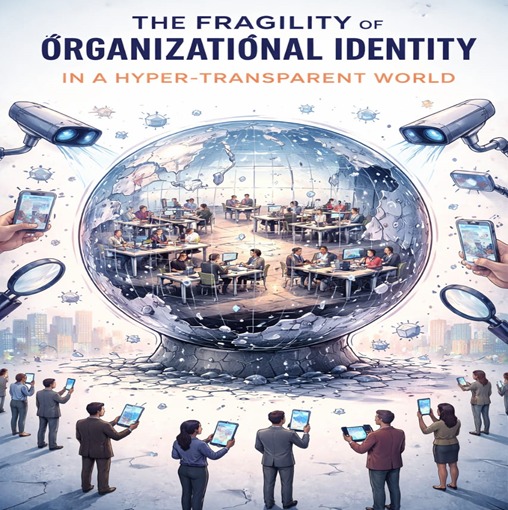
We are in an era that has stripped organisations of the luxury of managed distance. The polished annual report, the carefully worded press release, the strategic silence that once separated institutional declaration from operational reality none of these instruments work the way they once did. Employees broadcast culture in real time. Customers cross-reference values against supply chain records. Investigative journalists and citizen activists sit with leaked documents and algorithmic anomalies. In this environment, organisational identity is not what a company declares. It is what survives scrutiny. And for most organisations, the scrutiny never truly stops.
This is the defining condition of the modern institution: not merely that it can be watched, but that it is being watched, simultaneously, from every angle, by stakeholders who have both the tools and the motivation to look. For leaders who still think of reputation as something managed by communications departments, this is a disorienting reality. For those who understand that identity is built from the inside, it is something more clarifying than threatening though no less demanding.
Identity Has Always Been Contested. Now It Is Also Contested Publicly.
The theoretical foundations of organisational identity were laid by scholars Stuart Albert and David Whetten in 1985, who argued that an organisation’s identity consists of what is central, distinctive, and enduring about its character. It was a usefully stable concept for its time. But the conditions of that era limited information flow, concentrated media power, and the relative opacity of internal corporate life gave organisations considerable latitude in curating the distance between their claimed identity and their actual one. That latitude is gone.
Jane Dutton and Janet Dukerich’s 1991 study of the New York Port Authority offered an early and prescient insight into what happens when that distance collapses. They showed that when external audiences form a damaging image of an organisation, internal members feel it deeply and are moved to respond, often in ways that reveal far more about the organisation’s true character than any communications strategy intended. What they observed in the corridors of a public authority then is now playing out continuously, at scale, across every sector and geography. The construed external image what organisational members believe outsiders think of them has become a live and contested public artefact rather than a slowly-forming impression.
Research by Glassdoor shows that over 80 percent of job candidates research employee reviews before deciding where to apply, and that the average candidate reads at least six reviews before forming a view. More telling still is the finding that employee accounts are regarded as significantly more credible than statements made by the CEO. The organisation’s most carefully designed employer brand can, therefore, be dismantled not by competitors or critics, but by its own people describing their experience honestly.
This is not primarily a recruitment problem, though it manifests there. It is an identity problem. When internal experience consistently contradicts external identity claims, the organisation is not suffering a communications failure. It is suffering a coherence failure and coherence is what organisational identity, at its core, is made of.
When the Gap Becomes a Chasm: Volkswagen and the Physics of Exposure
Few corporate crises in recent memory illustrate the mechanics of identity collapse quite as clearly as the Volkswagen emissions scandal, which became public in September 2015 when the United States Environmental Protection Agency confirmed that the company had programmed approximately eleven million diesel vehicles worldwide to detect laboratory testing conditions and activate emissions controls only in those moments. In normal driving, the same vehicles emitted nitrogen oxides at levels up to forty times above the permitted American standard. The defeat device was not a localised malfunction. It was a deliberate engineering decision, deployed across a decade, across markets, and across a company that had spent years marketing itself as an environmental leader in the automotive industry.
The financial consequences were severe: over thirty billion dollars in fines, settlements, and vehicle buyback costs; a 20 percent drop in sales in key markets by the end of that year; the CEO’s resignation within days of disclosure. But the more structurally important damage was to the company’s identity. Volkswagen had presented itself, consistently and publicly, as a pioneer in clean technology. Its vehicles had received green car awards. Its advertising campaigns spoke proudly of clean diesel. The defeat device made those claims not merely inaccurate but fraudulent and fraudulent not just in a technical regulatory sense, but in the deeper sense that the company had known the truth and chosen to conceal it.
Research conducted in the aftermath found that the identity damage spread well beyond Volkswagen itself. German automakers with no connection to the fraud suffered measurable declines in sales and stock returns in the United States as scrutiny of the phrase ‘German engineering’ intensified. Volkswagen’s failure became a reputational tax on an entire manufacturing tradition. Identity damage, in a hyper-transparent world, does not observe corporate or sectoral boundaries with precision.
The INSEAD case study examining the scandal from inside identified the cultural preconditions: autocratic leadership, siloed structures that prevented the cross-departmental communication necessary to flag ethical concerns, and incentive systems designed to reward outcomes while insulating the organisation from questions about means. The University of Darden’s analysis pointed to the same cluster of factors, noting that the company’s culture made it structurally difficult for engineers to raise concerns about practices that senior leadership preferred not to interrogate. This is the anatomy of most identity crises in large organisations. The gap between stated values and operational reality does not usually appear overnight. It is constructed gradually, maintained through institutional silence, and protected by a culture in which asking certain questions carries personal cost.
Volkswagen’s subsequent recovery a genuine shift toward electric mobility, cultural reforms including open forums where employees and managers across all levels could discuss institutional failures is instructive. Recovery required not better communications, but operational transformation that was visible and sustained. The company could only begin to reconstitute its identity from the rubble of what disclosure had revealed. That is not a communications lesson. It is a governance lesson, and a cultural one.
Africa Is not watching from the sidelines
The pressures of hyper-transparency are not a Western preoccupation being imported into the African context. They are felt directly, urgently, and with particular intensity in markets where institutional trust was already fragile and where the expectations placed on corporations foreign and domestic alike extend well beyond shareholder returns. The cases that have defined African corporate life in the past decade make this plain.
In Nigeria, the crisis that engulfed MTN in 2015 carried all the hallmarks of an identity fracture at scale. The Nigerian Communications Commission issued an initial fine of $5.2 billion after a compliance audit found that MTN had failed to disconnect approximately 5.2 million improperly registered SIM cards by the regulatory deadline, at $1,000 per unregistered SIM under the Telephone Subscribers Regulation. What made this more than a regulatory dispute was the context in which it landed. President Muhammadu Buhari publicly connected the unregistered SIM issue to national security, noting that Boko Haram had exploited unregistered lines across a period in which at least 10,000 Nigerians had been killed by the insurgency. MTN’s operational negligence was not framed as a compliance gap. It was framed as proximity to violence.
The company’s CEO resigned. Diplomatic engagement between the governments of Nigeria and South Africa produced a negotiated reduction in the fine, ultimately settled at approximately $1.7 billion paid in instalments. MTN undertook a biometric re-registration exercise that captured over 70 million subscriber records in ten days. It subsequently listed on the Nigerian Stock Exchange as a gesture of genuine corporate citizenship. The identity question underlying all of this was sharp: was MTN, which had publicly positioned itself as a partner in African development, actually operating as a responsible institution in the communities it served? The answer that the compliance failure suggested was uncomfortable, and the Nigerian government, its regulators, and its public made certain the company heard it clearly.
MTN’s recovery, including subsequent recognition as a corporate governance leader on the continent, did not come from rebranding. It came from demonstrably changed behaviour from structures built to prevent the same failure, and from a willingness to engage with host governments and communities on genuinely reciprocal terms. The brand followed the behaviour. It always does.
South Africa’s Steinhoff International scandal, which broke in December 2017, stands as the largest corporate fraud in South African business history. Steinhoff, a global retail holding company listed on both the Johannesburg and Frankfurt stock exchanges, had spent years projecting an identity of growth, rigour, and financial sophistication. On 5 December 2017, its CEO Markus Jooste resigned and the board acknowledged accounting irregularities that a PwC investigation later confirmed were massive: fictitious and irregular transactions totalling approximately $7.4 billion across eight years, inflating profits and overstating asset values. The share price fell more than 95 percent. Nearly R200 billion in shareholder value was destroyed, affecting pensioners, ordinary investors, and the Government Employees Pension Fund. Some have described it, with reasonable accuracy, as South Africa’s Enron.
What makes Steinhoff particularly instructive is the duration of the deception. Serious red flags had been visible since at least 2013, and German prosecutors had opened an inquiry in September 2015 two years before the collapse. Researchers who applied standard fraud detection models to the company’s financials across that period found that due diligence guidelines would have identified warning signs that were, for reasons investigations continue to probe, not acted upon. The gap between Steinhoff’s projected identity and its operational reality was not the work of a moment. It was maintained across years through governance failures at board level, audit failures that sophisticated global banks subsequently found had cost them significantly, and a culture in which institutional honesty was crowded out by the ambitions of a small group of executives.
Kenya’s Imperial Bank collapse in October 2015 provides a third portrait. Abdulmalek Janmohamed, the bank’s founder and managing director, ran an elaborate fraud from within the institution he had created in 1992, directing the transfer of over Sh34 billion forensic investigations placed the embezzled total closer to Sh44.8 billion into fictitious accounts linked to shell companies across thirteen years. A whistleblower notified the Central Bank of Kenya of the scheme as early as 2012. No action was taken for three years. When Janmohamed died in September 2015, the scheme he had personally maintained unravelled almost immediately. Depositors were frozen out. More than ten thousand jobs were lost across the Kenyan banking sector as Imperial, Dubai Bank, and Chase Bank all collapsed in rapid succession.
Imperial Bank’s public identity was that of a growing, responsible mid-tier financial institution. Its operational reality was a parallel universe of off-ledger transactions, backdated entries, and a managing director whose personal authority had long displaced any meaningful governance structure. The institution was not what it said it was, and had not been for over a decade. The moment the human force field of its founder’s personality was removed, the truth had nowhere left to hide.
The Eskom Lesson: When Capture Hollows an Institution
Perhaps the most comprehensive African case study in organisational identity collapse is the Eskom saga in South Africa, documented in detail through the Zondo Commission’s inquiry. Eskom, the state-owned power utility, had a clear institutional identity: provider of affordable electricity, strategic asset of national development, an organisation of engineers and public servants committed to keeping South Africa’s lights on. That identity was, for a substantial period, real.
What the GuptaLeaks with hundreds of thousands of documents and emails released to the public in early 2017 revealed was an organisation that had been systematically hollowed from within. Senior board members held undisclosed, repeated communications with Gupta family associates about contract awards and executive appointments. A coal contract awarded to Tegeta Exploration and Resources, a Gupta-affiliated entity, was prepaid by Eskom at a time when Tegeta needed cash to complete the purchase of Optimum Coal Mine a transaction that benefited no party except the Guptas and had been enabled by executive decisions made inside Eskom. Audit independence was compromised. Procurement was manipulated. Governance structures were bent to serve the capture project. For years, the organisation continued to project the language of public service. The leaked documents made the distance between that language and actual behaviour measurable, documented, and undeniable.
The consequences were not only institutional. Rolling blackouts across South Africa became a national crisis, costing the economy billions annually and affecting the lives of ordinary citizens in ways traceable directly to the period when Eskom’s operational integrity was traded away. Identity failure at an institution of that scale is not a corporate governance abstraction. It is measured in hours without power, in businesses that cannot operate, in communities that fall behind.
The Eskom case adds a dimension that the others do not fully capture: the deliberate engineering of identity decay from outside the institution. State capture did not merely exploit weak governance. It actively recruited and installed people whose role was to ensure that the institution’s stated identity and its operational reality moved as far apart as possible. In this sense, Eskom is a warning about what happens when identity resilience is not just neglected but targeted. An institution with genuinely strong internal culture, honest governance, and embedded accountability mechanisms is much harder to capture. The vulnerability was created by the hollowing. The hollowing was preceded by the drift.
What Patagonia Understands That Most Organisations Do Not
Against this panorama of identity failure, Patagonia stands as a genuinely instructive counterpoint not as a flawless organisation, but as one that has understood something about identity integrity that most institutions have not. When founder Yvon Chouinard transferred ownership of the company to a trust and non-profit structure in 2022, committing all future profits to climate action and declaring that the earth was now the company’s only shareholder, the world’s media treated it as a remarkable corporate event. Patagonia’s own employees were not surprised. It was legible within the cultural grammar they had been living inside for decades.
Patagonia’s identity is not managed through communications. It is encoded in operational decisions that are consistent enough, over time, to constitute institutional character rather than brand positioning. The company has bailed employees out of jail for participating in environmental protests, covering legal fees and lost time. It actively discourages customers from buying new products through campaigns that calculate the environmental cost of excess consumption. It switched to more expensive organic cotton even when doing so raised costs and constrained margins. These are not marketing gestures. They are the residue of an organisation that actually does what it says it will do.
Even Patagonia has faced the test of visible contradiction. During the pandemic, supply chain disruptions forced the company to rely on air freight for a significant portion of its inventory, a direct deviation from its commitment to low-emission logistics. Employees raised the contradiction. Leadership explained the decision honestly, situated it within the logic of organisational survival and long-term impact, and continued holding itself accountable to the same framework that made the tension visible. This is not the absence of contradiction. It is the transparent management of it and it is precisely this transparency that preserves identity rather than exposing it as performance.
Patagonia is not trusted because it is perfect. It is trusted because the gap between what it says and what it does is small enough, and its willingness to address the gap when it widens is consistent enough, that stakeholders have learned to believe it. Trust, in the end, is not a communications outcome. It is a behavioural one.
Building Identity That Holds: What Leaders Actually Control
The temptation when confronting the pressures of hyper-transparency is to treat the problem as one of better perception management. This is the wrong diagnosis, and it leads organisations toward a strategy more polished messaging, faster crisis response, tighter media management that accelerates rather than arrests the problem. When the contradiction between stated identity and lived experience is real, faster communication about that identity makes the contradiction more visible, not less.
What leaders actually control is the operational culture from which identity emerges. Culture is not the values on the wall. It is what happens when values meet incentives. It is what a manager does when a team member raises a concern that is inconvenient for a quarterly target. It is what an organisation rewards, actually, when it says it rewards integrity. It is whether the people who ask hard questions from the inside are protected or marginalised. In Volkswagen, the culture made it professionally unwise to flag the defeat device. In Imperial Bank, the managing director’s authority was so total that governance checks atrophied. In Eskom, the culture was deliberately engineered to make compliance with Gupta-linked directives the path of least resistance. In all three cases, the cultural failure was not hidden from the people inside the organisation. It was the external world that was kept in the dark, and only a matter of time before the dark was illuminated.
Organisations that build identity resilience do so through practices that are less glamorous than brand strategy but far more durable. They close the loop between stated values and operational systems, so that the things they say they value are reflected in what gets rewarded, measured, and funded. They create pathways for internal dissent that are structurally protected, so that the earliest signals of identity drift surface before they become crises. They build governance that is genuinely independent rather than ceremonially so, meaning that board oversight, audit functions, and executive accountability operate with real authority. And they engage regularly and honestly with the distance between their aspirations and their current performance, treating that distance as information rather than embarrassment.
South Africa’s King IV Report on Corporate Governance, Nigeria’s Securities and Exchange Commission Corporate Governance Code, and Kenya’s revised Companies Act all reflect a regional and continental recognition that institutional integrity is an operational matter rather than a reputational one. They are imperfect instruments, applied unevenly and enforced with variable rigour. But they signal a shared understanding: the health of an institution’s identity is a matter of governance, not of communications.
The Standard Has Changed. The Question Is Whether Organisations Have
There is a social argument embedded in the transparency revolution that deserves to be stated plainly. The demand that organisations be what they say they are is not a market trend or a stakeholder relations challenge. It is an ethical demand, made by employees who spend their working lives inside institutions, by communities who depend on those institutions, and by citizens who understand that corporate behaviour at scale shapes the world they inhabit. The frustration that drives a Glassdoor review, an employee leak, or a regulatory complaint is not, in most cases, malicious. It is the frustration of people who were told one thing and experienced another, and who live in a moment when the tools to say so publicly are available to everyone.
The organisations that survive and lead in this environment will not be those that become better at perception management. They will be those that close the gap not to zero, because no organisation closes it to zero, but to a degree that is visible, honest, and continuously worked on. Closing the gap is not a communications project. It is a leadership project, a culture project, a governance project. It is the work of building institutions that are, in their daily operational reality, recognisably aligned with what they claim to stand for.
Identity in a hyper-transparent world is not what an organisation declares once, in a strategy document or a CEO address or a brand manifesto. It is what the organisation demonstrates, repeatedly, in the decisions that are most inconvenient to get right. The organisations that understand this are not merely better communicators, or better managed in the conventional sense. They are, over time, simply more honest with themselves. In the current environment, that honesty is not a moral luxury. It is the most durable competitive advantage an organisation can possess.
About the Author
Charles is a contrarian thinker and leadership strategist working at the intersection of organisational development, human capital strategy, and the future