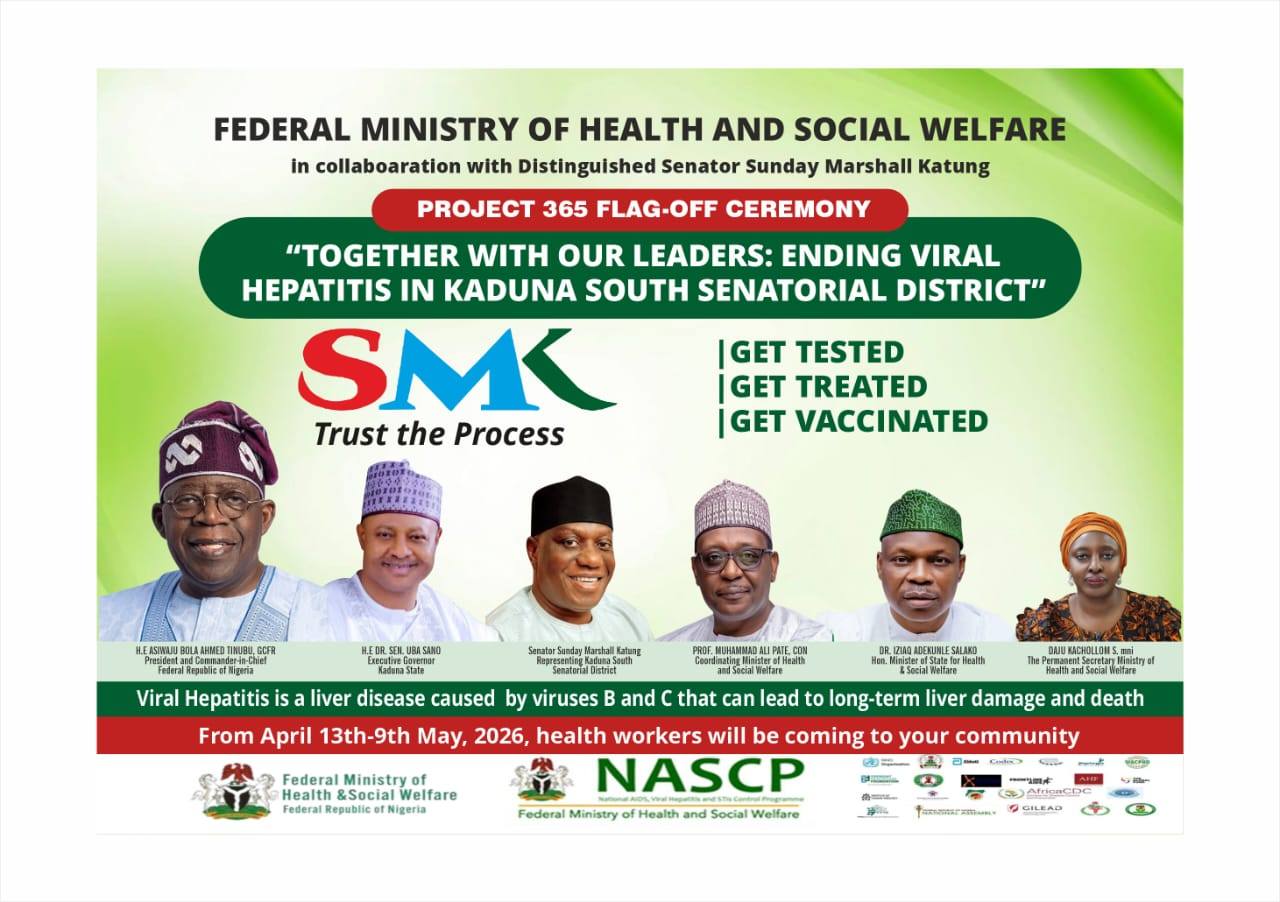
In a defining moment for grassroots healthcare delivery in Kaduna State, Sunday Katung has unveiled an ambitious public health campaign known as “Project 365,” a year-round intervention designed to combat and ultimately eliminate viral hepatitis across communities in Southern Kaduna.
The initiative, launched on Friday in the bustling town of Kafanchan, marks a significant collaboration between the senator’s office and the Federal Ministry of Health and Social Welfare. With a target population of over 620,000 residents, Project 365 seeks to bridge long-standing gaps in healthcare access by bringing essential services directly to the people.
The official flag-off ceremony, held at New Choice Hotel, was attended by government officials, healthcare professionals, and community leaders. Representing Uba Sani, the Deputy Governor, Hadiza Balarabe, described the programme as both timely and transformative.
Standing before a crowd of hopeful residents, Balarabe emphasised the urgency of addressing viral hepatitis, a silent but deadly disease that has continued to affect thousands across Nigeria. She noted that Project 365 aligns closely with the state government’s broader health sector reforms, which aim to improve healthcare delivery, expand access, and strengthen disease prevention systems.
“This intervention is not only timely but deeply people-centred,” she said. “It reflects a commitment to ensuring that every citizen, regardless of location or income, has access to quality healthcare services.”
At its core, Project 365 is built around a comprehensive approach to tackling hepatitis. Unlike previous efforts that often focused on isolated aspects of care, this initiative integrates screening, diagnosis, treatment, vaccination, and prevention into a single, continuous framework. By doing so, it aims to create a seamless healthcare experience for residents, from early detection to long-term management.
For many communities in Southern Kaduna, access to such services has historically been limited. Rural areas, in particular, have faced challenges ranging from inadequate healthcare infrastructure to a shortage of trained medical personnel. As a result, diseases like hepatitis often go undiagnosed until they reach advanced stages, with devastating consequences for individuals and families.
Senator Katung, in his remarks, highlighted the human cost of these gaps, stressing that Project 365 is as much about saving lives as it is about restoring dignity. He spoke of families affected by preventable illnesses and the need for a system that prioritises early intervention.
“We cannot continue to lose lives to diseases that are both preventable and treatable,” he said. “Project 365 is our commitment to changing that narrative—every day of the year, for every member of our community.”
Healthcare professionals involved in the programme explained that viral hepatitis, particularly types B and C, remains a major public health concern in Nigeria. Often transmitted through infected blood or bodily fluids, the disease can lead to chronic liver conditions, including cirrhosis and liver cancer, if left untreated. Yet, with proper screening and vaccination, many cases can be prevented or managed effectively.
Under Project 365, mobile clinics and outreach teams will be deployed across the senatorial district, bringing services closer to underserved populations. Community engagement will also play a key role, with awareness campaigns aimed at educating residents about transmission, prevention, and the importance of early testing.
The involvement of the Federal Ministry of Health and Social Welfare adds a layer of institutional support that stakeholders believe will enhance the programme’s sustainability. By aligning with national health policies and leveraging federal resources, Project 365 is positioned not just as a local initiative, but as a model that could be replicated in other parts of the country.
For residents of Southern Kaduna, the launch of the programme has sparked a renewed sense of hope. Many see it as a turning point—an opportunity to address long-neglected health challenges and build a healthier future for their communities.
Community leaders at the event expressed optimism that the initiative would not only reduce the burden of hepatitis but also strengthen trust in the healthcare system. They called for continued collaboration between government, healthcare providers, and local stakeholders to ensure the programme’s success.
As the first phase of Project 365 gets underway, attention will be focused on its implementation and impact. The scale of the initiative presents both opportunities and challenges, but its vision is clear: a Southern Kaduna where no one suffers or dies from a preventable disease.
In a region where access to healthcare has often been a privilege rather than a guarantee, Project 365 stands as a bold declaration—that every life matters, every community counts, and every day presents a chance to make a difference.