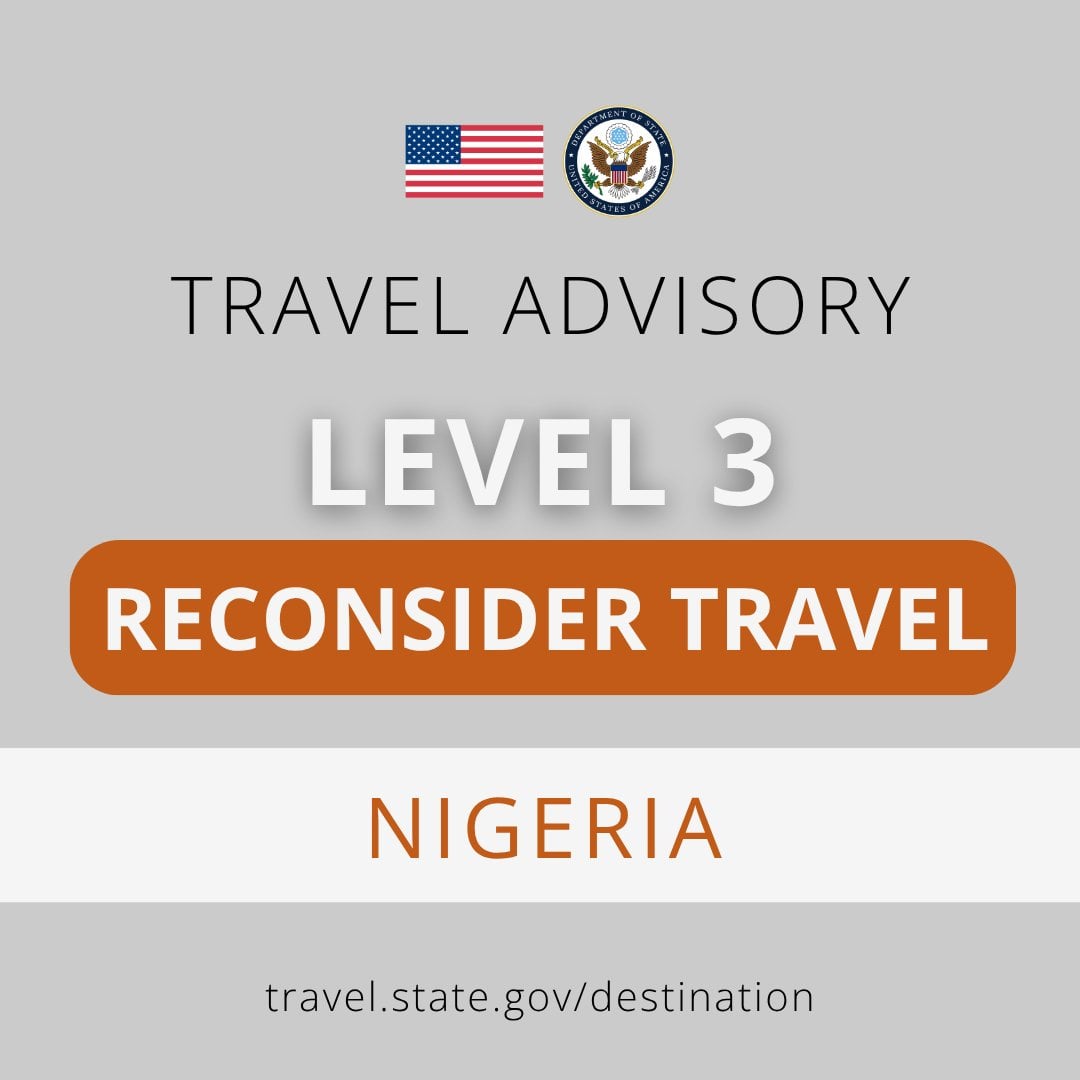
The United States Department of State has taken a significant step in response to rising insecurity in Nigeria, authorising the departure of non-emergency government personnel and their families from the American Embassy in Abuja. The move, announced in an updated travel advisory on Wednesday, underscores growing international concern over the safety situation in Africa’s most populous nation.
According to the advisory, the decision took effect from April 8, 2026, and reflects what US officials described as a “deteriorating security situation” marked by increasing incidents of crime, terrorism, kidnapping, and civil unrest. The development has sent ripples through diplomatic and security circles, highlighting the urgency of addressing Nigeria’s complex security challenges.
The US government classified Nigeria under “Level 3: Reconsider Travel,” a designation that urges American citizens to carefully evaluate the risks before planning any visit. More concerning, however, is the expansion of “Level 4: Do Not Travel” areas, the highest warning category, which now includes a total of 23 states.
Among the newly added states to this list are Plateau, Jigawa, Kwara, Niger, and Taraba—regions that have in recent years experienced varying degrees of insecurity, from communal clashes to armed banditry and insurgent activity. The advisory strongly discourages travel to these areas, citing the potential for life-threatening situations.
Security analysts note that this latest action by the United States is not an isolated response but part of a broader pattern of international concern. Over the years, several countries have periodically updated their travel advisories for Nigeria, often pointing to similar issues—ranging from violent crime in urban centres to insurgency in the northeast and banditry in the northwest.
At the heart of the current concerns is the cumulative effect of multiple security threats occurring simultaneously across different regions. In the northeast, remnants of insurgent groups continue to stage attacks, while in the northwest and north-central regions, banditry and kidnapping for ransom have become persistent challenges. Meanwhile, some southern regions grapple with cult-related violence and separatist tensions.
For American citizens living or working in Nigeria, the advisory serves as both a warning and a guide. The authorisation for voluntary departure allows embassy staff and their families to leave the country without penalty, particularly those whose roles are not deemed critical to ongoing diplomatic operations. Essential personnel, however, are expected to remain to ensure the continued functioning of the embassy.
The US Embassy in Abuja, a key diplomatic hub, has historically played a vital role in fostering bilateral relations between Nigeria and the United States. While the current decision does not signal a complete withdrawal, it reflects a cautious approach aimed at safeguarding lives amid uncertain conditions.
Nigerian authorities have yet to issue a formal response to the updated advisory, but past reactions to similar actions have often emphasized the government’s ongoing efforts to combat insecurity. Officials frequently highlight military operations, intelligence-sharing initiatives, and community-based interventions designed to restore peace in affected areas.
However, critics argue that more needs to be done. Civil society groups and policy experts have consistently called for a comprehensive strategy that addresses not only the symptoms of insecurity but also its root causes—such as poverty, unemployment, and weak governance structures.
For businesses and investors, the advisory may also carry economic implications. Travel warnings of this magnitude can influence foreign investment decisions, disrupt business operations, and affect Nigeria’s global image. Multinational companies operating in high-risk areas may reassess their security protocols or scale down operations temporarily.
Despite these challenges, many Nigerians continue to go about their daily lives with resilience, adapting to the realities of their environment. From bustling markets in Lagos to farming communities in the north, the spirit of determination remains evident, even in the face of adversity.
As the situation evolves, the focus will likely remain on how both Nigerian authorities and international partners respond to the growing concerns. For now, the message from the United States Department of State is clear: caution is paramount, and safety must come first.
The coming weeks may prove critical in determining whether conditions improve or whether further measures will be required. Until then, the advisory stands as a stark reminder of the security realities facing Nigeria—and the urgent need for lasting solutions.