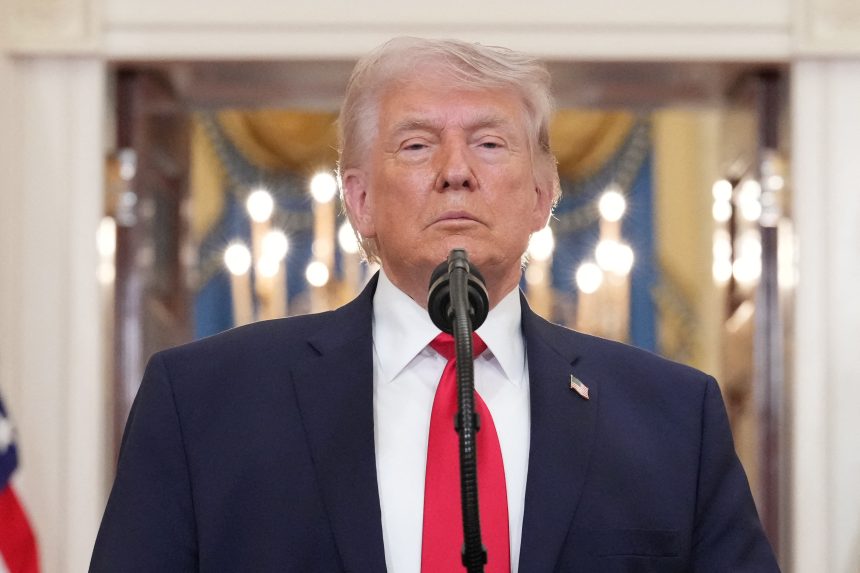
Fresh controversy has erupted in international circles after United States President Donald Trump accused a major American broadcaster of relying on what he described as a “fake news site from Nigeria” in its reporting on Iran’s reaction to a recently announced ceasefire.
The claim, made on Trump’s Truth Social platform on Wednesday, has not only intensified his long-running feud with the media but has also unexpectedly drawn Nigeria into a global conversation about credibility, information warfare, and the role of international journalism.
The dispute began shortly after the President announced a two-week ceasefire agreement between the United States and Iran—a move that had already triggered mixed reactions worldwide. While the ceasefire was broadly welcomed as a step toward de-escalation, competing narratives quickly emerged regarding who had gained the upper hand in the standoff.
A report aired by CNN cited a statement attributed to Iranian sources suggesting a form of victory or strategic advantage. Trump, however, strongly rejected the report, dismissing it as false and accusing the network of knowingly spreading misinformation.
“The alleged statement put out by CNN World News is a fraud, as CNN well knows,” Trump wrote, doubling down on his criticism of the media outlet. He further alleged that the report was sourced from a Nigerian-based platform he described as unreliable, though he did not specify the outlet in question.
The remarks quickly sparked debate across multiple fronts. Media analysts questioned the basis of the President’s claim, noting that no clear evidence had been presented to support the allegation. Others raised concerns about the broader implications of labeling foreign media sources as “fake” without substantiation, particularly in an era where misinformation is already a global challenge.
For Nigeria, the mention—though vague—has placed its media landscape under unexpected scrutiny. The country is home to a vibrant and diverse press ecosystem, ranging from established national dailies to emerging digital platforms. While issues of misinformation are not unique to Nigeria, critics argue that sweeping generalizations risk undermining the credibility of legitimate journalism.
Diplomatic observers also note that such statements, even when made in the context of domestic political disputes, can carry international consequences. By referencing a “fake news site from Nigeria,” Trump’s comments have inadvertently introduced a diplomatic dimension, raising questions about how countries are portrayed in global narratives.
Meanwhile, the controversy has added another layer to the already complex aftermath of the ceasefire. Competing claims about the outcome of the agreement reflect deeper tensions between Washington and Tehran, where information is often used as a strategic tool alongside military and diplomatic measures.
Within the United States, reactions have followed familiar partisan lines. Supporters of the President have echoed his skepticism toward mainstream media, arguing that networks like CNN have a history of bias. Critics, on the other hand, view the latest remarks as part of a broader pattern of undermining press freedom and deflecting scrutiny.
Internationally, the focus remains on the fragile ceasefire and the urgent need for sustained diplomacy. Yet the media controversy underscores how narratives—whether accurate or disputed—can shape perceptions and influence the course of events.
As the debate continues, one thing is clear: in today’s interconnected world, information travels fast, and its impact can be as significant as the events it describes. Whether the claims made by the President will be substantiated or fade into the background of ongoing political discourse remains to be seen.
For now, the episode serves as a reminder of the powerful intersection between politics, media, and global perception—where a single statement can spark conversations that cross borders and redefine narratives far beyond their point of origin.