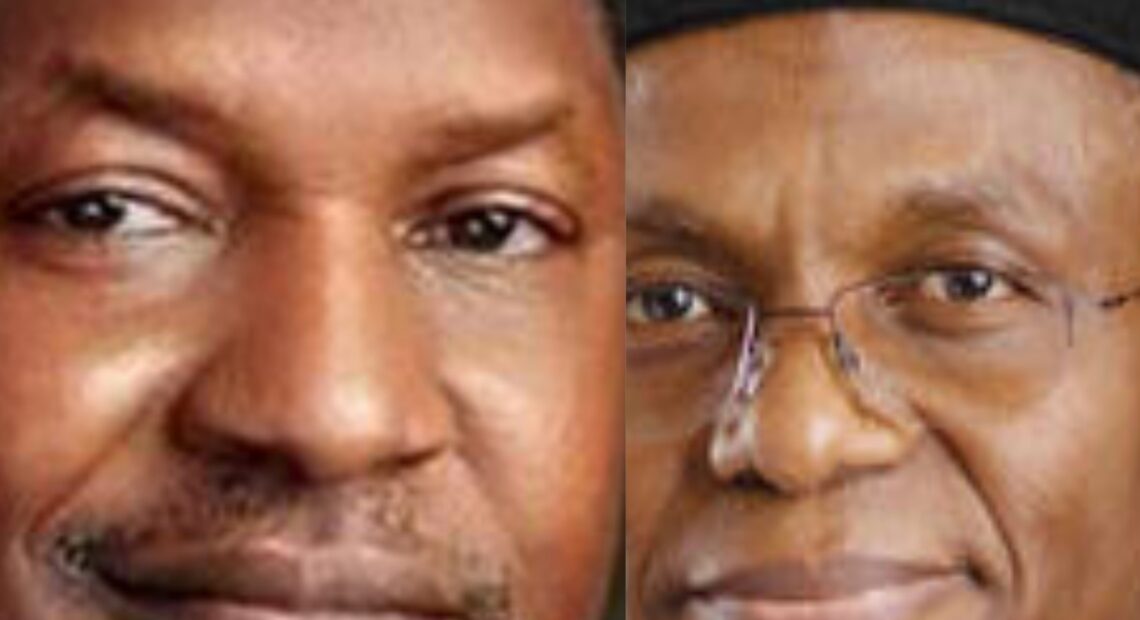
NASIR El-Rufai and Abubakar Malami are suddenly the objects of public pity in some corners of Nigeria’s political commentariat. Yes, my default ideological temperament is to empathise with and fight for the underdog. But El-Rufai and Malami are no underdogs. They are merely (temporarily) subdued top dogs whose canine viciousness is only momentarily at bay but will recrudesce should they get back in the saddle of power and influence.
They deserve due process because everyone does. But they deserve no canonisation, because neither has earned it.
Their defenders, some of whom have urged me to intervene on their behalf in line with my record of defending the oppressed, say they are victims of President Bola Ahmed Tinubu’s selective justice. I don’t dispute that. Since not even a single manifestly and self-evidently corrupt, Tinubu-supporting APC member is being tried for corruption, it’s entirely reasonable to assume that had El-Rufai and Malami chosen to remain in the APC, they would have been shielded from any legal consequences for their well-documented abuse of power.
Nonetheless, their immediate past history of similar selectivity and invidiousness against opponents and underdogs strips them of consideration for compassion, at least from me. El-Rufai and Malami were no apostles of compassion and due process.
They are now learning, from the wrong end of the stick, what they normalised, defended and inflicted on others when they predominated over the political landscape.
Of course, I don’t expect the folks in the ADC, in whose flock El-Rufai and Malami now fly, to mirror my position. Still, the morally serious response to this moment cannot be to pretend that what is happening to them descended from a moral vacuum.
Even the rhetoric of their defenders is revealing. The ADC has not said El-Rufai and Malami had spotless public records. It has instead said, correctly, that justice should not be selective. Fair enough. But selective justice is precisely the moral and political ecology in which both men flourished luxuriantly just a few years ago. What their defenders demand for them today is what they often denied others yesterday.
Take El-Rufai first. As FCT minister, he earned well-deserved notoriety for cruel, unjust Abuja demolitions and forced evictions on a scale that human rights groups found unacceptably staggering. That is why he is known as “Mai Rusau”, which means the demolisher, among Hausa-phone northern Nigerians. It is similar to his English moniker, “Mr. Demolition”.
On May 15, 2008, for instance, Reuters reported that nearly one million residents had been evicted from their homes in Abuja between 2003 and 2007 as part of the restoration of the city’s so-called master plan. It noted that El-Rufai said he had “no apology” for the demolitions.
You may support urban planning enforcement if you like, but the ruthlessness and human cost of those actions were early glimpses of the governing philosophy that made El-Rufai who he is: power first and only, compassion be damned.
His years as Kaduna governor made the pattern more nakedly political. I have written copiously on this and won’t repeat what I have written. Suffice it to say that he hunted and hounded opponents, including powerless people whose only strength derived from their ability to raise their voices against his tyranny, with a ruthlessness that has no parallel in the history of Kaduna State.