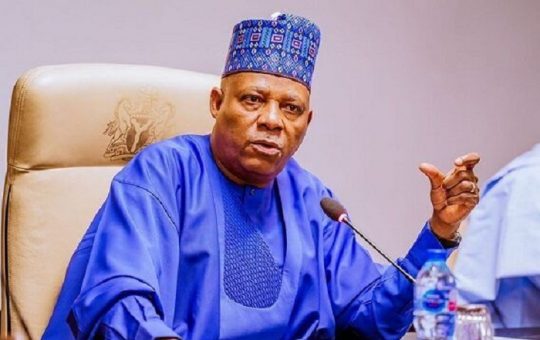
Vice President Kashim Shettima has charged members of the National Council on Skills (NCS) to ensure that Made-in-Nigeria products and services attain and sustain world-class standards, as part of broader efforts to accelerate the country’s industrialisation agenda.
Speaking on Thursday while chairing the 8th meeting of the council at the Presidential Villa, Abuja, the Vice President called on stakeholders across federal ministries, state governments, and the private sector to harness the innovative energy of Nigerians to power ongoing economic transformation.
Shettima emphasised that Nigeria possesses immense human capital and creative potential, noting that the ingenuity of its people—evident in workshops, classrooms, and informal sectors—must be deliberately channelled into building globally competitive products and services.
According to him, the country’s industrial future depends not only on policies and infrastructure but also on the quality of skills development and the ability to translate local innovation into commercially viable outputs that can compete on the global stage.
He noted that many Nigerian artisans, technicians, and young innovators are already demonstrating remarkable creativity, often producing solutions under challenging conditions. However, he stressed that without structured support, standardisation, and access to markets, such efforts may not reach their full potential.
The Vice President urged the council to focus on creating frameworks that would enhance skills acquisition, certification, and quality assurance, ensuring that Nigerian products meet international benchmarks. He said achieving this would boost confidence in locally made goods, reduce dependence on imports, and strengthen the country’s economy.
Shettima also highlighted the importance of collaboration between government institutions and the private sector, stating that sustainable industrial growth requires synergy among all stakeholders. He called for stronger partnerships that would link training institutions with industry needs, thereby ensuring that graduates possess relevant and market-ready skills.
He further stressed the need to modernise technical and vocational education, describing it as a critical pillar for economic development. According to him, investing in skills development would not only drive industrialisation but also address unemployment by equipping young Nigerians with practical abilities that can generate income.
The Vice President noted that Nigeria’s informal sector, which employs a large percentage of the population, should not be overlooked. He said policies must be designed to integrate informal workers into the formal economy by providing training, certification, and access to financing.
In addition, he called for the promotion of innovation hubs and entrepreneurship programmes that would support startups and small businesses in scaling their ideas into competitive enterprises. He emphasised that Nigeria’s economic transformation must be driven from the grassroots, where creativity and enterprise are most abundant.
Participants at the meeting included representatives from key ministries, state governments, and private sector organisations, all of whom were urged to align their efforts with the national vision of building a skilled and competitive workforce.
Observers say the Vice President’s remarks reflect the federal government’s renewed focus on skills development as a driver of economic growth and industrialisation.
They note that improving the quality of Nigerian products and services is essential for increasing exports, attracting investment, and enhancing the country’s global competitiveness.
The push for world-class standards also aligns with ongoing efforts to diversify the economy away from oil dependence and promote manufacturing, technology, and services as key growth sectors.
As deliberations at the council continue, stakeholders are expected to develop actionable strategies that will translate the Vice President’s vision into measurable outcomes, ensuring that Nigerian talent and innovation are effectively harnessed for national development.
For many Nigerians, the message is clear: the country’s path to industrialisation lies not just in resources, but in the skills, creativity, and determination of its people—qualities that, if properly supported, could position Nigeria as a major player in the global economy.