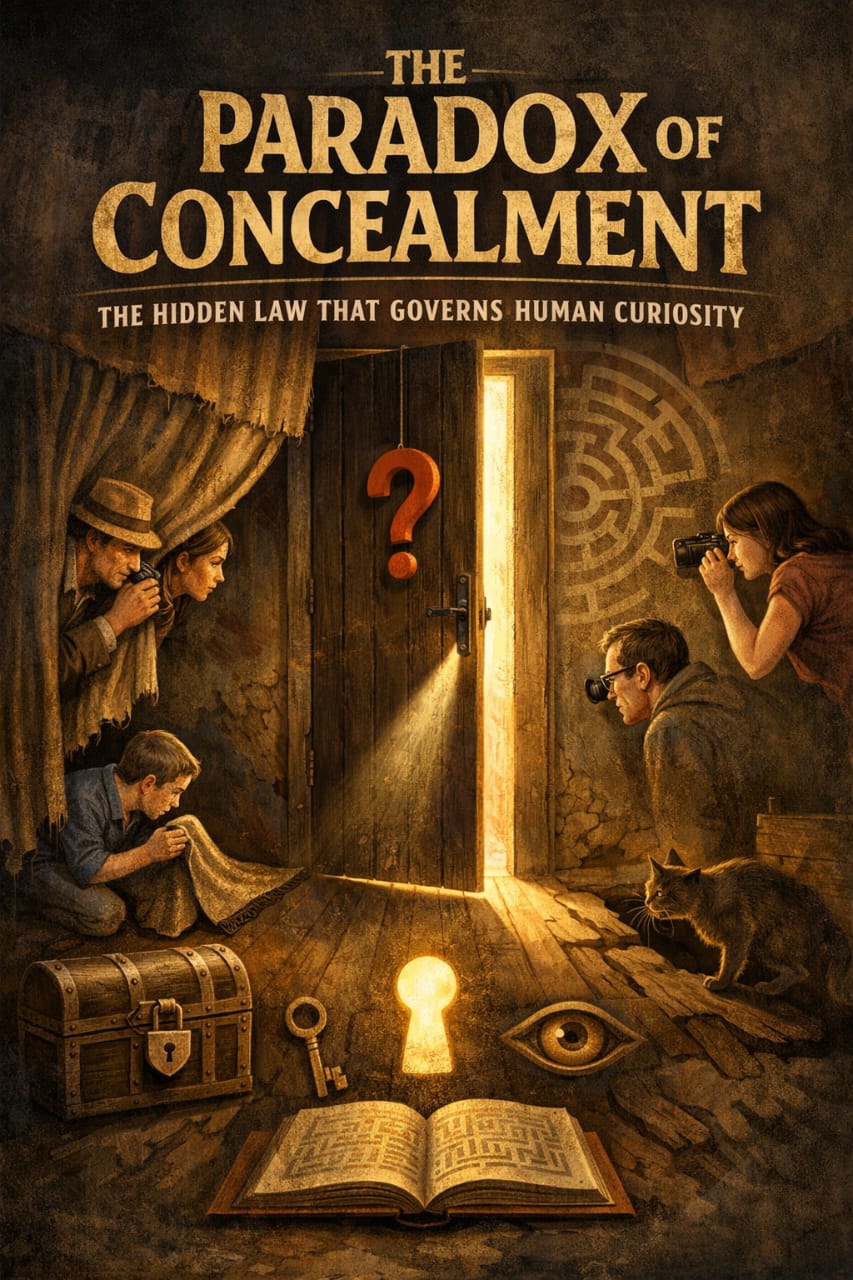
What locked doors, disaster headlines, and the human heart have in common and what it reveals about the secret logic of the human mind.
By Charles Obiajulu Ugwu-PhD
There is something nobody has properly named yet. It sits at the intersection of curiosity and dread, of fascination and repulsion, of the things we say we value and the things we cannot stop thinking about. It has been operating quietly inside every human being who has ever slowed down while driving past an accident, every child who has pressed an ear against a closed door, every person who clicked on a disturbing headline at midnight when they had work in the morning. It is older than language, deeper than culture, and far more universal than most psychological theories dare to claim. And yet, remarkably, it has no name.
This essay is an attempt to look it directly in the face.
The Locked Room
In 1697, Charles Perrault published a fairy tale about a wealthy man with a blue beard who permitted his new wife access to every room in his vast castle except one. He handed her a ring of keys, pointed to the forbidden door, and told her, with great ceremony, that she must never open it. Then he left on a journey.
She opened it, of course. Within hours.
Perrault intended the story as a cautionary tale about disobedience. But he accidentally documented something far more interesting in the form of a law of human attention that no cautionary tale has ever successfully repealed. The moment something is declared off-limits, the human mind does not move on. It moves toward. The locked room is not experienced as an absence. It is experienced as a presence, a dense, pulsing, almost gravitational presence that reorganizes everything else around it.
This is not a flaw in human character. It is a feature of human consciousness. And once you see it, you begin to notice it everywhere.
The most classified government files are the ones that generate the most elaborate theories. The most guarded celebrity is the one with the most devoted following. The religion that wraps its deepest truths in ritual, symbol, and restriction commands more reverence than the one that explains everything plainly. Luxury brands understand this intuitively as the item behind the glass, the product released in limited quantity, the invitation-only experience, all of these are exercises in deliberate concealment designed to manufacture irresistible desire. Cover something and you do not diminish it. You announce, to every human mind within range, that it matters enormously.
What we are really saying when we hide something is this: this is too important, too dangerous, or too sacred to be freely available. And the human mind, without fail, believes us.
The Grammar of the Strange
In 1969, a quiet American mathematician named Edward Lorenz published findings that would eventually give the world chaos theory. But what first captured the public imagination was not the mathematics. It was the image a butterfly flapping its wings in Brazil setting off a tornado in Texas. The idea was almost absurdly counterintuitive. It violated every ordinary assumption about cause and effect. And precisely because of that, it became one of the most widely circulated scientific metaphors in modern history. People who have never opened a mathematics textbook can tell you about the butterfly effect.
Compare this to the discovery, announced around the same period, that certain adjustments to agricultural irrigation methods had measurably improved crop yields across three continents. The finding was, by any practical measure, more immediately useful to more people. It is unknown by almost everyone.
This is not an accident, and it is not because people are shallow. It is because the human brain is, at its core, a machine built to detect and resolve anomaly. Normal events are processed quickly and filed away. The strange, the contradictory, the structurally impossible these trigger something deeper. They force the mind to stop, to question its own categories, to rebuild its model of how the world works. The strange is not a distraction from serious thinking. It is often the beginning of it.
Every major philosophical tradition began not with an answer, but with an unsettling question. Socrates did not build a following by confirming what people already believed. He built one by making them suddenly uncertain about things they had assumed were settled justice, virtue, knowledge, the nature of a good life. The discomfort was the point. The strangeness was the engine.
Science has its own version of this. The discoveries that have most radically reshaped human understanding heliocentrism, evolution, quantum mechanics, the expanding universe were all, at first encounter, deeply strange. They didn’t fit. They offended common sense. And that offense, that grinding friction between what was expected and what was found, is precisely what made them impossible to ignore. The strange demands resolution, and the demand for resolution is, in another name, the demand for understanding.
This is why the most enduring works of art are rarely the most comfortable ones. Dostoevsky’s characters are morally impossible people doing logically inexplicable things, and readers have been unable to put him down for a hundred and fifty years. Kafka wrote about men turning into insects and bureaucracies that devour human souls, and somehow every generation finds in him a perfect description of their own experience. The strange, when it is true enough, becomes the most precise language available.
The News We Cannot Stop Reading
Open any major newspaper on any given morning in Lagos or London, in Mumbai or Minneapolis and notice what sits at the top. It is rarely a story about something going well. It is rarely a report on the hospital that discharged a hundred recovered patients, the community that resolved a decade-long conflict through patient dialogue, the city whose air quality quietly improved over several years. These things happen. They are real. They matter. And they are, by the instincts of every experienced editor in the world, not news.
What is news is the hospital on fire. The conflict that suddenly exploded. The city choking under a cloud of pollution. The catastrophic, the violent, the heartbreaking, and the terrifying.
This tendency in media is widely criticized, and the criticism is fair. But what the criticism rarely does is ask the more uncomfortable question: why? Not why editors make these choices that answer is simple, they follow attention but why human attention flows so faithfully and so involuntarily toward the painful and the catastrophic in the first place.
The answer reaches back hundreds of thousands of years, to a time when the primary challenge facing any human being was not information management but survival. In that environment, the most dangerous thing a mind could do was become comfortably absorbed in something pleasant while a threat went unnoticed. The brain learned, over countless generations, to treat negative information as urgent and positive information as optional. A beautiful sunset could be appreciated later. The strange sound at the edge of camp could not wait.
We no longer live in that environment. But the brain has not been issued a memo. It still treats every catastrophic headline as potentially relevant to immediate survival, which is why the story about the disaster downtown can push everything else the book we were reading, the conversation we were having, the plan we were making completely out of mind. We are not morbid by choice. We are vigilant by inheritance.
But there is something else at work too, beyond the neurological. Painful events are, in a genuine sense, informationally richer than pleasant ones. A crisis reveals character in ways that comfort never does. A community under pressure shows its real values, its actual bonds, its true points of fracture and resilience, far more honestly than the same community in calm times. The painful story, looked at closely enough, is almost always a story about what it means to be human under the most unfiltered conditions. We are drawn to it not only because our nervous systems insist, but because, somewhere beneath the discomfort, we recognize it as a deeper form of truth.
What the Body Already Knew
Consider, for a moment, the human body not as a medical subject, but as a kind of philosophical text about value and concealment.
The organs that are least hidden like the skin, the hair, the face are the ones around which we have built entire industries of aesthetic attention. They are the surfaces we present, decorate, and modify. And yet they are, by any measure of biological importance, largely peripheral. Remove the skin and the body can, in various clinical conditions, survive. Alter the hair and nothing fundamental changes.
Now consider what the body has surrounded with its most elaborate protections. The brain is encased in the densest bone in the human skeleton. The heart and lungs are locked inside a ribcage. The reproductive organs are central, interior, and guarded. These are not merely important — they are the irreplaceable engines of existence itself. And the body, in its long evolutionary wisdom, decided that what is most vital should be most hidden.
There is something almost philosophical about this arrangement. The body seems to be telling us, in the only language it has, that depth and concealment are related and that what operates at the most fundamental level cannot afford to be exposed. Surface is for display. The interior is for substance.
This same logic seems to operate at every scale of human experience. The most intimate moments in human relationships such as grief shared between two people, the unguarded conversation at three in the morning, the admission of a fear long kept private these are not the moments anyone photographs or posts publicly. They are the ones people carry longest and value most. The hidden exchange, precisely because it is not on display, carries a different weight. It has not been performed. It is, by its nature, real.
Two Value Systems, Running at Once
What all of this the locked rooms, the strange ideas, the disaster headlines, the hidden organs suggests is something that takes a moment to fully absorb.
Human beings do not operate with a single, coherent value system. They operate with two, running simultaneously and often in direct contradiction with each other.
The first is the value system people are aware of and willing to describe. It prizes beauty, clarity, good news, openness, and comfort. It is the value system of polite conversation and social aspiration. Ask anyone what they value and this is the system they will draw from. They want health, happiness, peace, and pleasant things.
The second system is older and, in terms of actual behavior, far more powerful. It does not announce itself. It operates through compulsion rather than preference. It is the system that makes the hand reach for the disturbing article, that makes the crowd gather at the scene of the accident, that makes the mystic more compelling than the explainer, the secret more valuable than the known. This system does not ask what is pleasant. It asks what is unresolved.
And the deep, uncomfortable insight is this: almost everything humanity has produced that endures its religions, its great literature, its most transformative science, its most powerful art, its most durable political myths came not from the first value system, but from the second. The things that last were almost never the most comfortable or the most clearly stated. They were the ones that held something back, that disturbed something settled, that pointed at a locked door and refused to pretend it wasn’t there.
The Name We Haven’t Given It
The Greek philosopher Aristotle observed that all human beings, by nature, desire to know. It is the opening line of his Metaphysics, and for two and a half thousand years it has been treated as a straightforward statement about intellectual curiosity. But perhaps it is something stranger and more interesting than that. Perhaps the desire to know is not primarily drawn toward the beautiful and the available. Perhaps it is most powerfully ignited by the concealed, the broken, the strange, and the painful by precisely the things that the composed surface of life works hardest to keep out of view.
If that is true, then curiosity is not quite the serene, enlightened virtue it is usually portrayed as. It is something wilder. It is the mind’s refusal to accept that the locked room contains nothing important. It is the insistence that the strange shape in the distance is worth understanding even at the cost of comfort. It is the inability to read about a disaster and simply move on, because something in the wreckage looks, unmistakably, like a truth.
We have no single word for the force that makes a child press against a closed door, that makes a scientist devote a career to a phenomenon that doesn’t fit, that makes a novelist set her story in the ugliest corner of human experience, that makes the hidden organ more vital than the visible one. We have no name for the law that connects these things the law that says, with a consistency that crosses every culture and every century, that what is covered matters most, that what is strange demands the most, and that what hurts somehow teaches best.
We do not have a name for it yet.
But the fact that it has gone unnamed this long is itself, in a way, the most perfect illustration of its own principle.
The most important things are always, somehow, the ones we haven’t yet found the words for.
And that absence, that open, unresolved, quietly maddening absence is exactly why we keep looking.
*If you know the name, tells us
About the Author
Dr Charles Obiajulu Ugwu is a contrarian thinker writing from Lagos