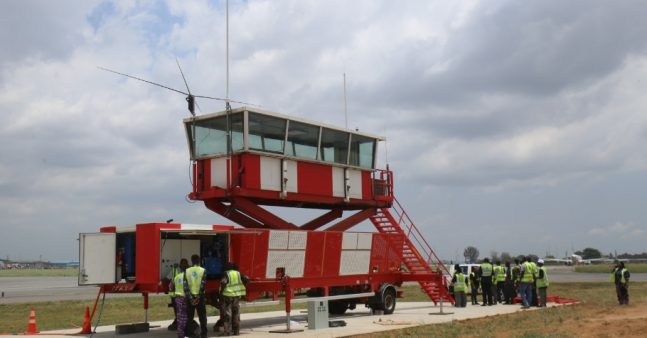
In a decisive move to sustain flight operations and ensure safety, the Nigerian Airspace Management Agency has deployed a Mobile Control Tower at the Murtala Muhammed International Airport following a recent fire incident that disrupted critical communication systems at the airport’s old terminal.
The emergency intervention comes as part of efforts to quickly stabilise air-ground communication and prevent operational setbacks at Nigeria’s busiest aviation hub, which handles a significant volume of domestic and international traffic daily.
Speaking during an on-site inspection, the Director of Safety Electronics and Engineering Services, Engr. Terese Ihenacho, described the deployment as a major operational breakthrough. She noted that the swift installation of the mobile tower demonstrates the agency’s readiness to respond to unexpected challenges without compromising safety standards.
According to Ihenacho, the mobile facility is fully equipped to support seamless communication between air traffic controllers and pilots, thereby ensuring that flight operations continue without disruption despite the damage caused by the fire incident.
She praised the technical team of NAMA for their professionalism and rapid response, highlighting that their expertise was instrumental in making the facility operational within a short timeframe.
“Their dedication and technical competence ensured that this critical infrastructure was delivered and made ready for use promptly,” she said.
Aviation stakeholders have welcomed the development, describing it as a proactive measure that reflects improved crisis management within Nigeria’s aviation sector. Experts note that maintaining uninterrupted communication is essential for safe aircraft movement, particularly in a high-traffic airport like Murtala Muhammed International Airport.
The deployment of the Mobile Control Tower is expected to serve as a temporary solution while authorities assess the extent of damage to the affected infrastructure and undertake necessary repairs or upgrades.
Industry analysts say the incident and the swift response by NAMA highlight the importance of investing in backup systems and emergency preparedness within the aviation industry.
As operations continue, passengers and airlines alike are likely to benefit from the restored stability, with authorities reaffirming their commitment to safety, efficiency, and resilience in the face of operational challenges.