By Charles Obiajulu Ugwu – PhD
If you stand on a street corner in Lagos, Kano, or Onitsha at five o’clock in the morning, you are greeted by a soundscape that defines the Nigerian soul. It is a cacophony of competing megaphones in the form of the rhythmic, haunting call of the Adhan from a neighborhood mosque clashing with the high-decibel intercessions of a “Fire and Miracles” morning cry. In this moment, Nigeria feels like the most God-conscious place on the planet. Every bus is a rolling chapel; every shopfront is a prayer point. Yet, as the sun rises, this same pious energy dissolves into a day defined by broken traffic lights, systemic bribery, and a palpable lack of the very order that faith claims to provide.
These structures are the lithic remains of a profound sociological truth: for the vast majority of human history, religion has functioned as the primary architect of the social contract. It was the original “Big Data,” a system of codes, taboos, and ethical guardrails that allowed disparate groups of primates to transcend the tribal unit and build the city-state. In Europe, the Middle East, and parts of Asia, the temple or the cathedral was not just a place of worship; it was the anchor of the community. It provided the moral literacy required for trade, the discipline for governance, and the safety nets that the state was too primitive to offer.
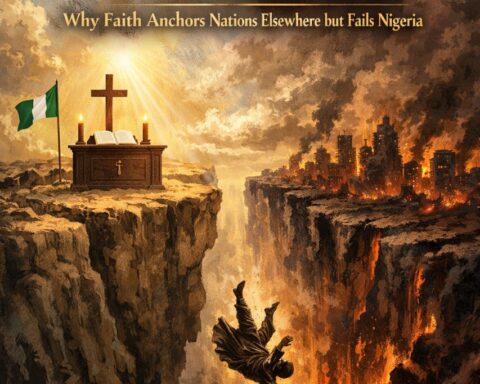
But in Nigeria, we are witnessing a historical anomaly. We have the “lithic remains” of modern cathedrals and grand mosques, yet we lack the institutional stability they were supposed to foster. The global narrative of faith as a nation-builder has been rewritten in the tropics into a narrative of survival, exploitation, and a staggering disconnect between private piety and public integrity.
The Global Engine: How Religion Engineered Trust
To understand the Nigerian divergence, one must first appreciate how religion acted as a catalyst for other civilizations. In the 17th century, the “Protestant Ethic” in Northern Europe didn’t just fill pews; it created a culture of accountability. When a Quaker merchant in London refused to haggle and instead set a “fixed price,” he wasn’t just being “holy”, he was inventing modern consumer trust. He believed his word was a covenant before God. This reduced “transaction costs” because people didn’t have to spend hours verifying the quality of goods.
Similarly, during the Islamic Golden Age, the concept of Waqf (charitable endowments) created the world’s first sustainable social welfare systems. These were not mere handouts; they were institutionalized funds that built universities and hospitals that stood for centuries. In these contexts, religion served as the “invisible infrastructure.” It provided a common moral language that allowed strangers to cooperate. It turned “me” into “us.”
The Intersection of the Altar and the Asphalt: A Lagosian Encounter
To understand this disconnect, one need not look further than a typical rainy Tuesday on a major road in Lagos. I recall an afternoon trapped in a gridlock that had turned the highway into a sweltering parking lot. The cause was familiar: a massive gully in the center of the road that the government had ignored for months.
In the heat, a luxury SUV, adorned with stickers proclaiming “I am a Winner” and “Touch Not My Anointed,” swung recklessly onto the shoulder, driving against traffic. The driver, a man in an expensive, starched traditional outfit, clutched a leather-bound Bible on his dashboard. When he nearly collided with a commercial minibus, he didn’t offer an apology. Instead, he leaned out of his window and shouted, “Don’t you see I am on a mission for God? Clear the way for the blessed!”
Behind him, a group of “prayer warriors” began to chant, framing his dangerous lawlessness as a “divine spiritual breakthrough” over the “spirits of delay.” In that moment, the essence of the crisis was laid bare. Here was a man using the symbols of the divine to justify the destruction of the civic order. He wasn’t just driving against traffic; he was driving against the very concept of the common good. To him, his personal “blessing” was valid even and perhaps especially if it came at the expense of everyone else’s safety and time. This is the Nigerian paradox: a faith that seeks to transcend the law rather than fulfill it.
Crass Opportunism and the Economy of the Abyss
Why has this engine stalled in Nigeria? The answer lies in what can be described as crass opportunism. In many thriving societies, religious leaders were the primary critics of the state’s failures. In Nigeria, religion has become a “free-rider” on state failure.
When the Nigerian government fails to provide security, the religious entrepreneur steps in not to demand better policing, but to sell “spiritual protection” and “divine immunity.” When the public healthcare system collapses, the pulpit becomes a clinic, offering “miracle healings” for a fee (or a tithe) rather than holding the Ministry of Health accountable. This is the ultimate form of opportunism: nurturing a situation of collective pain because that pain drives “customers” to the sanctuary.
This creates a perverse incentive. If the country worked, if there were jobs, functioning hospitals, and safe roads, the demand for the “miraculous” would plummet. Therefore, the religious establishment, often unconsciously, becomes a stakeholder in the status quo of dysfunction. They thrive in the “abyss.” They build private cities with 24-hour electricity while their congregations live in darkness, framing their own institutional success as a “sign of God’s favor” rather than a symptom of a fractured society where the elite (spiritual and political) have simply opted out of the public mess.
The Free-Rider Problem: Piety Without Contribution
In sociology, a “free-rider” is someone who benefits from a resource without contributing to its upkeep. In the Nigerian context, we see a form of “religious free-riding” where individuals use their faith to bypass civic responsibilities.
A citizen will spend six hours in a midweek service praying for a “business breakthrough” but will then spend the next day evading taxes, cutting corners on a construction project, or demanding a bribe to perform a public service. This is a bifurcation of the soul. The faith is used as a “moral laundry”, a place to wash away the guilt of Monday’s shortcuts with Sunday’s songs.
Unlike the Calvinists of the past or the early Islamic scholars who saw their professional excellence as an extension of their worship, the Nigerian religious experience often treats the “secular” world as a place to be plundered, and the “sacred” world as a place to hide the loot.
Image comparing the integration of religious ethics in historical trade vs. modern performative piety.
Fractures and Calcifications: The Damning Benchmarks
When we benchmark Nigeria against other religious societies, the fractures become glaring. Consider the role of the Catholic Church in Poland during the Cold War. It was the backbone of the Solidarity movement, providing the moral and physical space to challenge an oppressive state. It unified the nation against a common ill.
In contrast, religiosity in Nigeria has often been the primary source of calcification. The Sharia crises of the early 2000s in Northern Nigeria are a prime example. While historical Islamic governance in places like the Sokoto Caliphate once fostered scholarship and administration, the modern political invocation of faith was largely a tool for power negotiation. It didn’t lead to better schools or cleaner water; it led to “moral policing” that targeted the poor while the political elites continued their excesses unabated. It created a fracture that the nation still hasn’t healed.
Similarly, the explosion of Pentecostalism in the South has created a “personality cult” culture that mirrors the nation’s “Big Man” politics. In other climes, like South Korea, the growth of the church coincided with a massive push for national discipline and economic modernization. In Nigeria, the growth of the mega-church has occurred simultaneously with the de-industrialization of the country. Warehouses that once employed thousands of textile workers have been converted into “worship centers.” We are literally consuming our industrial future to fuel our spiritual present.
The Monday-Sunday Divide: A Case Study in Dissonance
The most damning evidence of this failure is the lack of “prosocial behavior” outside the church or mosque. In a landmark social experiment, researchers often look at “The Lost Wallet” test that measures how many people return a wallet found on the street. In highly “religious” Nigeria, the return rate is abysmal compared to “secular” Japan or Scandinavia.
This suggests that our religion is performative rather than principled. It is a series of rituals made up of; the loud “Amen,” the heavy “Insha’Allah,” the flamboyant dresses that signal belonging to a group but do not dictate behavior toward a stranger. In the societies where religion “worked,” it taught that the stranger was your brother. In Nigeria, the religion often teaches that the stranger is a “spiritual rival” or a “mission field,” but rarely a fellow citizen with equal rights.
From Miracles to Methods: Reclaiming the Architect
If Nigeria is to bridge this gap, the narrative must change from the “supernatural bypass” to the “moral method.” Faith must stop being an excuse for the lack of a system and start being the inspiration for building one.
The great civilizations of the past understood that God’s primary “miracle” was the human intellect and the ability to organize. The monks who drained the swamps of Europe didn’t just pray for dry land; they grabbed shovels. The early Islamic astronomers didn’t just pray for direction; they built the astrolabe.
Nigeria needs a movement that rejects the “crass opportunism” of the current religious landscape. We need a faith that is offended by a dirty street, a faith that views a bribe as a sacrilege, and a faith that understands that a well-paved road is more pleasing to the Creator than a thousand-voice choir in a crumbling city.
The “lithic remains” of our great cathedrals and mosques should not be tombstones of a failed society. They should be the blueprints for a new one. But that requires a shift from seeking God’s hand for a “personal breakthrough” to seeking God’s heart for a collective one. Until the Nigerian believer realizes that their highest act of worship is their civic integrity on a Tuesday afternoon, our steeples and minarets will continue to be nothing more than expensive monuments to our own decline.
“A nation is not built by the volume of its prayers, but by the weight of its character”
About the Author
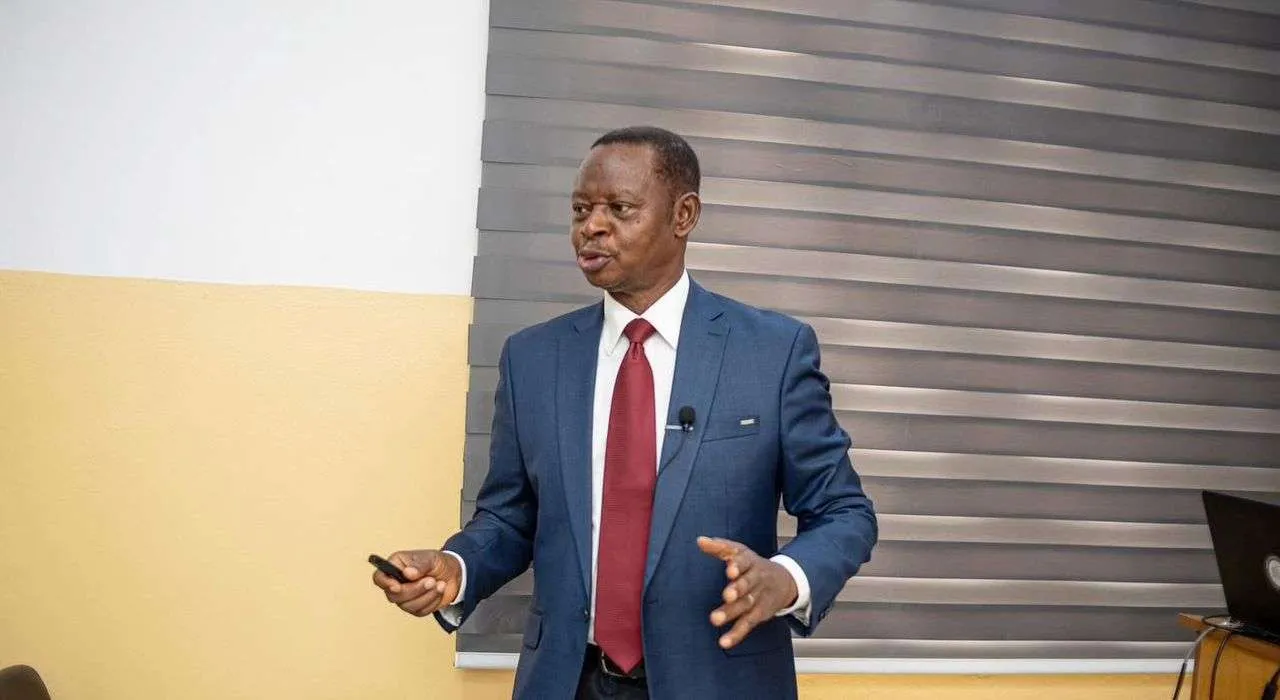
Dr Charles Obiajulu Ugwu is a contrarian thinker writing from Lagos