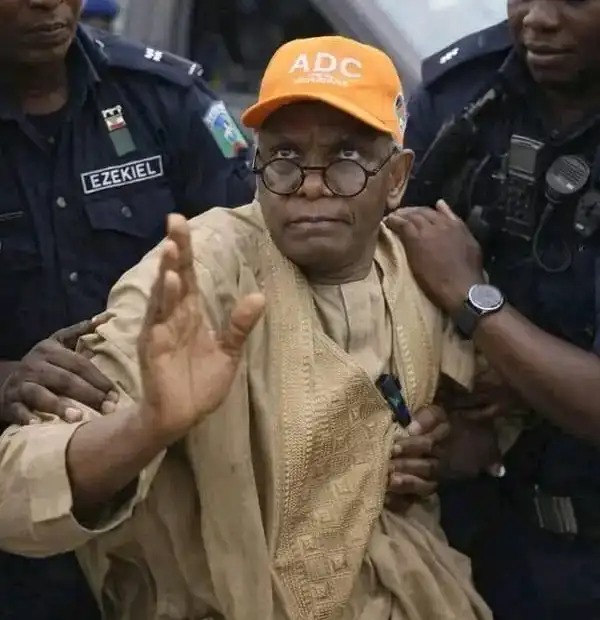
A Kaduna-based advocacy organisation, Kaduna-Scribe, has taken a swipe at former Kaduna State Governor, Nasir Ahmad el-Rufai, over his recent outcry against alleged arbitrary arrests, accusing him of “selective amnesia” and attempting to rewrite history.
In a strongly worded statement issued on Friday and signed by its National Chairman, Comrade Ezekiel Gambo, the group said the former governor’s complaints were ironic, given what it described as a turbulent eight-year tenure marked by arrests, demolitions, labour unrest, and strained relations with traditional institutions.
el-Rufai had recently condemned what he termed arbitrary arrests by the current administration, a remark that has sparked mixed reactions across the state. While some political allies expressed sympathy, Kaduna-Scribe said the statement reopened unresolved wounds for many residents.
“It is astonishing that a man under whose watch journalists, activists and critics were routinely arrested is now presenting himself as a victim of political intimidation,” the group said.
The group recalled that between 2015 and 2023, several arrests of activists and media practitioners generated national attention, with cases involving individuals such as Audu Maikori, Steven Kefas and Luka Binniyat becoming rallying points for free speech advocates.
According to Kaduna-Scribe, while the then-government consistently defended its actions as lawful enforcement against incitement and fake news, many civil society organisations argued that dissent was often treated as a security threat.
“El-Rufai repeatedly warned that his administration would not tolerate what he described as ‘fake news’ in a fragile security climate. But social media commentary and critical voices frequently attracted legal consequences,” the statement noted.
The group argued that the present debate should not ignore the experiences of those who, it said, faced intimidation during the previous administration.
Beyond arrests, the statement revisited controversial demolitions carried out during el-Rufai’s tenure.
Among the most debated was the demolition of a property linked to Senator Suleiman Hunkuyi, once a political ally of the former governor. While the government maintained that such actions were part of urban renewal and enforcement of planning regulations, critics alleged political undertones.
Kaduna-Scribe also referenced operations in parts of Gbagyi Villa towards the end of the administration in 2023, which reportedly led to displacement and public unrest.
“Urban renewal cannot become urban removal,” the group stated, arguing that development must be balanced with compassion and due process.
The face-off between the Kaduna State Government and the Nigeria Labour Congress (NLC) over teacher competency tests and civil service restructuring led to strikes and protests. While the administration described the reforms as necessary to improve standards, labour leaders accused it of mass sacking and insensitivity.
Traditional institutions were similarly affected by restructuring policies that resulted in the removal and reclassification of several traditional rulers, a move the government justified as administrative reform but which generated widespread controversy.
Kaduna-Scribe further recalled that during the eight-year period, insecurity dominated public discourse.
From Birnin Gwari to communities in Southern Kaduna, banditry, kidnappings and communal violence persisted. High-profile school abductions and the train attack deepened public anxiety.
Although el-Rufai frequently blamed limitations in federal security architecture and cross-border criminal networks, the group maintained that leadership must ultimately be judged by citizens’ lived realities.
On the former governor’s recent claims of persecution, Kaduna-Scribe insisted that investigations by security or anti-graft agencies should not automatically be framed as political witch-hunts.
“Investigation is not intimidation. Scrutiny is not persecution. Public office comes with public accountability,” the statement read.
The group urged political actors to embrace transparency and allow institutions to function without undue pressure or public sentiment manipulation.
As political alignments begin to shift ahead of future electoral cycles, debates over el-Rufai’s legacy appear far from settled in Kaduna.
Efforts to obtain the reaction of the former governor to the group’s statement were unsuccessful as of press time.