Stakeholders on Wednesday in Abuja called for a deeper and more strategic Nigeria and China partnership that is anchored on industrialisation, expanded market access, and enhanced cooperation within the Global South.
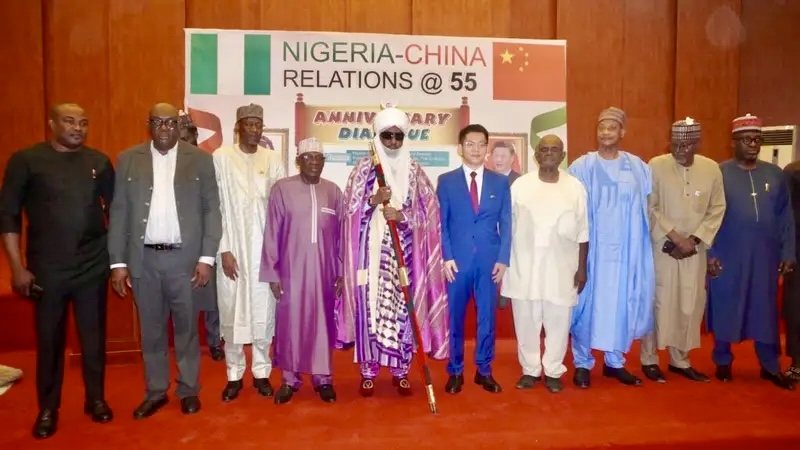
They made their views known at the 55th anniversary dialogue to commemorate the establishment of diplomatic ties between Nigeria and the People’s Republic of China on Feb. 10, 1971.
The dialogue was organised by the Centre for China Studies (CCS) in collaboration with the Institute for Peace and Conflict Resolution (IPCR), themed: “Nigeria-China Relations @55 and beyond”.
Mr Charles Onunaiju, Director of the CCS, said the relationship began at a crucial moment for both nations and had evolved into a model of South-South cooperation with global significance.
He recalled that at the time of the establishment of diplomatic relations between both countries, Nigeria had just emerged from a civil war and China was seeking to reclaim its UN seat.
Citing UN Resolution 2758 as the cornerstone of global diplomatic consensus, he said: “Nigeria, alongside 25 African countries and over 50 others, supported China’s return to the United Nations in October 1971, barely 10 months after diplomatic relations were established.
“In 55 years of sustained engagement, Nigeria has consistently upheld the One-China policy, while China has remained committed to Nigeria’s unity, sovereignty, and territorial integrity,” Onunaiju said.
He noted that bilateral trade exceeded 22 billion U.S. dollars in 2025, with prospects for growth as China implements its 15th Five-Year Development Plan.
“China’s transition from the workshop of the world to the market of the world presents new opportunities for Nigeria and other African countries with zero-tariff access to the Chinese market.”
Onunaiju urged Nigerian policymakers, scholars, and businesses to study China’s development plans closely.
He highlighted China’s post-1978 reforms that lifted over 700 million people out of poverty and transformed China into the world’s second-largest economy.
The CSS Director also cited infrastructure projects, such as the Lekki Deep Sea Port under the Belt and Road Initiative (BRI) as evidence of practical cooperation.
“At 55 years, Nigeria and China stand at a new historical starting point. What lies ahead is even greater than what has already been achieved,” he said.
Dr Joseph Ochogwu, IPCR Director-General, represented by Mr Emmanuel Mamman, Director of the National Peace Academy, said the dialogue was timely amid geopolitical tensions, economic uncertainty, and security challenges.
“Nigeria and China relations demonstrate how cooperation between developing countries can advance development while respecting sovereignty and non-interference,” Mamman said.
He stressed that economic partnerships must be people-centered, conflict-sensitive, and aligned with peace goals, particularly in youth employment, technology transfer, and inclusive growth.
Mr Zhou Hongyou, Chargé d’Affaires of the Chinese Embassy in Nigeria, said that the bilateral relationship is rooted in mutual trust and shared development.
“For 55 years, China and Nigeria have been trusted, friends who stood together through thick and thin,” he said.
He added that the partnership was elevated to the Comprehensive Strategic Partnership in 2024 following President Bola Tinubu’s state visit to China.
Zhou also highlighted projects, including the Zungeru Hydropower Station, Ajaokuta–Kaduna–Kano Gas Pipeline, and Abuja Water Supply Project.
He added that China’s direct investment in Nigeria rose to 690 million dollars, a 103 per cent year-on-year increase.
Zhou reaffirmed China’s commitment to supporting Nigeria’s industrialisation, modernisation, and self-reliant development through initiatives, such as the Global Development Initiative and Global Security Initiative.
“We aim to ensure that the benefits of our cooperation reach the people of both countries in a tangible and equitable way,” he said.
The Minister of Foreign Affairs, Amb. Yusuf Tuggar, represented by Amb. Muhammed Haidara, Director of Asia and Pacific Division, described China’s zero-tariff treatment as a historic opportunity for Nigeria to accelerate economic diversification.
“Zero-tariff access is not merely a trade concession; it is a bridge to industrial strength, value addition, and shared prosperity,” Haidara said.
Haidera stressed that realising these opportunities requires addressing domestic constraints, such as infrastructure, logistics, and standards.
“Deeper collaboration in productive investment, technology transfer, and capacity building will be essential to balance trade and ensure that the benefits of our partnership reach the Nigerian people,” he said.
He further noted that a stronger Nigerian industrial base would enhance trade with China.
The minister added that it would also enhance Nigeria’s position as a manufacturing and export hub under the African Continental Free Trade Area, with benefits radiating across the continent
Earlier, the Emir of Kano, Muhammadu Sanusi II, reflected on the relationship as “work in progress with unfinished business,” and urged Nigeria to strategically attract Chinese manufacturing investments.
“We need to ensure that production and value addition occur in Nigeria, creating jobs, revenue, and industrial capacity. Otherwise, we risk remaining a consumer nation,” he said.
He noted the historical ties of his father, Amb. Aminu Sanusi, Nigeria’s first Ambassador to China.
Sanusi stressed that policymakers must adopt a long-term strategic vision that would leverage Nigeria’s position as West Africa’s largest economy and population centre.