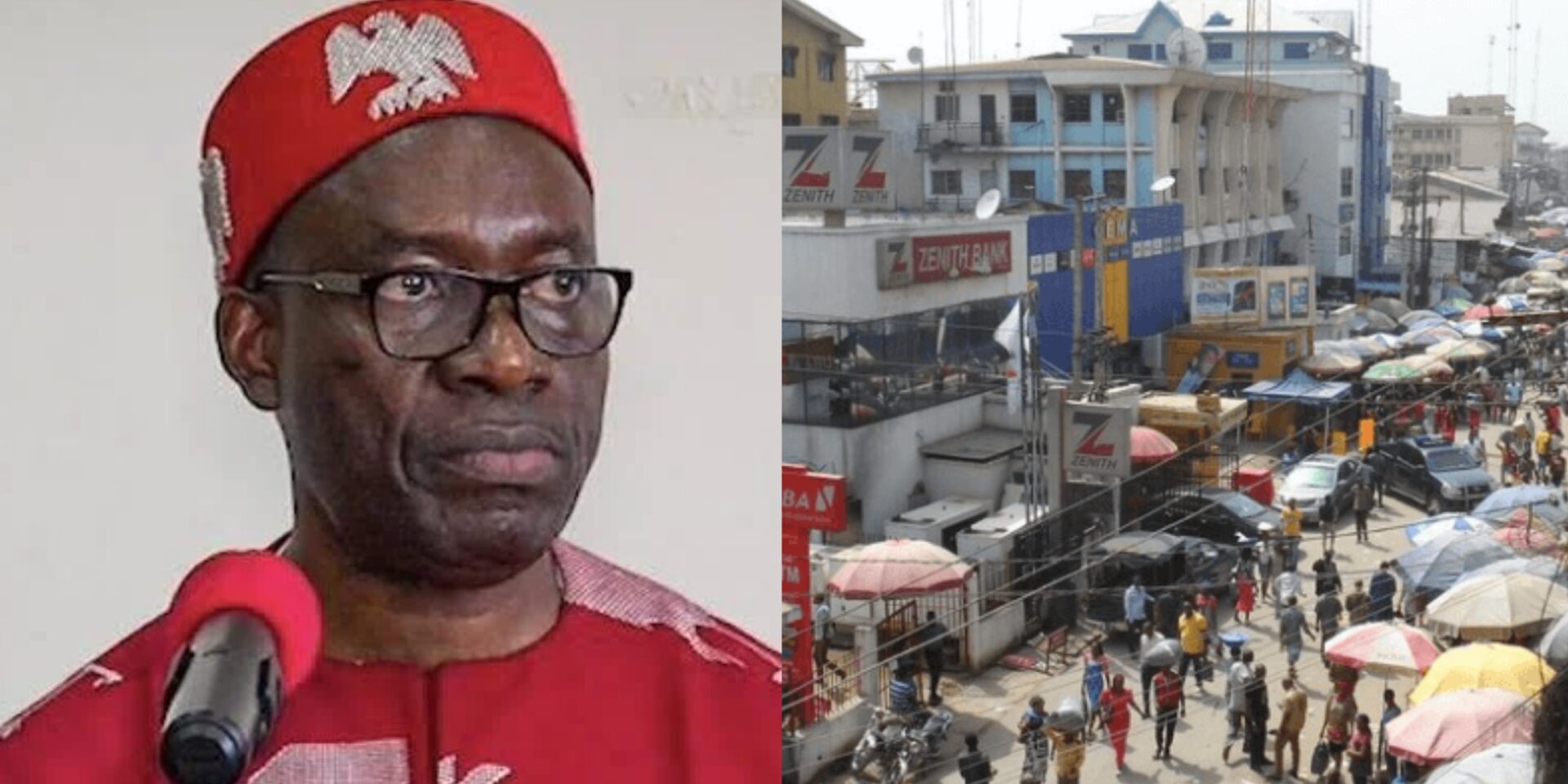
The stage was set at Onitsha main market in Anambra state. The cast were the Onitsha market traders on one side and the Anambra State Governor, Professor Chukwuma Soludo on the other side. The issue at stake was the sit-at-home challenge. The order by Professor Soludo to close the Onitsha main market for one week for failure of the traders to open for business on Mondays in obedience to the sit at home sparked the crises.
Following the development, Onitsha, the commercial nerve center of the South-East has been embroiled in unmitigated crises. Businesses have been held down; movements restricted as vehicular traffic is impaired. The strategic Onitsha head bridge was blocked by rampaging market protesters. For complete one week, peace eluded the once vibrant beehive of commercial activities. How to douse the tension for peace to return to Onitsha is the issue at hand.
I would like to appeal to Governor Soludo to take it easy with the traders and do the needful as two wrongs don’t make a right. The Onitsha market trader’s imbroglio is like a family fight. An angry father gains nothing by destroying his family no matter how justified he may be. There can be no justification for a man to destroy his family, or for a Governor to destroy his state. In all cases, wisdom should be allowed to prevail.
The sit-at-home order in the South-East, Nigeria, started about five years ago, as a response to the arrest and detention of Mazi Nnamdi Kanu, the leader of the pro-Biafra agitation group known as Indigenous People of Biafra (IPOB). It is a call for people to stay at home every Monday to show solidarity and support against the incarceration of Nnamdi Kanu and the perceived marginalization of the Igbo. There is no doubt that sit-at-home is an unfortunate historical anathema that has impacted heavily on the South-East.
According to reports, between August 2021 and December 2022, the movement has resulted in estimated loss of approximately N7.6 trillion in productivity, potential investments, life and property.
Economically, N50 billion was lost in four weeks, with private sector bearing 60 percent of the losses. The transport sector lost N3 billion daily due to the sit- at-home orders. Small and medium enterprises incurred 60 percent of the N50 billion losses within four weeks. At the state level, Anambra State lost N19.6 billion, while Ebonyi State lost N10 billion every Monday.
Socially, there have been disruptions of social activities, including closure of schools, increased insecurity, and social vices and negative impacts on daily livelihoods, with many residents staying indoors. The movement’s impacts is a subject of debate, with some Governors like Anambra’s Professor Soludo, taking steps to counter the sit-at-home, even though IPOB has since dissociated itself from the order.
On that note, while the effort of Prof. Soludo, among other Governors in the south-East, to end the sit-at-home completely is commendable, the problem is not in the people complying Soludo’s order, the problem is on the safety of those who complied. As mentioned above, there is increased insecurity and criminality in the land, with hoodlums taking over the social spare and committing havoc.
There have been cases of attacks and deaths related to the enforcement of the sit-at-home in different parts of the South-East. According to reports, over 700 people have lost their lives in attacks by non state actors with Imo and Anambra states being the worst hit. In some cases, innocent civilians who defied the order were killed.
For instance, in May 2022, 14 civilians were killed in Anambra for allegedly violating the order. In September 2023, three hoodlums were killed in Enugu by security forces while planning to enforce the sit at home.
About four years ago, one Monday morning, a fully loaded bus was attacked and set ablaze at Nkwogwu Mbaise, Imo State for defying the sit-at-home order. On another occasion, some civilians were attacked and killed by hoodlums at Nworie Ubi near Owerri in Imo State. The foregoing is but a tip of the iceberg.
Over the period, the sit-at-home order has been enforced by different unclassified elements, including unknown gunmen using various tactics like roadblocks, attacks on businesses, and intimidation. Whereas, the authorities put the blame for all these on IPOB, IPOB has denied responsibility for these attacks. The Government has condemned violent enforcement, which it atributes to criminals exploiting the situation. There is need to deploy security forces to protect the citizens against unwarranted attacks.
The one week closure of the Onitsha main market was the climax of the sit-at- home debacle. Following the closure, many traders whose livelihoods depend on daily sales – the suspension of businesses triggered mounting anxiety.
At one point when the gates were opened briefly on the day of the closure, there was rampage as scores of traders rushed towards the market in a bid to have access into the market.
Luckily, there were no reports of casualties or injuries. The heavy presence of security personnel and booms of gunfire heightened fear among the crowd. The Anambra state police command reiterated that the security forces were “obligated to maintain law and order and enforce lawful directives”.
Meanwhile, some community leaders have appealed for calm and patience, urging both traders and government to seek resolution that balances economic needs with concerns over safety.
Prior to Monday, February 2, 2026, another possible day of sit-at-home, the Anambra State Government had warned that it would not hesitate to revoke shop owners rights or take over and redevelop the market if traders failed to comply. Soludo insisted that all market traders must open for business on Mondays and sign attendance register before 10 am.
In all honesty, it is impossible for all traders to arrive the market and sign attendance register before 10 am as if it is a classroom. There is no register in the market that contains the names of all the traders. Besides, there is no market anywhere that has mandatory time of attendance. A market has sellers as well as buyers. Both come at their own time. There is no rule that marketers must be in the market at a specific time.
The problem of sit-at-home is a zonal challenge facing the entire South-East. To be effective; the governors of the South-East must unite to tackle the problem. Above that, the larger issue of Nnamdi Kanu that led to sit-at-hoe needs to resolved as the ultimate solution.
Dr. Onyekakeyah, a former member of The Guardian Editorial Board, is a public affairs commentator and a Daily Query columnist,