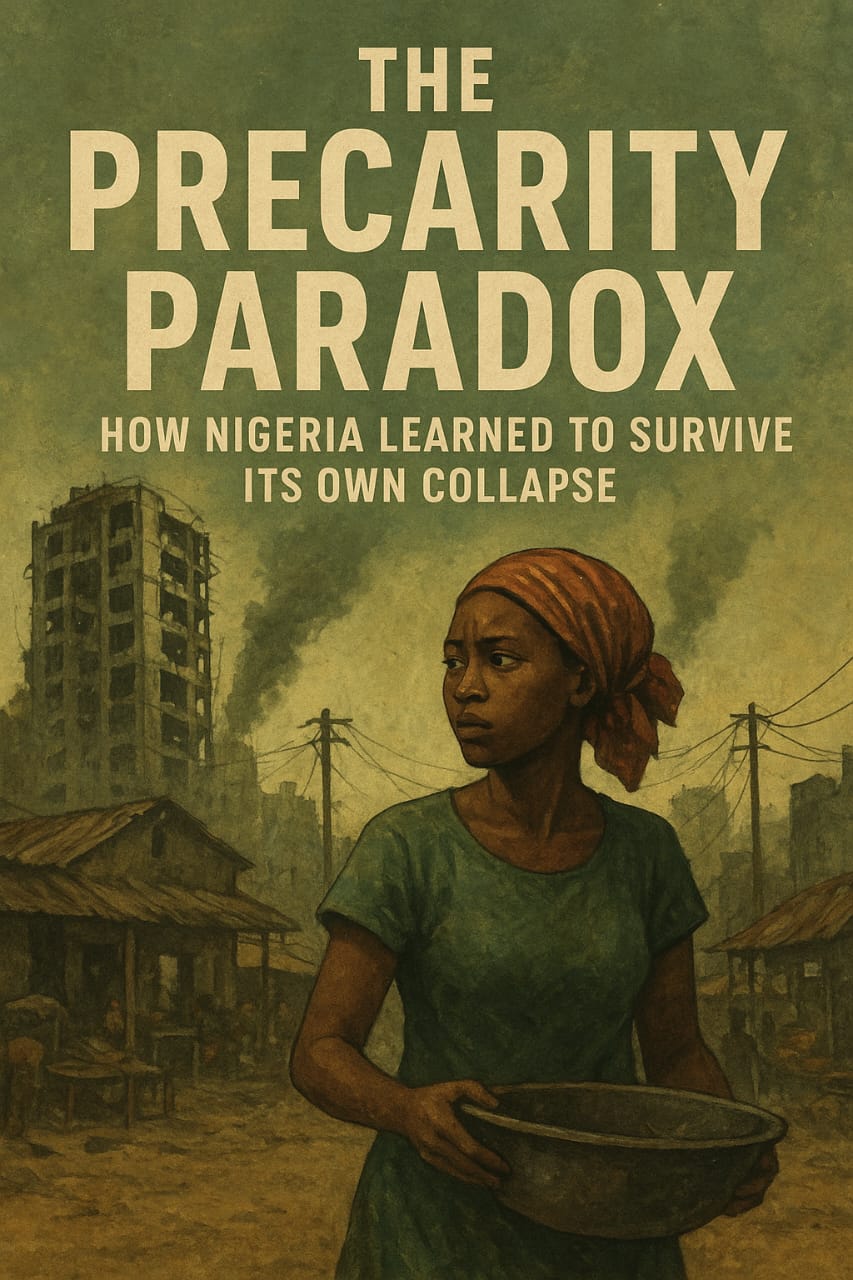
By Dr. Charles Obiajulu Ugwu
There is a peculiar kind of silence that settles over a country when it has been broken for too long. It is not the silence of peace, but of resignation, the quiet hum of a people who have adjusted their lives around dysfunction, who have learned to call crisis normal. That silence now defines Nigeria.
Every morning in Lagos, Abuja, Port Harcourt, Kano, and countless unnamed towns, Nigerians wake to improvise existence. They queue for fuel in a country that exports crude oil, store rainwater in drums because taps have run dry, and buy electricity from men stringing illegal wires across compounds. In the markets, prices shift like weather, not policy. Government workers haven’t been paid in months, but still show up not out of hope, but habit. It’s an entire civilization running on generator fumes and psychological duct tape.
This is not chaos. It’s choreography. Nigerians have become virtuosos of survival, performing daily miracles inside systemic ruin. The tragedy is that this talent for survival once a badge of resilience has become the very thing holding the nation hostage.
That is the precarity paradox.
The Design of the Everyday Struggle
Precarity is not simply poverty or insecurity. It’s the condition of perpetual uncertainty, where everything that should be stable such as income, safety, trust that becomes negotiable. For Nigerians, this instability has hardened into the structure of life itself.
Consider the ritual of “managing.” When the light goes out, you manage. When salaries delay, you manage. When fuel prices rise overnight, you manage. The language of survival has replaced the grammar of aspiration. Managing has become a civic religion.
A friend once described how his mother, a retired teacher, still keeps kerosene lamps ready despite having solar panels. “In Nigeria,” she said, “you never fully trust the light.” That sentence, casual as it was, could summarize the national condition. No one trusts anything not institutions, not systems, not even hope yet life goes on. The country’s great achievement is that it continues to function without functioning.
The roads collapse, yet transport thrives. The naira tumbles, yet new millionaires emerge. Universities go on strike, yet private academies mushroom. Nothing works, but nothing stops. It’s an equilibrium of dysfunction and a strange kind of balance achieved through constant improvisation.
From Resilience to Addiction
Resilience was once a moral virtue, the ability to endure adversity with dignity. But in Nigeria, it has metastasized into an addiction. Nigerians no longer resist bad governance; they outwit it. Instead of demanding change, they devise shortcuts.
When hospitals fail, we create prayer camps.
When schools crumble, we create lesson houses.
When police extort, we pay and drive on.
It’s an ecosystem of coping, ingenious, exhausting, and tragically self-sustaining. The citizens who could demand reform are too busy inventing ways to survive the absence of reform. The political class, seeing that the people can adjust to anything, adjusts nothing.
A trader in Onitsha once told me, “Government is for those who can wait; I have to eat today.” That sentence explains forty years of failed reform. Hunger has no patience for systems change. So, while the poor scramble for daily bread, the rich corner policy for profit. Everyone adapts; no one advances.
The Economy of Instability
The precarity paradox deepens when one realizes that instability itself has become a market. Entire sectors now profit from chaos.
The fuel scarcity that cripples cities feeds black-market dealers.
The insecurity that terrorizes communities feeds private security firms.
The unemployment that devastates youth feeds political patronage networks.
What looks like disorder is, in fact, an economy, a thriving shadow ecosystem where the incentives for dysfunction outweigh those for reform. Those who benefit from the current mess have every reason to keep it messy.
Even government institutions quietly adjust. The bureaucracy has learned to feed on delay, to convert inefficiency into currency. The longer you wait, the more you pay; the slower the process, the larger the bribe. Precarity is not just tolerated it is monetized.
And like every market, it follows a cruel logic: demand creates supply. The more Nigerians need workarounds, the more “helpers” appear to sell shortcuts through middlemen, touts, fixers, prophets. The informal becomes the only formal system that works.
The Emotional Economy of Fear and Faith
At the psychological level, precarity produces a peculiar intimacy between fear and faith. Nigerians oscillate between despair and divine optimism, between outrage and prayer.
Walk into any church or mosque and you’ll hear the same litany: “God will do it.” This isn’t naive piety; it’s a coping mechanism as a way of anesthetizing pain in a context where civic tools have failed. When politics becomes meaningless, spirituality fills the void.
But faith, when weaponized by precarity, loses its prophetic edge. Instead of provoking justice, it pacifies injustice. The hungry are told to fast; the unemployed are told to sow seeds. Religion becomes an emotional subsidy for a failed state keeping people hopeful enough to survive, but not angry enough to revolt.
This is how precarity preserves itself: it converts suffering into virtue. Nigerians no longer measure progress by improvement, but by endurance. The ability to “take it” becomes the new patriotism.
The Inverted Logic of Leadership
In societies caught in the precarity paradox, leadership ceases to be about vision. It becomes theater. Those in power govern not by solving problems, but by performing concern. Each crisis is met with a committee, a press release, a promise of “palliative.” The state manages perception, not reality.
A governor inaugurates a road that leads nowhere. A senator donates wheelbarrows to graduates. A president declares “war on poverty” while increasing the cost of living. These absurdities would provoke outrage in functional nations. In Nigeria, they trend for a week and dissolve into jokes. The population has learned to laugh its way through humiliation.
And here lies the deeper danger: laughter becomes a defense against despair. When citizens mock their own suffering, the ruling class knows it can survive anything. Humor becomes the final sedative.
How Survival Kills the Future
The young understand this paradox most viscerally. They were born into scarcity but trained for dreams. They can code, trade crypto, and quote global trends — yet live in cities where a rainstorm can paralyze power for a week. Many have stopped believing that progress is possible here; instead, they focus on “japa,” the exit plan.
Migration has become the new social contract: the state fails you; you flee it. Every brain that leaves makes reform harder. Every departure strengthens the system’s immunity to shame. Nigeria loses not only talent but belief — the quiet faith that things can get better.
Inside the country, those who remain sink deeper into the logic of improvisation. Life becomes a sequence of quick fixes — patched tyres, borrowed cash, shared generators, unending hustles. Long-term thinking feels luxurious, even dangerous.
The consequence is cultural: we stop investing in the future because we no longer trust it will come. The child raised in uncertainty learns to gamble, not plan. The adult who survives by chance cannot build by design.
The Political Utility of Precarity
Why doesn’t the government fix what everyone knows is broken? Because precarity is politically convenient. A desperate population is easier to control than a dignified one. When citizens are too busy struggling for water, food, or safety, they cannot organize for justice.
Every administration, regardless of party, inherits and weaponizes this truth. They rule not through performance of competence, but through management of despair. They distribute crumbs and call it compassion. They speak of “hope renewals” while the system decays underneath.
In a functional democracy, citizens demand accountability. In a precarious one, they beg for favors. The difference is moral, not procedural. It marks the shift from citizenship to clientelism, from a people who know their rights to a people who barter for relief.
The Cultural Sediment of Decay
Over time, the survival mindset shapes culture itself. Mediocrity becomes acceptable. Time loses value. Even small efficiencies feel foreign. Try insisting on punctuality, honesty, or rules in many Nigerian settings, and you’ll be called rigid or naïve. The moral compass has been bent to fit the terrain.
One Lagos banker told me, “In Nigeria, if you play by the rules, you’ll die waiting.” That sentence, bleak as it sounds, captures how ethics have been downgraded to luxury. The honest man is no longer admired; he’s pitied.
The collective psyche adapts accordingly. People stop expecting fairness. They stop believing in merit. Every opportunity becomes a hustle, every transaction a bet. In this moral haze, nothing shocks anymore — not election fraud, not police extortion, not missing billions. Outrage has expired.
The Invisible Profiteers
Behind the visible chaos are invisible interests. Precarity has shareholders. The elite class including political, corporate, and clerical thrives precisely because of the disorder they publicly condemn. They’ve learned to convert insecurity into influence.
Take the security industry. Each fresh wave of violence means new contracts for “consultants” and “task forces.” The more citizens fear, the richer the middlemen get. Or the power sector: every blackout sustains the diesel cartel. The dysfunction is not accidental; it’s engineered profit.
This is why Nigeria’s crises never resolve — they mutate. From Boko Haram to bandits, from fuel scarcity to subsidy removal, each new disaster replaces the old one without reforming its cause. The system feeds on its own failure.
The Precarity Mindset as National Identity
The saddest outcome of this long descent is psychological: Nigerians have internalized precarity as identity. We describe ourselves as “hustlers,” not citizens; “survivors,” not builders. The national anthem’s optimism feels like a ghost.
Ask a random Nigerian if they believe their country can change, and most will smile with tragic politeness. “We’ll survive,” they’ll say not “we’ll improve.” Survival has replaced transformation as the highest aspiration.
That is the true collapse: when the imagination itself gives up.
Breaking the Spell
So how does a nation escape the precarity paradox? The answer is not more coping mechanisms or borrowed reforms. It begins with a refusal to normalize pain. The first revolution must be moral a collective decision to stop managing decay and start confronting it.
Citizens must rediscover the political utility of anger not the violent kind, but the dignified fury that demands order, competence, and truth. Faith communities must recover their prophetic voice to comfort the afflicted, yes, but also to afflict the comfortable.
We must dismantle the industries of dysfunction, the opaque subsidies, the predatory bureaucracies, the security rackets. And we must rebuild the moral economy from the bottom up: where honesty pays, where merit matters, where failure costs.
Above all, Nigerians must relearn the art of long-term thinking. Survival solves today; only vision secures tomorrow.
A Nation Between Resilience and Renewal
There is no doubt Nigerians are extraordinary people. To live daily in this whirlpool and still smile, still create, still love, is a form of grace. But grace must not be mistaken for progress. We cannot build a future on endurance alone.
The world once admired our resilience. Now it pities it. Because resilience without renewal is just another word for captivity.
The precarity paradox teaches that a nation can survive its collapse for generations — but at the cost of its soul. Nigeria is not dying because of its problems; it is dying because it has learned to live with them.
Somewhere in that recognition lies the seed of rebirth. The day Nigerians decide that “managing” is no longer noble, that endurance is not destiny, that suffering is not a civic virtue that day, the silence will break.
And perhaps, for the first time in decades, the light will come on — and stay.