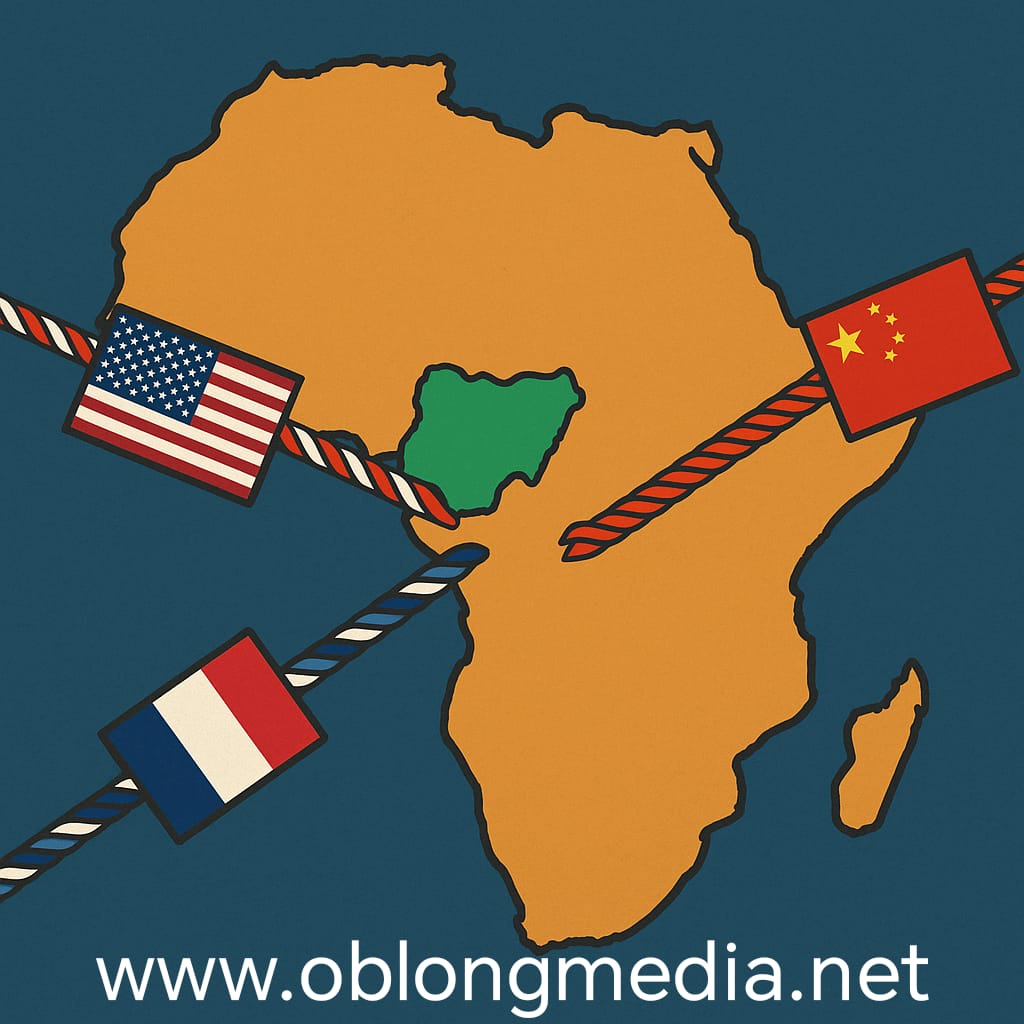
“The recent U.S. talk of invading Nigeria under the guise of fighting bandits and protecting Christians hides a deeper geopolitical agenda, to roll back China’s influence, check France’s growing presence, and reassert America’s dominance in Africa.”
America’s “Nigeria Option”: The Real Agenda Behind the Headlines
When the Americans suddenly start talking about “invading Nigeria to stop bandits and protect Christians,” one must “muru anya” pause and ask: why now?
Nigeria’s insecurity didn’t begin yesterday. Banditry, terrorism, and mass kidnappings have plagued the North for over a decade, yet only now does Washington sound ready to “intervene.”
It bears reminding that this same America once refused to designate Boko Haram as a terrorist organization, despite the group’s reign of terror across northern Nigeria. Washington not only declined to sell Nigeria arms to combat the insurgents, but also blocked alternative attempts by the Jonathan administration to procure weapons from other international sources. Ironically, many of the actors now preaching security cooperation, including President Tinubu, were part of the Western-aligned political machinery that benefited from that orchestrated intentional frustration, which ultimately helped push Jonathan out of power. Back then, when Christians were being slaughtered daily by Boko Haram, the U.S. looked away. So it is only natural, and indeed necessary, for Nigerians to ask: why now? Why this sudden moral awakening and military interest, what has changed?
The truth is, this sudden concern has less to do with compassion and more to do with competition, the global contest for influence, markets, and strategic control of Africa’s biggest nation.
China: The Shadow America Wants to Chase Away
For years, China has steadily woven itself into Nigeria’s economic fabric, building railways, refineries, airports, and power infrastructure. These are not acts of charity; they are strategic loans with long-term influence attached.
The U.S. knows this. Beijing’s quiet grip on Nigeria’s future worries Washington more than any bandit group ever could. So, by raising the flag of “humanitarian intervention,” America is simply opening a backdoor to reassert itself where it has already lost ground to China.
Every new “security partnership” means contracts, advisors, and influence, all of which conveniently realign Nigeria’s loyalties toward Washington.
France: The Complication America Doesn’t Like
The Tinubu government’s deepening relationship with France only adds salt to America’s wound.
After being thrown out of Mali, Niger, and Burkina Faso, France is desperate to find relevance in Africa again, and Nigeria is its new golden ticket.
Recent trade, defense, and oil discussions between Abuja and Paris show a warming alliance. But America doesn’t want to share the table. It prefers to lead, not partner. So while it pretends to support Nigeria’s anti-bandit campaign, it’s really playing chess against France and China on Nigerian soil.
The Religion Card: The Oldest Trick in Washington’s Playbook
To sell foreign intervention to the American public, politicians need emotion. So they wrap it up as a moral mission, “protecting Christians in Nigeria.”
But let’s face facts: the killings in Nigeria are not purely religious. They are the result of poverty, weak governance, corruption, and illegal arms trafficking. Muslims, Christians, and even nonbelievers have all suffered.
By painting it as a “Christian persecution” issue, the U.S. simplifies the crisis, making it easier to justify interference, just as they did in Iraq, Libya, and Syria under the same banner of “humanitarianism.”
The Silent Invasion: Not With Soldiers, But Systems
America doesn’t need boots on Nigerian soil to control Nigeria. It operates through what they call ‘train, advise, and assist’ missions, selling weapons, providing intelligence, deploying drones, and embedding advisors in military operations.
In this way, the U.S. gradually builds dependency. Soon, key decisions, from targeting operations to security budgeting, begin to orbit around American input and approval.
That’s how influence becomes control without firing a shot.
Nigeria in the Middle of a Three-Way Power Game
Right now, Nigeria is standing at a delicate crossroads:
America wants to control security cooperation.
France wants to rebuild its lost empire of influence.
China wants to deepen its economic footprint.
Each of them wants Nigeria, not for our people’s safety, but for strategic and economic reasons.
My View: Accept Help, But Protect Sovereignty
Nigeria must be wise. Accepting help to fight insecurity is fine, but it must be done on Nigeria’s terms, with transparency and national oversight.
We must not allow foreign powers to use our insecurity as an excuse to plant military or political control. And we must never again be a proxy battlefield for superpowers.
Ultimately: Every Empire Comes with an Agenda
America’s renewed “interest” in Nigeria is not a revival of conscience, it’s a strategic recalculation.
The so-called mission to “save Nigeria” is really a struggle to reclaim lost ground in Africa’s most important nation, to outflank Beijing, outshine Paris, and dominate West Africa once again.
Nigeria must wake up to this reality.
Our independence should never be negotiable, not for weapons, not for loans, not for promises of protection.
By Hon. Duruebube “Oblong” Chima Nnadi-Oforgu
(Oblong Media Unlimited)
November 2025
#OblongView #AfricaGeopolitics #NigeriaFirst
Me:
Obnong Halfbaked sense! What changed is that Trump is the opposite of Obama and his Democrats!
Indeed what’s wrong with America invading this marooned paradise!!