By Agbeze Ireke Kalu Onuma, AI-KO
There is a certain sacred gravity that comes with invoking the name Christopher Okigbo. He was not merely a poet – he was a threshold, a burning point where language met spirit, where art became offering. His life and work shimmer with intensity, mystery, and sacrifice. To read him is to feel both illuminated and undone. To remember him is to remember that poetry can cost a life – and still, somehow, give life back.
There’s something haunting about returning to Okigbo.
Returning to Okigbo has become a haunting ritual for me. His poetry doesn’t speak – it incants; it doesn’t just sting, it consecrates a wound. It moves not like smoke, but like the very spirit of a sacred fire: elusive, fragrant, a form of intelligence that evaporates before it can be possessed. And yet, it colonizes the air long after the page is closed, long after the echo of the voice has been absorbed by silence. Of all the African poets I encountered as a boy, Okigbo was the cipher, the one whose language was a locked sanctuary – and precisely for that reason, he has become a permanent resident of my imagination. His mystery was a gravity from which I…
Back then, I read him for reading sake, not grace or understanding. His poems were dense, abstract, and filled with mythic echoes that felt far removed from the small classroom where I sat. But even then, something in his words refused to let go. A rhythm. A shadow. A question that hummed beneath comprehension. I didn’t know it then, but Okigbo was teaching me that poetry is not always meant to be understood – sometimes it is meant to be felt, to be carried like a secret flame that slowly teaches you how to see.
As I grew older, I began to return to him – not to decode, but to dwell. Not to analyze, but to absorb. I realized that Okigbo’s work is not a puzzle to be solved but a presence to be entered. His poems are like shrines – you approach them barefoot, aware that something larger than intellect is at play.
Okigbo was born in 1932 in Ojoto, Anambra State. He was a scholar, a librarian, a teacher – and above all, a poet of fierce conviction. He died in 1967, fighting for Biafra in the Nigerian Civil War. He was only thirty-five. His death was not just tragic; it was prophetic. He did not merely write about sacrifice – he became it. His life and art fused into one continuous act of devotion, a testament to the belief that words, when lived fully, can become destiny.
He wrote in English, but his soul was unmistakably Igbo. His verse carried the pulse of ancestral drums, the whisper of river spirits, the ache of exile, and the yearning for return. In his work, Western modernism met African mysticism, and out of that collision came a new kind of voice – one that spoke from both wound and wonder. He was at once a modernist and a mystic, a rebel and a priest.
And perhaps that is why he feels so urgent now. In today’s Nigeria – where the ghosts of Biafra still murmur, where identity and belonging remain contested, where silence too often replaces truth – Okigbo’s voice resounds with uncanny relevance. He reminds us that poetry is not decoration; it is divination. It is how a people remember themselves when history tries to forget them.
In an age when poetry is often reduced to slogans and soundbites, Okigbo’s verses demand stillness. They do not flatter the reader; they confront the reader. They ask you to sit with your own contradictions, to listen to your own silences, to feel the sacred weight of language again.
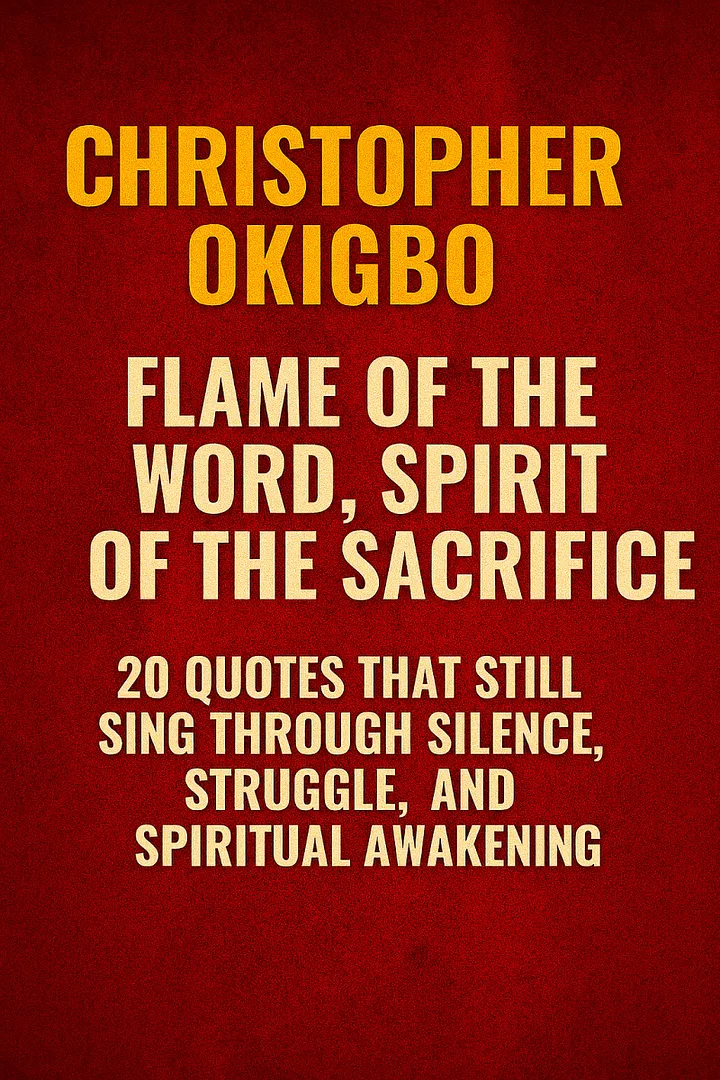
So this installment is not just a tribute – it is a pilgrimage. The twenty quotes that follow are drawn from Okigbo’s poems, letters, and reflections. Each one is followed by a meditation – my own attempt to meet him halfway, to wrestle with his echoes, to find my reflection in his flame.
Let us walk into that flame together – not to be consumed, but to be clarified. Because in Okigbo’s world, fire is not destruction. It is revelation.
To read Christopher Okigbo is to enter a sacred threshold where poetry becomes both mirror and altar. His words do not merely describe the world – they summon it. Each line is an invocation, each silence a doorway. Okigbo’s voice rises from the confluence of myth and memory, of exile and belonging. He does not write for the mind alone; he writes for the marrow. His poems are not meant to be understood in haste – they are meant to be inhabited. They demand that you slow down, breathe, and listen for the pulse beneath the page.
Below are twenty of his most resonant lines, each followed by a meditation – an attempt not to explain, but to respond. These reflections are not literary commentaries; they are soul reckonings. They are what happens when poetry stops being text and becomes testimony.
“BEFORE YOU, MOTHER IDOTO, NAKED I STAND.”(from Heavensgate)
This line is a baptism – a surrender beyond words. The first time I read it, I felt stripped, not of clothing but of certainty. Okigbo stands before the river goddess, unclothed in ego, unguarded in spirit. And I ask myself: when was the last time I stood naked before truth? Before memory? Before my own soul? In a world obsessed with performance, this line invites me back to essence. Intentional living begins here – with the courage to be seen, unmasked and unafraid.
2. “I AM THE DEW ON THE TIPS OF GRASSES.”(from Distances)
This is a whisper of impermanence. It reminds me of dawns in the village when the earth exhaled tenderness. Okigbo does not claim eternity; he claims presence. To be dew is to exist briefly but beautifully – to touch the world and vanish without regret. Intentional living, then, is not about leaving monuments; it’s about leaving moments – gentle, fleeting, real.
3. “THE WORD IS NOT A TEMPLE, BUT A TOMB.”(from Fragments)
Here, Okigbo dismantles our worship of language. Words can heal, but they can also hide. I have used them to decorate pain, to disguise confusion. Okigbo warns that words can entomb truth if wielded carelessly. Intentional living demands that we speak from the raw center of being – not to impress, but to liberate.
4. “THE PASSAGE IS CLEAR, AND THE GATES ARE OPEN.”(from Path of Thunder)
This is revelation. The gates we wait for are often already ajar. I think of all the times I mistook fear for fate. Okigbo’s line reminds me that clarity is not comfort – it is calling. Intentional living means walking forward even when the destination is uncertain, trusting that movement itself is grace.
5. “THEY ARE BEATING THE DRUMS, THE DRUMS OF THE THUNDER.”(from Path of Thunder)
This is rhythm and reckoning. The drums are not mere sound – they are summons. I hear them in the streets, in the pulse of protest, in the silence before transformation. Okigbo’s thunder is the voice of awakening. Intentional living means listening to the drums that disturb, not just the ones that delight. Because truth often arrives as thund
6. “I AM WRAPPED IN THE CLOAK OF EXILE.”(from Silences)
Exile is not just distance – it is dislocation. I have known that ache: to be among people yet apart, to belong nowhere fully. Okigbo does not resist exile; he wears it. He transforms alienation into identity. Intentional living means embracing the cloak, even when it chills, because sometimes exile is the only road home.
7. “THE RIVER HAS NO END.”(from Heavensgate)
This is eternity speaking in water’s voice. Life is not a straight line – it is a current. I have tried to control the flow, to predict its turns, but Okigbo whispers: let it run. Intentional living is surrender – not passivity, but trust. The river knows where it’s going, even when I do not.
8. “I AM THE VOICE OF THE LAND.”(from Path of Thunder)
This line roots me. I carry more than my own story – I carry the soil’s memory. Okigbo speaks for the land, for ancestors, for the unspoken. I ask: whose silence am I breaking? Whose song am I continuing? Intentional living means speaking not just for self, but for lineage – for the earth that remembers us.
9. “THE MESSENGER IS SILENT.”(from Silences)
Silence, here, is not absence – it is presence in another form. I have waited for signs that never came, but Okigbo reminds me that silence is the message. Intentional living means learning to listen beyond noise. Sometimes, the divine speaks in stillness.
10. “THE EARTH BREAKS OPEN FOR THE NEW SEED.”(from Labyrinths)
Breaking is not the end – it is the beginning disguised. I have feared fracture, but Okigbo reframes it as fertile. The earth must split for life to emerge. Intentional living means trusting the breaking, because only through rupture can renewal root.
11. “I AM THE BEGINNING OF THE WORD.”(from Heavensgate)
This is creation’s echo. Okigbo claims not arrogance, but authorship. I am reminded that I am not merely a reader of life – I am its co-writer. Intentional living means reclaiming agency: to speak, to shape, to start again. I am not the echo; I am the beginning.
12. “THE LIGHT IS A BURDEN.”(from Distances)
Light is not always liberation – it can be labor. To see clearly is to carry responsibility. Okigbo’s paradox teaches me that illumination demands endurance. Intentional living means bearing the weight of awareness, even when ignorance would be easier.
13. “I AM THE SHADOW OF THE FLAME.”(from Path of Thunder)
Not every calling is to burn; some are to reflect. I have wanted to be the fire, the brilliance. But Okigbo honors the shadow – the quiet witness to the blaze. Intentional living means embracing the unseen roles, the subtle contributions. The flame needs its shadow to be whole.
14. “THE WIND IS MY BROTHER.”(from Silences)
This is kinship with creation. The wind is not background – it is breath. Okigbo’s intimacy with nature reminds me that we are not above the elements; we are among them. Intentional living means walking with the wind, learning its language of movement and mercy.
15. “I AM THE QUESTION THAT HAS NO ANSWER.”(from Labyrinths)
To live is to inquire endlessly. I have sought answers as if they were anchors, but Okigbo invites me to become the question itself. Intentional living means making peace with mystery. Some truths are not to be solved – they are to be lived.
16. “THE ROAD IS A RIVER.”(from Heavensgate)
This is a vision of motion. Roads seem rigid, but Okigbo reveals their flow. Every journey is fluid, every step a ripple. Intentional living means seeing movement where others see monotony. The road and the river are one – both lead home.
17. “I AM THE VOICE THAT BREAKS THE STONE.”(from Path of Thunder)
This is defiance made divine. I have known silence imposed by fear, but Okigbo reminds me that voice is power. Intentional living means speaking even when resistance is hard as rock. Because truth, when spoken, can fracture anything.
18. “THE TREE IS MY MOTHER.”(from Silences)
To call the tree mother is to remember that wisdom grows vertically and quietly. Okigbo finds nurture in nature, guidance in growth. Intentional living means learning from the tree – how to root deeply, bend gracefully, and bloom faithfully.
19. “I AM THE THUNDER THAT SINGS.”(from Path of Thunder)
This is contradiction turned harmony. I have been told to choose – soft or strong – but Okigbo fuses both. Thunder can sing, and song can shake the sky. Intentional living means embracing wholeness – the fierce and the tender, the storm and the song.
20. “I AM THE SACRIFICE.”(from Path of Thunder)
This is culmination. Okigbo did not only write about sacrifice – he embodied it. His art was offering, his life altar. Intentional living means giving not for applause, but for purpose. Some truths require surrender; some love demands blood.
Conclusion
Christopher Okigbo did not live long, but he lived luminous. His words were not crafted for comfort – they were carved for communion. They do not soothe; they stir. They do not conclude; they continue.
To read Christopher Okigbo is to step into a sacred space where language ceases to be mere communication and becomes invocation. His poetry does not simply ask to be read; it demands to be experienced. It is not an academic exercise, not a checklist of metaphors or a classroom dissection of form – it is a spiritual encounter, a pilgrimage through sound and silence. When you open his pages, you do not find a poet waiting to explain himself; you find a voice that echoes through your own interior corridors. He doesn’t give you answers; he gives you echoes. He doesn’t hand you clarity; he hands you a mirror. And in that mirror, you see not just your face, but your fractures. You see your longing, your exile, your unspoken prayers. You begin to recognize that Okigbo’s poetry is less about understanding and more about remembering – remembering what it means to be human, to be broken, to be searching for home in a world that keeps shifting beneath your feet.
Okigbo’s poetry is not for the hurried – it’s for the haunted. It calls out to those who have sat in the stillness of their own grief, who have felt the ache of silence pressing against their ribs. It speaks to those who know the weight of history not as a chapter in a textbook, but as a pulse in their blood. His lines are rivers of memory and prophecy, carrying both the debris of colonial disillusionment and the shimmer of ancestral wisdom. He wrote as if the world was ending and beginning at the same time. And maybe it was. Maybe it still is. Because every time we read him, we are reminded that the apocalypse is not always fire and brimstone – it can be the quiet collapse of meaning, the slow erosion of identity, the daily negotiation between faith and doubt.
In today’s Nigeria – where the thunder still rolls, where the river still runs, where the questions still outnumber the answers – Okigbo remains a prophet. Not the kind who shouts, but the kind who whispers. Not the kind who predicts, but the kind who provokes. His voice lingers in the spaces between our national conversations, in the pauses where truth trembles before it is spoken. He reminds us that prophecy is not always about foretelling the future; sometimes it is about holding a mirror to the present until we can no longer look away. In his verses, the personal and the political are inseparable – the poet’s private anguish becomes the nation’s collective cry.
I return to him not because I understand him, but because he understands me. He speaks my language – the language of yearning, of contradiction, of becoming. He speaks my thoughts, but he also speaks beyond them, into the places where words fail and only rhythm remains. Okigbo’s voice is the bridge between the sacred and the profane, between the ancestral drumbeat and the modern dissonance. If there is any poet who carries the soul of Igbo cosmology, the pulse of African modernism, and the fire of personal sacrifice – it is Okigbo. He is the poet of thresholds, standing between worlds, translating silence into song and loss into light.
This collection is not a conclusion. It is a continuation. A conversation. A communion. To read Okigbo is to join a lineage of seekers – those who walk toward the flame knowing it will both burn and illuminate. I offer these reflections not as final words, but as footsteps – toward the silence, toward the flame, toward the river that has no end. Because Okigbo’s poetry, like the river, does not stop. It flows through us, reshaping our inner landscapes, reminding us that every ending is only another beginning.