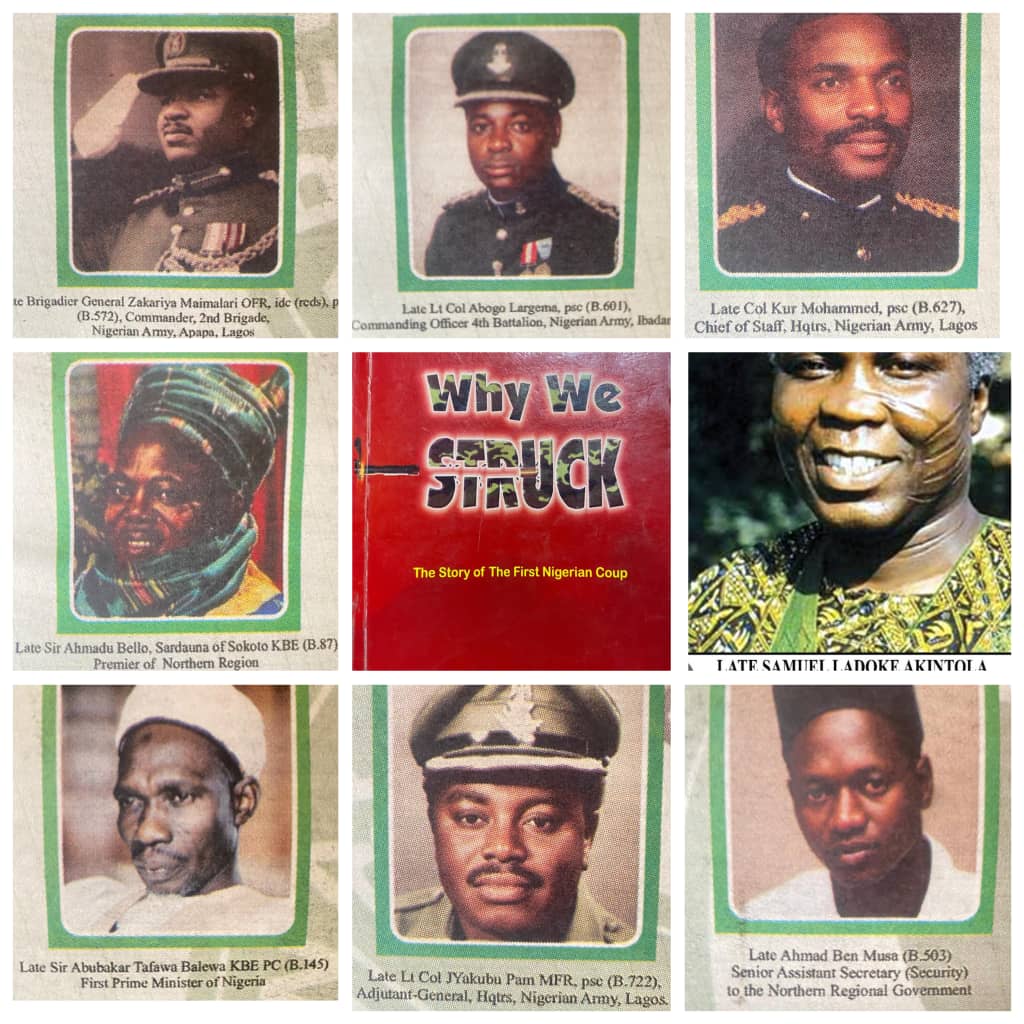
Excerpts from WHY WE STRUCK by Major Adewale Ademoyega; an active participant’s account by one of the prime movers of the military coup
Honourable Intentions
Contrary to the load of wicked propaganda that had since been heaped upon us, there was no decision at our meeting to single out any particular ethnic group for elimination or destruction. Our intentions were honourable, our views were national and our goals were idealistic. We intended that the coup should be national in execution so that it would receive nationwide acclamation. We planned that the use of force should be minimal so that our methods could at once be seen as superior to those of the politicians, who simply went on killing the very people that they were called upon to govern.
It would be recalled that by late 1965 the efforts of the Belewa Government to Northernise the top echelon of the Army were already bearing fruit. Some northerners were already holding most of the strategic positions in the Army. Those positions could easily be used to thwart our attempt to change the Government. Sheer caution dictated that we should be sure to neutralize those officers so that our revolution would have a chance of taking off and succeeding.
Later events did fully justify our apprehension, since it was the escape of only one of those marked down for arrest that brought us intense hardship and finally compromised our success. There was no plan whatsoever to arrest or kill all the officers above the rank of Major as was later claimed by the extreme Northern propagandists. The following officers were known to be around and not holding any strategic positions: Brigadier Ogundipe, Lieutenant –Colonels Gowon, Njoku, Fajuyi Kurubo, Effiong, Ojukwu, Ejoor, Banjo and Bassey. None of these were marked down for arrest. We knew that when our coup had taken shape, they would not be in our way.
Even among those earmarked for arrest, only four were Northerners, two were Westerners and two were Easterners. But the North had always had more than 50% of the intake of officers into the Army since 1961, and more than 70% of the intake of the other ranks. Therefore, if casualties were to happen, it was more likely to be in that proportion than anything else. The wicked propaganda that followed the coup was only made possible by the weakness and non-revolutionary principles of the Ironsi regime, which bore no semblance to the well ordered and well controlled government that was envisaged and could have been run by us if our plans were fully executed.
Finally, it was unanimously agreed at that meeting that the coup should be staged simultaneously in all the Regional Capitals of the Federation. To this end, since there were no troops stationed in Benin, the Mid-West Capital, a small unit was to be sent from Eungu to put the plan into effort therein, Nzeogwu was name as the commander for North, Chude-Soke for the East and Mid-West, Ifejuna and I for Lagos and the West respectively.
The need to bring more of the middle level officers (Majors and Lieutenant-Colonels) into the planning and execution of the coup was discussed. But the few names that could be mentioned had to be dropped because their interpersonal connections would compromise the security of the planning. After ninety minutes of discussion, the meeting was over. We dispersed as if from a prayer meeting since it was Sunday and the Lord was in our midst. I drove Nzeogwu back to Abeokuta where he picked up his vehicle and journeyed back to the North, the same day.
That was how the meeting went. That was how our journey that began over the years developed and culminated in mutual friendship and trust. In the course of time, our common ideas had been gradually formed and trimmed even before the first and only formal meeting.
Who stayed where and who did what was entirely decided according to our Army postings, over which none of us had any control. All we did was to find officers on the spot who could act according to our principles. Who took part was entirely determined by the response of individual officers to our revolutionary call…