When the Old Virtue Leaves the Shadows and Joins the Marketplace
By Charles Obiajulu Ugwu-PhD
There are moments in history when an idea steps out of its hiding place and demands to be counted. Not whispered about, not taken for granted counted. Trust is approaching such a moment. You can almost feel it. Like a tremor beneath the surface of a seemingly calm field, signaling that the ground beneath our feet has already begun to shift. When trust collapses or mutates, societies do not simply adjust; they buckle, recalibrate, or reinvent themselves entirely.
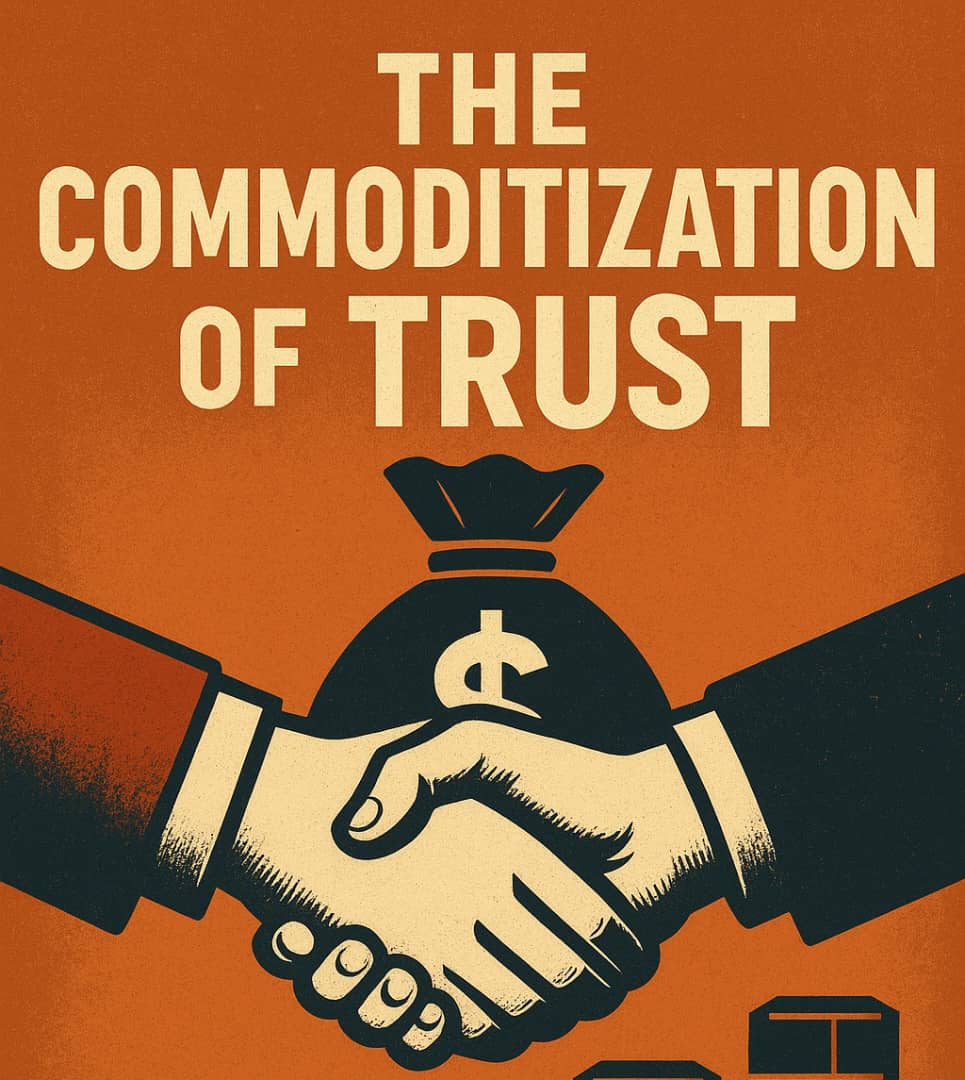
We are living in a world that speaks endlessly about crisis political, economic, institutional. Yet beneath the noise lies a quieter, more fundamental rupture: trust has become too thin to sustain the weight we place on it. What used to be an instinct is now a negotiation. What used to be a handshake is now a legal clause. What used to be a promise is now a line item in a compliance report.
And still, none of these substitutions fill the void.
But a new world is emerging where trust won’t remain in this ghostly state. It will take a form. It will carry a price. It will travel across systems with the same clarity as money. This is the story of trust leaving its invisible realm and entering the marketplace not as a moral virtue alone, but as a tradable asset.
The Strange Geography of Trust
Trust has always lived in that odd corner of human life where power and vulnerability meet. It functions like a hinge. Too small to be admired, too essential to ignore. A hinge is noticed only when it breaks. Trust behaves the same way. When present, it recedes into the fabric of life. When absent, it magnifies every tension.
Consider the small business owner who extends credit to a long-time supplier because “he has never failed me.” There is no ledger entry for this trust, no contract capturing the countless moments they chose to believe in each other. Only when betrayal occurs does the invisible hinge suddenly glow in neon.
Or think of a community where everyone knows everyone, where a misplaced wallet finds its way back to the owner within hours. The wallet returns not because people are saints, but because trust creates small economies of mutual dignity. These places are disappearing. Not because humans have become worse, but because the scale of our systems has outgrown the reach of human intuition.
This is where the rupture begins: when relationships exceed the span of human memory, trust demands new instruments.
The Collapse of Assumed Trust
We forget how young large-scale trust is. For most of human history, people traded with those they could look in the eye. The moment civilization expanded beyond the village; trust had to evolve. Coins, contracts, courts—these were technologies not of commerce, but of trust. They allowed strangers to believe in each other without proximity.
But now we operate at a scale even those tools can’t contain.
We transact with faceless sellers, interact with invisible algorithms, rely on corporations with histories we cannot trace, and surrender our deepest data to digital platforms whose values change without warning.
As a result, trust has thinned out like overused fabric.
We live in a world where:
- People trust reviews from strangers more than advice from neighbors.
- Employees trust online communities more than their employers.
- Citizens trust global influencers more than national leaders.
- Markets trust algorithms more than human judgment.
- The old trust reservoirs such as government, religious institutions, media, academia are losing their gravitational pull. The collapse is silent, but pervasive. And into this vacuum, a new form of trust is being forged.
When Trust Acquires a Price Tag
The first signs are already among us, though easy to overlook.
Think of ride-share platforms. They do not rely on intuition. They trade in micro-behaviors. Each driver and passenger are scored constantly. You don’t see their humanity; you see a number. That number dictates the interaction. It determines access. It influences opportunity.
This is trust turning into a unit of account.
Or consider online marketplaces where your credibility is shaped not by who vouches for you, but by a constellation of digital footprints, delivery records, dispute histories, conversational patterns, responsiveness metrics. All these invisible trails become a reputation signature.
Trust is becoming portable.
Portable trust becomes exchangeable.
Exchangeable trust becomes valuable.
And what becomes valuable rarely stays unmonetized.
This is the transition we are living through: the movement of trust from intuition to infrastructure, from sentiment to score, from invisible virtue to economic resource.
Why Trust Is Becoming Measurable
There are three primary forces pushing trust into the realm of measurement:
1. The Explosion of Strangers
We interact with more unknown people in a week than our ancestors did in months. Trust cannot rely on kinship or familiarity at this scale. It requires verification.
2. The Rise of Digital Personhood
Your digital reputation is now as consequential as your physical behavior.
You are Googled before you are greeted.
3. The Death of Institutional Guarantees
People no longer assume institutions can ensure fairness, integrity, or truth.
When authorities lose legitimacy, individuals demand alternative validation.
Together, these forces create the need for trust to be externalized in the form of being captured, stored, and communicated in ways not dependent on memory or intuition.
Reputation: The New Collateral
In the past, wealth was something you could touch land, cattle, gold. Today, wealth is drifting toward the intangible: data, networks, influence, credibility.
Imagine a young professional applying for a loan. Instead of presenting collateral, she presents a reliability score derived from years of transparent, consistent micro-behaviors.
She has no property to pledge.
But she has a record of integrity.
That record becomes currency.
A merchant who delivers every package on time, responds courteously, and resolves disputes fairly may access better financing than a larger competitor because his visible trust history reduces perceived risk.
Trust becomes liquidity.
A consultant with a strong trust profile; verified clients, transparent outcomes, consistent conduct may attract global opportunities he never had access to before. Not because a gatekeeper approved him, but because his trust footprint speaks louder.
Trust becomes mobility.
A leader with a fractured credibility score may hold a title yet struggle to lead.
The badge of office loses potency when trust is measurable.
Hierarchies flatten when transparency reigns.
Trust becomes legitimacy.
The New Marketplace of Micro-Behaviors
Commoditized trust doesn’t emerge from grand gestures. It emerges from micro-choices:
how you respond to pressure,
how you treat the lesser-powered,
how you handle errors,
how you honor small commitments,
how you disagree without poisoning the well.
The new marketplace does not forget. It collects signals the way marine snow accumulates on the ocean floor particle by particle, forming landscapes over time. Every interaction, every click, every decision leaves residue. These residues cohere into a reliability signature.
Not all of this is pleasant. A world where every behavioral crumb becomes data can become suffocating. But a world drowning in noise and deception will naturally reach for ways to filter signal from chaos.
Measured trust becomes that signal.
What Happens to Power When Trust Is Quantified
We assume power flows from wealth, status, or institutional backing. But in the years ahead, power will increasingly be drawn from credibility. Not performative credibility, but demonstrated consistency.
In such a world:
- The whistleblower with a flawless trust signature may outweigh a well-funded corporation.
- The citizen with a transparent track record may challenge state narratives.
- Movements may arise not from charismatic leaders but from networks of trusted participants.
- Trust becomes a force multiplier.
It shifts the balance between the individual and the institution.
It elevates the ordinary by recognizing patterns of integrity invisible under the old order.
The Ethical Edge of Commoditized Trust
Every new system creates new shadows.
A world where trust is quantified can strengthen fairness, but can also harden bias.
It can deepen accountability, but also enable surveillance.
It can reward integrity, but also erase the space for redemption.
Trust, once commoditized, will require moral guardianship.
This is where thinkers, futurists, and humanists must step in not to halt the movement, but to shape its direction.
The question is not “Will trust be measured?”
It is: “Who decides the metrics?”
And: “What do we preserve of our humanity in the process?”
This is the philosophical frontier of the next decade.
A Glimpse Into What Comes Next
Consider the child born today.
By the time she turns ten, trust metrics may accompany her the way birth certificates once did.
Her learning environments, digital interactions, health behaviors, and social engagements may all contribute to a fluid reputation system designed to protect, empower, or limit her.
Imagine businesses without HR departments because trust histories make certain disputes obsolete.
Or justice systems where minor infractions are resolved not through courts, but through reputation adjustments.
Or global trade operating on real-time credibility signals rather than outdated compliance documents.
This world is not decades away.
Its scaffolding is already visible.
Why We Cannot Look Away
The commoditization of trust is not merely a technological trend. It is a civilizational pivot.
A silent rearrangement of how societies allocate fairness, opportunity, and dignity.
Trust is the oldest currency of humanity.
We are simply witnessing its migration into a new medium.
To ignore this shift is to arrive late to the most consequential transformation of the next five years.
To engage with it is to participate in shaping the moral grammar of the future.
An Invitation to the Edge of What Comes After
This moment demands more than observation it demands participation.
We stand at the threshold of a world where trust will no longer hide in the blind spots of human interaction. It will step into the light, carrying both promise and peril. How we guide that emergence will determine whether trust becomes a tool for liberation or another mechanism of control.
What lies ahead is not a single idea but a continuum, a series of uncharted territories where trust, identity, and human worth collide in ways both astonishing and unsettling.
This essay is only the first step.
The next question is the real one:
If trust becomes a currency, what becomes the moral compass that governs its use?
And that is where the next chapter begins.
About the Author
Dr. Charles Obiajulu Ugwu is a contrarian thinker, creative philosopher, and systems analyst.