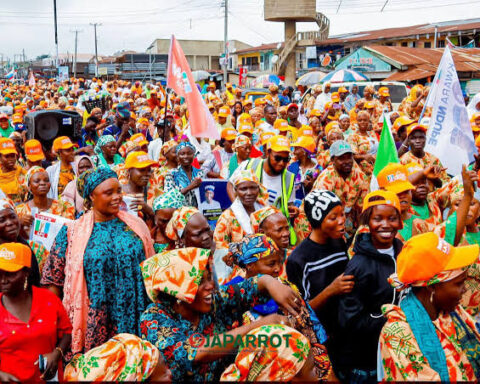
The Young Progressives Party (YPP) has thrown down a high-stakes economic challenge to the ruling administration ahead of the 2027 general elections, as its presidential flagbearer, Arch. Peter Agada, rolled out an ambitious ₦3.2 trillion targeted fuel subsidy blueprint.
The policy proposal, designed as a time-bound intervention rather than an open-ended treasury drain, promises to slash commuter transport costs by up to 45 per cent and pull Nigeria’s stubborn inflation down to a single-digit target of 7.5 per cent.
The strategy was presented on Sunday, October 11, 2026, during a world press conference at 10:00 AM inside the YPP Campaign Headquarters in Maitama, Abuja.
Flanked by the spokesperson for the Peter Agada Presidential Campaign Council (PAPCC), Dr. Chidubem Nnamdi, and YPP National Publicity Secretary, Comrade Egbeola Wale Martins, Agada framed the plan as a pragmatic response to the severe cost-of-living crisis gripping Nigerian households.
Challenging the premise that all fuel subsidies are inherently corrupt, Agada argued that the central flaw of previous regimes lay in poor design and unmonitored leakages.
The YPP model relies on strict volume caps, daily allocation monitoring, and dynamic price corridors that automatically dial back government funding as local refining capacity matures. Under the plan, the federal government would cap subsidized daily consumption across four key energy categories at 29.1 million litres:
Premium Motor Spirit (PMS) is 18.96 million litres daily, with prices capped to sunset at ₦621 per litre from the current ₦1,380 baseline. Government intervention automatically restarts if ex-gantry rates cross ₦759.
Automotive Gas Oil (AGO/Diesel) is 9.075 million litres daily, setting a target price of ₦832 per litre down from ₦1,850, with a reactivation threshold of ₦1,018.
Aviation Turbine Kerosene (ATK) 735,000 litres daily, capping prices at ₦878 per litre down from ₦1,950, with a safety threshold set at ₦1,072. Household Kerosene, 315,000 litres daily, resetting prices to ₦720 per litre down from ₦1,600, with a ceiling trigger at ₦880.
At an estimated outlay of ₦11.48 billion daily, or roughly ₦349 billion per month, the party projects a total first-year bill of ₦3.20 trillion following a planned July 2027 implementation launch.
Explaining the macroeconomic transmission mechanism, campaign spokesperson Dr. Chidubem Nnamdi stressed that high energy costs remain the single biggest driver of food inflation and logistics bottlenecks in Nigeria.
”When you lower the price of diesel and petrol for verified commercial transport fleets, you instantly pull the rug out from under inflated food prices,” Dr. Nnamdi told reporters. “By pairing energy subsidies with fleet conversion to compressed natural gas (CNG), urban commuters will see transit fares drop by 45 per cent within the first 100 days of an Agada presidency.”
The party projects that the sharp drop in freight costs will push headline inflation down to 7.5 per cent within 18 months of execution.
YPP Publicity Secretary Egbeola Wale Martins disclosed that the party has mapped out a disciplined four-phase implementation roadmap to prevent arbitrage and cross-border smuggling:
Phase 1 (Days 0–30): Establish real-time consumption baselines, audit crude supply contracts to local refiners, and publish clear eligibility criteria.
Phase 2 (Days 31–60): Roll out biometric registration and unique Identification Numbers for verified transport operators and accredit participating filling stations.
Phase 3 (Days 61–100): Activate targeted price supports across commercial transport corridors and launch public performance dashboards.
Phase 4 (Year 1 Onward): Transition fleet operators to domestic CNG infrastructure and phase out fuel market interventions as local refining hits full capacity.
To build broad consensus, the PAPCC announced it will host a national economic town hall on October 28, 2026, at the Grand Ball Room of the Eko Hotels & Suites in Lagos, bringing together organised labor, transport unions, fuel marketers, and civil society leaders.