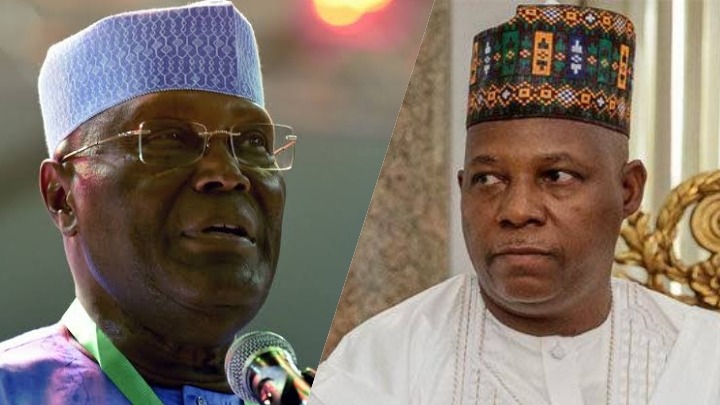
The political landscape ahead of the 2027 general elections has been thrown into a state of intense volatility as the ruling and opposition parties grapple with deep-seated internal crises, strategic recalculations, and factional warfare.
At the center of the brewing storm are unresolved tensions surrounding Vice President Kashim Shettima within the ruling All Progressives Congress (APC), a aggressive southern VP search by former Vice President Atiku Abubakar and the African Democratic Congress (ADC), and a bruising parallel structure crisis holding the Peoples Democratic Party (PDP) in limbo.
Despite public denials and efforts by the APC leadership to project an image of absolute stability, high-level insider sources confirm that controversies surrounding Vice President Kashim Shettima’s position on the ticket are “not completely resolved.”
While the presidency has pushed back against undercurrents regarding the future of the Tinubu-Shettima ticket, subterranean power plays among influential northern political blocs and strategic stakeholders continue to fuel speculation. Insiders hint that ongoing alignments within the ruling party could still alter the dynamics before the official campaign season kicks off.
Concurrently, former Vice President Atiku Abubakar is aggressively consolidating his latest political vehicle, the African Democratic Congress (ADC).
The campaign’s current priority is the selection of a formidable southern running mate. Intense lobbying is reportedly underway across the South-West, South-South, and South-East geopolitical zones to find a candidate with significant economic and political clout.
Meanwhile, the main opposition Peoples Democratic Party (PDP) is facing a full-blown identity crisis, splintered into rival factions with completely different visions for the 2027 presidency. The party structure currently hangs in limbo, caught between two competing heavyweights.
A powerful wing of the party, led by former Minister Tanimu Turaki, bypassed institutional roadblocks and security closures to organize a special national convention in Abuja. The faction officially ratified former President Goodluck Jonathan as its 2027 presidential candidate, arguing that legal and constitutional frameworks validate their independent action.
Simultaneously, the mainstream party leadership and a separate faction have thrown their weight behind former Cross River Central Senator, Sandy Onor. Unveiled as a consensus presidential candidate by party leaders, the Onor camp argues that his candidacy represents a strategic blueprint to unify the party, restore its democratic legacy, and inject fresh energy into the national race.
”The PDP cannot afford a house divided against itself,” warned a senior party chieftain who spoke on the condition of anonymity. “As long as we have one faction printing a Certificate of Return for former President Jonathan and another declaring Senator Sandy Onor as the consensus candidate, we are simply clearing the path for the ruling party.”
With the Independent National Electoral Commission (INEC) deadlines looming and the political atmosphere growing increasingly polarized, the next few weeks will prove decisive for Nigeria’s major political actors as they navigate these deep internal fractures.