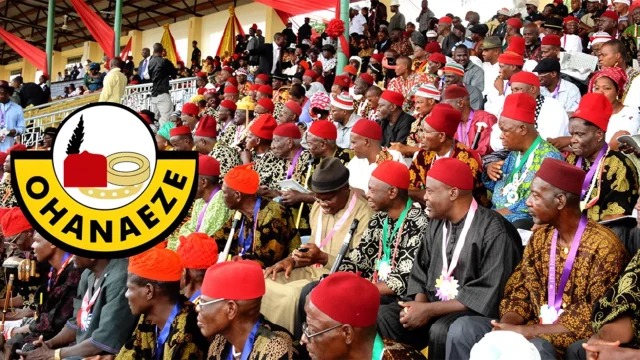
An assembly of prominent Southeastern intellectuals, traditional rulers, and civic leaders under the auspices of the Igbo Leaders of Thought (ILT) has warned the Federal Government that Nigerians will fiercely reject any compromised outcome in the 2027 general elections.
The warning came in a joint communiqué issued on Wednesday, September 2, 2026, following an emergency consultative meeting at the group’s headquarters in Enugu. The declaration was signed by ILT President, Emeritus Professor Elochukwu Amucheazi, and Secretary, Prof. Dozie Chukwuokolo.
The assembly expressed grave concern over what it described as intentional political sabotage by the presidency, accusing the ruling administration of using state institutions, including the judiciary, security forces, and the Independent National Electoral Commission (INEC), to choke opposition parties.
The group singled out provocative statements such as “there is no vacancy in Aso Rock” and President Bola Tinubu’s remark to the Catholic Bishops Conference that “all is fair in politics” as signals that the ruling party intends to bypass fair ballots.
Recommending immediate international oversight, the ILT called on global powers, including the United States, to monitor Nigeria’s democratic processes.
Drawing attention to systemic injustice, the ILT highlighted severe infrastructural and political marginalisation against Ndi Igbo:
The assembly revealed that out of 34 recent major federal appointments reviewed, the South-East region received zero positions.
The leaders lamented the absence of standard-gauge rail lines in the South-East, the underutilisation of Eastern seaports, and the exclusion of Igbo ownership from national oil blocks despite oil exploration on their land.
The group condemned the ongoing confiscation of Igbo-owned real estate and businesses in major hubs like Lagos and Abuja.
ILT scolded South-East governors for political sycophancy, rebuking those who attribute routine state developments to federal benevolence rather than delivering on their elected mandates.
Reiterating its stance on security and national cohesion, the ILT demanded the immediate and unconditional release of Indigenous People of Biafra (IPOB) leader, Mazi Nnamdi Kanu.
Describing Kanu as a “prisoner of conscience,” the leaders condemned his extraordinary rendition from Kenya and rejected proposed plans to transfer his trial to the North.
They contrasted his ongoing detention with the government’s official authorization of Western regional security figures to bear arms, labeling the disparity an act of systemic hostility.
Conclusively, the group asserted that the ultimate resolution to Nigeria’s recurring political crises lies in restructuring the country into self-governing regional autonomies along ethno-linguistic lines, citing the multi-nation model of the United Kingdom as a blueprint for sustainable development.